Thank you for visiting SNEWPapers!
Sign up free
Literary
November 2, 1850
The Texas Republican
Marshall, Harrison County, Texas
What is this article about?
In this moral tale, Harriet Lee rejects suitor Albert Dunroy for his callous attitude toward the poor, as seen in incidents of denied charity. She chooses compassionate Charles Vernor, who aids the needy, and they marry happily.
Clipping
OCR Quality
95%
Excellent
Full Text
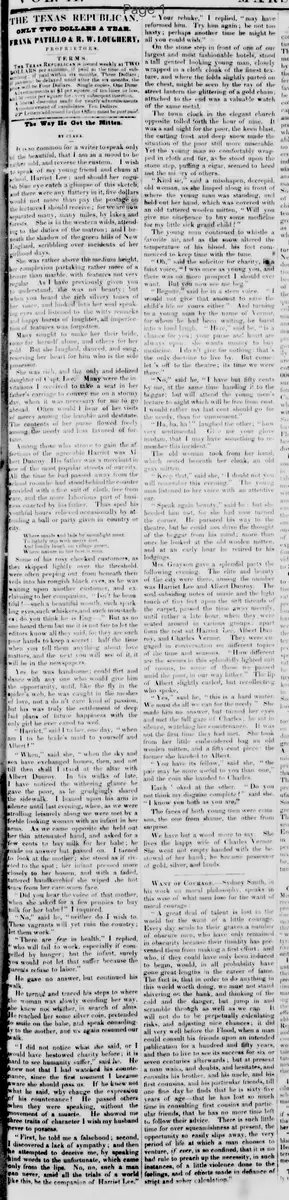
The Way He Got the Mitten.
BY CLARA.
It is so common for a writer to speak only of the beautiful, that I am in a mood to be rather odd, and reverse the custom. I wish to speak of my young friend and chum at school, Harriet Lee: and should her roguish blue eye catch a glimpse of this sketch, and there were any flattery in it, five dollars would not more than pay the postage on the lectures I should receive; for we are now separated many, many miles, by lakes and forests. She is in the western wilds, attending to the duties of the matron; and I beneath the shadow of the green hills of New England, scribbling over incidents of her girlhood days.
She was rather above the medium height, her complexion partaking rather more of a bronze than marble, with features not very regular. As I have previously given you to understand, she was no beauty: but when you heard the rich silvery tones of her voice, and looked into her soul-speaking eyes and listened to the witty remarks and happy bursts of laughter, all imperfection of features was forgotten.
Many sought to make her bride, some for herself alone, and others for her gold. But she laughed, danced, and sung, reserving her heart for him who is the sole possessor.
She was rich, and the only and idolized daughter of Capt. Lee. Many were the invitations I received to take a seat in her father's carriage to convey me on a stormy day, when it was necessary for me to go abroad. Often would I hear of her visits of mercy among the humble and destitute. The contents of her purse flowed freely among the needy and less favored of fortune.
Among those who strove to gain the affections of the agreeable Harriet was Albert Dunroy. His father was a merchant in one of the most popular streets of our city. All the time he had passed away from the school room he had stood behind the counter provided with a fine suit of cloth, free from care, and the more laborious part of business enacted by his father. Thus sped his youthful hours relieved occasionally by attending a ball or party given in country or city.
Where maids and lads by moonlight meet
To lightly trip with merry feet
And fondly laugh on smiling green,
Where nature in her best is seen
Some of his rosy cheeked customers, as they skipped lightly over the threshold were often peeping out from beneath their veils into his roguish black eyes, as he was waiting upon another customer, and exclaiming to her companion, "Isn't he beautiful?--such a beautiful mouth, such sparkling eyes, such whiskers, and such moustaches; do you think he is engaged?" But as no one heard them but me it is not fair to let the editors know all they said, for they are such poor hands to keep a secret: half the time when you tell them anything about love matters, and the next you will see of it, it will be in the newspapers.
Yes he was handsome: could flirt and dance with any one who would give him the opportunity, until, like the fly in the spider's web, he was caught in the meshes of love, not a don't care kind of passion, but his was truly the settlement of deep laid plans of future happiness with the only girl he ever cared to wed.
"Harriet," said I to her, one day, "when am I to be bride's maid to yourself and Albert?"
"When," said she, "when the sky and sea have exchanged homes, then, and not till then shall I stand at the altar with Albert Dunroy. In his walks of late, I have noticed the withering glance he gave the poor, as he grudgingly shared the sidewalk. I leaned upon his arm in silence until last evening, when, as we were strolling leisurely along we were met by a feeble looking woman with an infant in her arms. As we came opposite she held out her thin attenuated hand, and asked for a few cents to buy milk for her babe: he made no answer but passed on. I turned to look at the mother; she stood as if riveted to the spot; her infant pressed more closely to her bosom, and with a faded, tattered handkerchief she wiped the hot tears from her care-worn face.
"Did you hear the voice of that mother when she asked for a few pennies to buy milk for her babe?" I inquired.
"No," said he, "neither do I wish to. These vagrants will yet ruin the country: let them work."
"There are few in health," I replied, "who will fail to work, especially if compelled by hunger; but the infant, surely you would not let that suffer because the parents refuse to labor."
He gave no answer, but continued his walk.
He turned and traced his steps to where the woman was slowly wending her way, she knew not whither, in search of alms. He reached her some silver coin, pretended to smile on the babe, and speak consolingly to the mother, and we again resumed our walk.
"I did not notice what she said, or I would have bestowed charity before; it is hard to see humanity suffer," said he. He knew not that I had watched his countenance, since the first moment I became aware she should pass us. If he knew not what he said, why change the expression of his countenance! He passed others when they were speaking, without the movement of muscle. He showed me three traits of character I wish my husband never to possess.
"First, he told me a falsehood; second I discovered a lack of sympathy; and then attempted to deceive me, by speaking kind words to the unfortunate, which came only from the lips. No, no, such a man can never, amid all the trials of a world like this, be the companion of Harriet Lee."
"Your rebuke," I replied, "may have reformed him. Try him again: be not too hasty; perhaps another time he might be all you could wish."
On the stone step in front of one of our largest and most fashionable hotels, stood a tall genteel looking young man, closely wrapped in a cloth cloak of the finest texture, and where the folds slightly parted on the chest, might be seen by the ray of the street lantern the glittering of a gold chain; attached to the end was a valuable watch of the same metal.
The town clock in the elegant church opposite tolled forth the hour of nine. It was a sad night for the poor, the keen blast the cutting frost and deep snow made the situation of the poor still more miserable. Yet the young man so comfortably wrapped in cloth and fur, as he stood upon the stone step, puffing a cigar, seemed to heed not the misery of others.
"Kind sir," said a misshapen, decrepid old woman, as she limped along in front of where the young man was standing, and held out her hand, which was covered with an old tattered woolen mitten, "Will you give me ninepence to buy some medicine for my little sick grand-child?"
The young man continued to whistle a favorite air, and as the snow altered the temperature of his blood, his feet commenced to keep time with the tune.
"Oh," said the solicitor for charity, in a faint voice, "I was once as young as you, and there was no more prospect I should ever want. But you now see me beg."
"Begone," said he in a stern voice. "I would not give that amount to save the child's life or yours either." And turning to a young man by the name of Vernor, for whom he had been waiting, he burst into a loud laugh, "Here," said he, "is a chance for you. Your purse and heart are always open; she wants money to buy medicine. I don't give for nothing: that's the only doctrine to live by. But come let's off to the theatre: its time we were there."
"No," said he. "I have but fifty cents by me," at the same time handing it to the beggar; "but will attend the young men's lecture to night which will be free from cost. I would rather my last cent should go for the needy, than for amusement."
"Ha, ha, ha!" laughed the other; "how very sentimental. Give me your glove madam, that I may have something to remember this incident."
The old woman took from her hand which rested beneath her cloak, an old gray mitten.
"Keep that," said she. "I doubt not you will remember this evening." The young man listened to her voice with an attentive ear.
"Speak again beauty," said he: but she heeded him not, for she had now turned the corner. He pursued his way to the theatre, but he could not drive the thought of the beggar from his mind; more than once he looked at the old woolen mitten, and at an early hour he retired to his lodgings.
Mrs. Grayson gave a splendid party the following evening. The elite and beauty of the city were there, among the number was Harriet Lee and Albert Dunroy. The soul-subsiding notes of music and the light touch of tiny feet upon the soft threads of the carpet, passed the time away merrily, until rather a late hour, when they were seated around in various groups. Apart from the rest sat Harriet Lee, Albert Dunroy, and Charles Vernor. They were engaged in conversation on different topics of the time and seasons. "How different are the scenes in this splendidly lighted suite of rooms, to some of those we passed amid the poor, in our way hither." The lip of Albert slightly curled, but recollecting who spoke,
"Yes," said he, "this is a hard winter. We must do all we can for the needy." She made him no answer, but turned her eyes and met the full gaze of Charles. He sat in silence, watching her countenance. It was not the first time they had met. She took from her little embroidered bag an old woolen mitten, and a fifty-cent piece: the former she handed to Albert.
"You have its fellow," said she, "the pair may be more useful to you than one."
and the coin she handed to Charles.
Each looked at the other. "Do you not think my disguise complete?" said she.
"I know you both as you are."
The faces of both young men were crimson, the one from shame, the other from surprise.
We have but a word more to say.
She lives the happy wife of Charles Vernor. She went not empty handed with the bestowal of her hand; he became possessor of gold, silver, and lands.
BY CLARA.
It is so common for a writer to speak only of the beautiful, that I am in a mood to be rather odd, and reverse the custom. I wish to speak of my young friend and chum at school, Harriet Lee: and should her roguish blue eye catch a glimpse of this sketch, and there were any flattery in it, five dollars would not more than pay the postage on the lectures I should receive; for we are now separated many, many miles, by lakes and forests. She is in the western wilds, attending to the duties of the matron; and I beneath the shadow of the green hills of New England, scribbling over incidents of her girlhood days.
She was rather above the medium height, her complexion partaking rather more of a bronze than marble, with features not very regular. As I have previously given you to understand, she was no beauty: but when you heard the rich silvery tones of her voice, and looked into her soul-speaking eyes and listened to the witty remarks and happy bursts of laughter, all imperfection of features was forgotten.
Many sought to make her bride, some for herself alone, and others for her gold. But she laughed, danced, and sung, reserving her heart for him who is the sole possessor.
She was rich, and the only and idolized daughter of Capt. Lee. Many were the invitations I received to take a seat in her father's carriage to convey me on a stormy day, when it was necessary for me to go abroad. Often would I hear of her visits of mercy among the humble and destitute. The contents of her purse flowed freely among the needy and less favored of fortune.
Among those who strove to gain the affections of the agreeable Harriet was Albert Dunroy. His father was a merchant in one of the most popular streets of our city. All the time he had passed away from the school room he had stood behind the counter provided with a fine suit of cloth, free from care, and the more laborious part of business enacted by his father. Thus sped his youthful hours relieved occasionally by attending a ball or party given in country or city.
Where maids and lads by moonlight meet
To lightly trip with merry feet
And fondly laugh on smiling green,
Where nature in her best is seen
Some of his rosy cheeked customers, as they skipped lightly over the threshold were often peeping out from beneath their veils into his roguish black eyes, as he was waiting upon another customer, and exclaiming to her companion, "Isn't he beautiful?--such a beautiful mouth, such sparkling eyes, such whiskers, and such moustaches; do you think he is engaged?" But as no one heard them but me it is not fair to let the editors know all they said, for they are such poor hands to keep a secret: half the time when you tell them anything about love matters, and the next you will see of it, it will be in the newspapers.
Yes he was handsome: could flirt and dance with any one who would give him the opportunity, until, like the fly in the spider's web, he was caught in the meshes of love, not a don't care kind of passion, but his was truly the settlement of deep laid plans of future happiness with the only girl he ever cared to wed.
"Harriet," said I to her, one day, "when am I to be bride's maid to yourself and Albert?"
"When," said she, "when the sky and sea have exchanged homes, then, and not till then shall I stand at the altar with Albert Dunroy. In his walks of late, I have noticed the withering glance he gave the poor, as he grudgingly shared the sidewalk. I leaned upon his arm in silence until last evening, when, as we were strolling leisurely along we were met by a feeble looking woman with an infant in her arms. As we came opposite she held out her thin attenuated hand, and asked for a few cents to buy milk for her babe: he made no answer but passed on. I turned to look at the mother; she stood as if riveted to the spot; her infant pressed more closely to her bosom, and with a faded, tattered handkerchief she wiped the hot tears from her care-worn face.
"Did you hear the voice of that mother when she asked for a few pennies to buy milk for her babe?" I inquired.
"No," said he, "neither do I wish to. These vagrants will yet ruin the country: let them work."
"There are few in health," I replied, "who will fail to work, especially if compelled by hunger; but the infant, surely you would not let that suffer because the parents refuse to labor."
He gave no answer, but continued his walk.
He turned and traced his steps to where the woman was slowly wending her way, she knew not whither, in search of alms. He reached her some silver coin, pretended to smile on the babe, and speak consolingly to the mother, and we again resumed our walk.
"I did not notice what she said, or I would have bestowed charity before; it is hard to see humanity suffer," said he. He knew not that I had watched his countenance, since the first moment I became aware she should pass us. If he knew not what he said, why change the expression of his countenance! He passed others when they were speaking, without the movement of muscle. He showed me three traits of character I wish my husband never to possess.
"First, he told me a falsehood; second I discovered a lack of sympathy; and then attempted to deceive me, by speaking kind words to the unfortunate, which came only from the lips. No, no, such a man can never, amid all the trials of a world like this, be the companion of Harriet Lee."
"Your rebuke," I replied, "may have reformed him. Try him again: be not too hasty; perhaps another time he might be all you could wish."
On the stone step in front of one of our largest and most fashionable hotels, stood a tall genteel looking young man, closely wrapped in a cloth cloak of the finest texture, and where the folds slightly parted on the chest, might be seen by the ray of the street lantern the glittering of a gold chain; attached to the end was a valuable watch of the same metal.
The town clock in the elegant church opposite tolled forth the hour of nine. It was a sad night for the poor, the keen blast the cutting frost and deep snow made the situation of the poor still more miserable. Yet the young man so comfortably wrapped in cloth and fur, as he stood upon the stone step, puffing a cigar, seemed to heed not the misery of others.
"Kind sir," said a misshapen, decrepid old woman, as she limped along in front of where the young man was standing, and held out her hand, which was covered with an old tattered woolen mitten, "Will you give me ninepence to buy some medicine for my little sick grand-child?"
The young man continued to whistle a favorite air, and as the snow altered the temperature of his blood, his feet commenced to keep time with the tune.
"Oh," said the solicitor for charity, in a faint voice, "I was once as young as you, and there was no more prospect I should ever want. But you now see me beg."
"Begone," said he in a stern voice. "I would not give that amount to save the child's life or yours either." And turning to a young man by the name of Vernor, for whom he had been waiting, he burst into a loud laugh, "Here," said he, "is a chance for you. Your purse and heart are always open; she wants money to buy medicine. I don't give for nothing: that's the only doctrine to live by. But come let's off to the theatre: its time we were there."
"No," said he. "I have but fifty cents by me," at the same time handing it to the beggar; "but will attend the young men's lecture to night which will be free from cost. I would rather my last cent should go for the needy, than for amusement."
"Ha, ha, ha!" laughed the other; "how very sentimental. Give me your glove madam, that I may have something to remember this incident."
The old woman took from her hand which rested beneath her cloak, an old gray mitten.
"Keep that," said she. "I doubt not you will remember this evening." The young man listened to her voice with an attentive ear.
"Speak again beauty," said he: but she heeded him not, for she had now turned the corner. He pursued his way to the theatre, but he could not drive the thought of the beggar from his mind; more than once he looked at the old woolen mitten, and at an early hour he retired to his lodgings.
Mrs. Grayson gave a splendid party the following evening. The elite and beauty of the city were there, among the number was Harriet Lee and Albert Dunroy. The soul-subsiding notes of music and the light touch of tiny feet upon the soft threads of the carpet, passed the time away merrily, until rather a late hour, when they were seated around in various groups. Apart from the rest sat Harriet Lee, Albert Dunroy, and Charles Vernor. They were engaged in conversation on different topics of the time and seasons. "How different are the scenes in this splendidly lighted suite of rooms, to some of those we passed amid the poor, in our way hither." The lip of Albert slightly curled, but recollecting who spoke,
"Yes," said he, "this is a hard winter. We must do all we can for the needy." She made him no answer, but turned her eyes and met the full gaze of Charles. He sat in silence, watching her countenance. It was not the first time they had met. She took from her little embroidered bag an old woolen mitten, and a fifty-cent piece: the former she handed to Albert.
"You have its fellow," said she, "the pair may be more useful to you than one."
and the coin she handed to Charles.
Each looked at the other. "Do you not think my disguise complete?" said she.
"I know you both as you are."
The faces of both young men were crimson, the one from shame, the other from surprise.
We have but a word more to say.
She lives the happy wife of Charles Vernor. She went not empty handed with the bestowal of her hand; he became possessor of gold, silver, and lands.
What sub-type of article is it?
Prose Fiction
What themes does it cover?
Moral Virtue
Social Manners
What keywords are associated?
Charity
Courtship
Moral Tale
Poverty
Suitor
Sympathy
Disguise
Marriage
What entities or persons were involved?
By Clara.
Literary Details
Title
The Way He Got The Mitten.
Author
By Clara.
Key Lines
"First, He Told Me A Falsehood; Second I Discovered A Lack Of Sympathy; And Then Attempted To Deceive Me, By Speaking Kind Words To The Unfortunate, Which Came Only From The Lips. No, No, Such A Man Can Never, Amid All The Trials Of A World Like This, Be The Companion Of Harriet Lee."
"You Have Its Fellow," Said She, "The Pair May Be More Useful To You Than One."
"Do You Not Think My Disguise Complete?" Said She.
"I Know You Both As You Are."