Thank you for visiting SNEWPapers!
Sign up free
Literary
April 10, 1800
Gazette Of The United States, & Philadelphia Daily Advertiser
Philadelphia, Philadelphia County, Pennsylvania
What is this article about?
The Lay Preacher column applies lines from Mr. Tago's elegy 'The Black Birds' to a New York marriage, notes the delicate subject, and shares a specimen from a new translation of Secundus' 'Basia,' a Latin poem on love's kisses.
Clipping
OCR Quality
95%
Excellent
Full Text
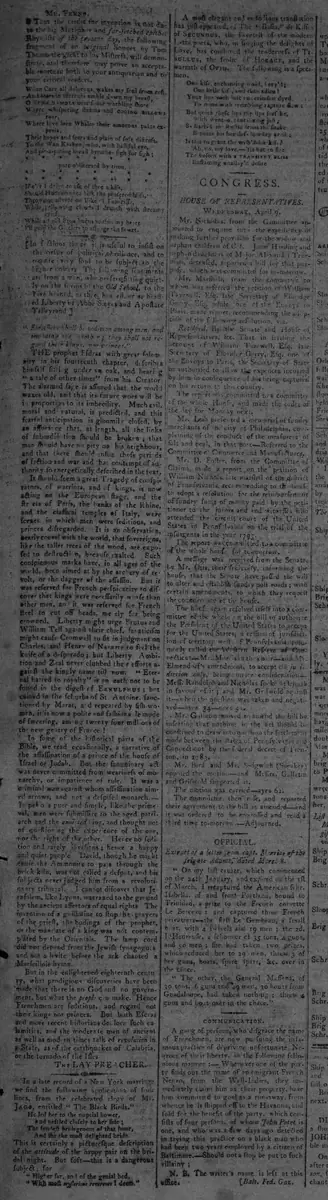
THE LAY PREACHER.
In a late record of a New York marriage we find the following application of four lines, from the celebrated elegy of Mr. Tago, entitled "The Black Birds."
He led her to the nuptial bower,
And nestled closely to her side;
The fondest bridegroom of that hour,
And the most delighted bride.
This is certainly a picturesque description of the attitude of the happy pair on the bridal night. But oft—this is a dangerous subject; for
"Higher and of the genial bed,
With most mysterious reverence I deem."
A most elegant and melodious translation has just appeared, of The Basia, or Kiss of Secundus, the sweetest of the modern Latin poets, who, in singing the delights of Love, has combined the tenderness of Tibullus, the frolic of Horace, and the warmth of Ovid. The following is a specimen.
One kiss, enchanting maid, cried;
Our little kiss, and then adieu!
Your lips with luscious crimson dyed,
To mine with trembling rapture flow:
But quick those lips meet lips in kiss,
With wanton, tantalizing bliss.
She starts and from the make.
Beneath his heel her footstep prest:
Is this to grant the wish'd-for kiss?
Ah, no, my love,—'tis but to fire
The boom with a transient bliss
Enflaming unallay'd desire.
In a late record of a New York marriage we find the following application of four lines, from the celebrated elegy of Mr. Tago, entitled "The Black Birds."
He led her to the nuptial bower,
And nestled closely to her side;
The fondest bridegroom of that hour,
And the most delighted bride.
This is certainly a picturesque description of the attitude of the happy pair on the bridal night. But oft—this is a dangerous subject; for
"Higher and of the genial bed,
With most mysterious reverence I deem."
A most elegant and melodious translation has just appeared, of The Basia, or Kiss of Secundus, the sweetest of the modern Latin poets, who, in singing the delights of Love, has combined the tenderness of Tibullus, the frolic of Horace, and the warmth of Ovid. The following is a specimen.
One kiss, enchanting maid, cried;
Our little kiss, and then adieu!
Your lips with luscious crimson dyed,
To mine with trembling rapture flow:
But quick those lips meet lips in kiss,
With wanton, tantalizing bliss.
She starts and from the make.
Beneath his heel her footstep prest:
Is this to grant the wish'd-for kiss?
Ah, no, my love,—'tis but to fire
The boom with a transient bliss
Enflaming unallay'd desire.
What sub-type of article is it?
Essay
What themes does it cover?
Love Romance
Social Manners
What keywords are associated?
Lay Preacher
Elegy
Black Birds
Basia
Secundus
Kiss
Love Poetry
Literary Details
Title
The Lay Preacher.
Form / Style
Prose Commentary With Poetry Excerpts
Key Lines
He Led Her To The Nuptial Bower,
And Nestled Closely To Her Side;
The Fondest Bridegroom Of That Hour,
And The Most Delighted Bride.
One Kiss, Enchanting Maid, Cried;
Our Little Kiss, And Then Adieu!
Your Lips With Luscious Crimson Dyed,
To Mine With Trembling Rapture Flow:
But Quick Those Lips Meet Lips In Kiss,
With Wanton, Tantalizing Bliss.
She Starts And From The Make.
Beneath His Heel Her Footstep Prest:
Is This To Grant The Wish'd For Kiss?
Ah, No, My Love,—'Tis But To Fire
The Boom With A Transient Bliss
Enflaming Unallay'd Desire.