Thank you for visiting SNEWPapers!
Sign up free
Story
August 28, 1865
Daily Ohio Statesman
Columbus, Franklin County, Ohio
What is this article about?
Military commission trial of Capt. Henry Wirz in Washington on Aug. 26, 1865, for conspiracy in deaths of Union prisoners at Andersonville. Amendments to charges, objections by defense counsel Baker, testimony by Dr. Burrows on horrific prison conditions, and by Robert Kellogg on prisoner suffering and deaths.
Clipping
OCR Quality
95%
Excellent
Full Text
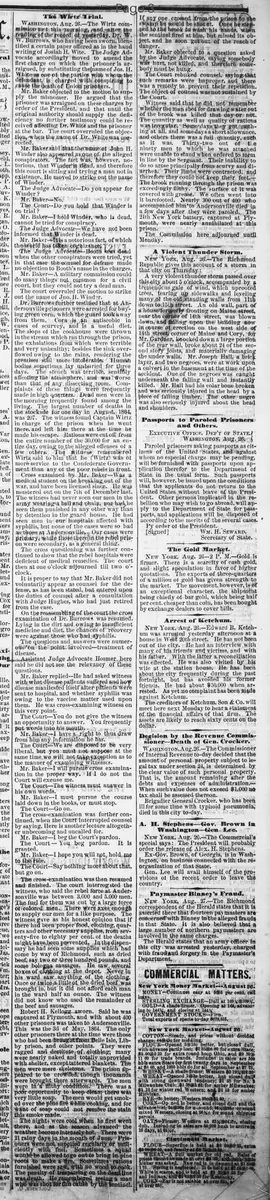
Washington, Aug. 26.—The Wirtz commission met this morning, and after the reading of the record of yesterday, Dr. W. W. Burrows, who having been sworn, identified a certain paper offered as in the hand writing of Josiah H. Wirtz. The Judge Advocate accordingly moved to amend the first charge on which the prisoner is arraigned, by substituting the name of Jos. H. White as one of the parties with whom the defendant is charged with conspiring to cause the death of Union prisoners.
Mr. Baker objected to the motion to supply the misnomer. He argued that the prisoner was arraigned on these charges by order of the President, and that until the original authority should supply the deficiency no further testimony could be received affecting Dr. White and the prisoner at the bar. The court overruled the objection, when the name of Dr. White was corrected.
Mr. Baker said that the name of John H. Winder also appeared as one of the alleged conspirators. The fact was, however, notorious, that Winder is dead, and therefore this court is sitting and trying a man not in existence. He moved to strike out the name of Winder.
The Judge Advocate—Do you appear for Winder?
Mr. Baker—No.
The Court—Do you hold that Winder is on trial?
Mr. Baker—I hold Winder, who is dead, cannot be tried for conspiracy.
The Judge Advocate—We have not been informed that Winder is dead.
Mr. Baker—It is a notorious fact, of which the world has taken cognizance.
The Judge Advocate—Booth was dead when the other conspirators were tried, yet in that case the counsel for defense made no objection to Booth's name in the charges.
Mr. Baker—A military commission could do many things not common for a civil court, but they could not try a dead man.
The court overruled the motion to strike out the name of Jno. H. Winder.
Dr. Burrows further testified that at Andersonville prisoners were arrested for buying green corn, which the guard took away from them. Corn is an antiscorbutic in cases of scurvy, and is a useful diet. The slops of the cookhouse were thrown in the stream which ran through the prison, the exhalations from which were terrible and very unhealthy; besides the sink overflowed owing to the rains, rendering the premises still more intolerable. Human bodies sometimes lay unburied for three days. The stench was terrible, sensibly affecting the atmosphere, and was worse than that of any dissecting room. Complaints of these things were frequently made in high quarters. Dead men were in the morning frequently found among the living. The largest number of deaths in the stockade for one day in August, 1864, was 127. The witness found Captain Wirtz in charge of the prison when he went there, and left him there at the time he made his escape. Rations were cut off from the entire number of the 30,000 for an entire day, owing to the alleged offenses of a few others. The witness remembered Wirtz said to him that he (Wirtz) was of more service to the Confederate Government than any of the poor rebels in front.
Cross examined by Mr. Baker—Was a medical student on the breaking out of the war, and have been licensed since. He was mustered out on the 7th of December last. The witness had never seen our men in the army wearing a ball and chain, nor had he seen them punished in any other way than by detention in the guard house. He had seen men in our hospitals affected with syphilis, but none of the cases were so bad as those at Andersonville. Our cases were primary, while those there in the rebel prison were secondary, as a general thing.
The cross questioning was further continued to show that the rebel hospitals were deficient of medical remedies. The court then at one o'clock adjourned till two o'clock.
It is proper to say that Mr. Baker did not voluntarily appear as counsel for the defense, as has been stated, but entered upon the duties of counsel after a consultation with Judge Hughes, who had just retired from the case.
On the reassembling of the court the cross examination of Dr. Burrows was resumed. Lying in the dirt and owing to insufficient medicine and diet, the chances of recovery were against those who had syphilis.
The questions and answers were numerous on the point involved—treatment of disease.
Assistant Judge Advocate Hosmer, here said he did not see the relevancy of these questions.
Mr. Baker replied—He had asked witness with what disease patients suffered and how disease manifested itself after patients were sent to hospital, and whether syphilis was owing to the vaccine matter used upon them. He was cross-examining witness on this very point.
The Court—You do not give the witness an opportunity to answer. "You frequently put words into his mouth."
Mr. Baker—I have a right to thus draw from him any information he has.
The Court—We are disposed to be very liberal, but you must not suppose at the same time we will not take exception as to the manner of examining witnesses.
Mr. Baker—I will pursue cross examination in the proper way. If I do not the Court will excuse me.
The Court—The witness must answer in his own words.
Mr. Baker—I must pursue the course laid down in the books, or must stop.
The Court—Go on.
The cross-examination was further continued, when the Court interrupted counsel by saying, Here is another lecture altogether unbecoming and uncalled for.
Mr. Baker—I beg the Court's pardon.
The Court—You beg pardon. It is granted.
Mr. Baker—I hope you will not, hold me to the rule.
The Court—Say nothing more about that, but go on.
The cross-examination was then resumed and finished. The court interrogated the witness, who said the rebel force at Andersonville was between 3,000 and 5,000 men. The fuel for them was cut by a large force of colored men. There were axes enough to supply our men for a like purpose. The witness gave as his honest opinion that if there had been proper food, clothing, quarters and other necessary supplies, from seventy-five to eighty per cent. of the deaths might have been prevented. In the dispensary he had seen some supplies which had come by way of Richmond, such as dried beef say two or three hundred pounds, and some bologna sausages. He saw several boxes of clothing at the depot. Never in his ward, saw anything of the clothing. Once or twice, a little of the dried beef was brought in, but it did not afford each man in the ward half an ounce. The witness did not know who used the remainder of the beef and sausages.
Robert H. Kellogg—sworn. Said he was captured at Plymouth, and with about 400 other prisoners was taken to Andersonville. This was the 3d of May, 1864. The only other prisoners there at the time were those who had been brought from Belle Isle, Libby prison, and other points. They were ragged and destitute of clothing; many were nearly naked and totally unprovided with shelter, except tattered blankets. The men were mere skeletons. The prison appeared to be crowded, though thousands were brought there afterwards. The men were in a filthy condition. There was a poor opportunity to keep clean; there was very little soap. The men would get smoked over the pine fire while cooking, and for want of soap could not remove the stain this smoke made. The nights were cool when he first went there, and as the season advanced the weather become intensely hot. There were 21 rainy days in the month of June. Prisoners were not supplied regularly or sufficiently with fuel. Sometimes a squad would be allowed to go out to bring in pine roots to make a fire. Sometimes rations furnished were raw, with no wood to cook. The penalty of trespassing on the dead line was death. He remembered seeing a man who was shot for this cause by the sentinel.
If any one crossed from the prison to the swamp he would be shot at. Once he stepped to the brook to wash his hands, when the sentinel fired at him, but missed its object, and he soon got out of the reach of danger.
Mr. Baker objected to a question asked by the Judge Advocate, saying somebody was hurt, not killed, and therefore somebody must be hung.
The Court rebuked counsel, saying that such remarks were improper, and there was a remedy to prevent their repetition.
The object of counsel was not sustained by the Court.
Witness said that he did not remember whether the man shot for drawing water out of the brook was killed that day or not.
The quantity as well as quality of rations was irregular. Some days they got nothing at all, and some days a short allowance, and others there was a full quantity, such as it was. Thirty-two out of the ninety men to which he was attached were unable to stand when ordered to form in line by the Sergeant. Their inability to do so arose principally from scurvy and diarrhea. Their limbs were contracted, and therefore they could not keep their feet.
The brook running through the prison was exceedingly filthy. The surface of it was covered with grease. We often went into it barefooted. Nearly 300 out of 400 who accompanied him to Andersonville died in a few days after they were paroled. The 21st New York battery, captured at Plymouth, were nearly annihilated at this prison.
The Commission here adjourned until Monday.
Mr. Baker objected to the motion to supply the misnomer. He argued that the prisoner was arraigned on these charges by order of the President, and that until the original authority should supply the deficiency no further testimony could be received affecting Dr. White and the prisoner at the bar. The court overruled the objection, when the name of Dr. White was corrected.
Mr. Baker said that the name of John H. Winder also appeared as one of the alleged conspirators. The fact was, however, notorious, that Winder is dead, and therefore this court is sitting and trying a man not in existence. He moved to strike out the name of Winder.
The Judge Advocate—Do you appear for Winder?
Mr. Baker—No.
The Court—Do you hold that Winder is on trial?
Mr. Baker—I hold Winder, who is dead, cannot be tried for conspiracy.
The Judge Advocate—We have not been informed that Winder is dead.
Mr. Baker—It is a notorious fact, of which the world has taken cognizance.
The Judge Advocate—Booth was dead when the other conspirators were tried, yet in that case the counsel for defense made no objection to Booth's name in the charges.
Mr. Baker—A military commission could do many things not common for a civil court, but they could not try a dead man.
The court overruled the motion to strike out the name of Jno. H. Winder.
Dr. Burrows further testified that at Andersonville prisoners were arrested for buying green corn, which the guard took away from them. Corn is an antiscorbutic in cases of scurvy, and is a useful diet. The slops of the cookhouse were thrown in the stream which ran through the prison, the exhalations from which were terrible and very unhealthy; besides the sink overflowed owing to the rains, rendering the premises still more intolerable. Human bodies sometimes lay unburied for three days. The stench was terrible, sensibly affecting the atmosphere, and was worse than that of any dissecting room. Complaints of these things were frequently made in high quarters. Dead men were in the morning frequently found among the living. The largest number of deaths in the stockade for one day in August, 1864, was 127. The witness found Captain Wirtz in charge of the prison when he went there, and left him there at the time he made his escape. Rations were cut off from the entire number of the 30,000 for an entire day, owing to the alleged offenses of a few others. The witness remembered Wirtz said to him that he (Wirtz) was of more service to the Confederate Government than any of the poor rebels in front.
Cross examined by Mr. Baker—Was a medical student on the breaking out of the war, and have been licensed since. He was mustered out on the 7th of December last. The witness had never seen our men in the army wearing a ball and chain, nor had he seen them punished in any other way than by detention in the guard house. He had seen men in our hospitals affected with syphilis, but none of the cases were so bad as those at Andersonville. Our cases were primary, while those there in the rebel prison were secondary, as a general thing.
The cross questioning was further continued to show that the rebel hospitals were deficient of medical remedies. The court then at one o'clock adjourned till two o'clock.
It is proper to say that Mr. Baker did not voluntarily appear as counsel for the defense, as has been stated, but entered upon the duties of counsel after a consultation with Judge Hughes, who had just retired from the case.
On the reassembling of the court the cross examination of Dr. Burrows was resumed. Lying in the dirt and owing to insufficient medicine and diet, the chances of recovery were against those who had syphilis.
The questions and answers were numerous on the point involved—treatment of disease.
Assistant Judge Advocate Hosmer, here said he did not see the relevancy of these questions.
Mr. Baker replied—He had asked witness with what disease patients suffered and how disease manifested itself after patients were sent to hospital, and whether syphilis was owing to the vaccine matter used upon them. He was cross-examining witness on this very point.
The Court—You do not give the witness an opportunity to answer. "You frequently put words into his mouth."
Mr. Baker—I have a right to thus draw from him any information he has.
The Court—We are disposed to be very liberal, but you must not suppose at the same time we will not take exception as to the manner of examining witnesses.
Mr. Baker—I will pursue cross examination in the proper way. If I do not the Court will excuse me.
The Court—The witness must answer in his own words.
Mr. Baker—I must pursue the course laid down in the books, or must stop.
The Court—Go on.
The cross-examination was further continued, when the Court interrupted counsel by saying, Here is another lecture altogether unbecoming and uncalled for.
Mr. Baker—I beg the Court's pardon.
The Court—You beg pardon. It is granted.
Mr. Baker—I hope you will not, hold me to the rule.
The Court—Say nothing more about that, but go on.
The cross-examination was then resumed and finished. The court interrogated the witness, who said the rebel force at Andersonville was between 3,000 and 5,000 men. The fuel for them was cut by a large force of colored men. There were axes enough to supply our men for a like purpose. The witness gave as his honest opinion that if there had been proper food, clothing, quarters and other necessary supplies, from seventy-five to eighty per cent. of the deaths might have been prevented. In the dispensary he had seen some supplies which had come by way of Richmond, such as dried beef say two or three hundred pounds, and some bologna sausages. He saw several boxes of clothing at the depot. Never in his ward, saw anything of the clothing. Once or twice, a little of the dried beef was brought in, but it did not afford each man in the ward half an ounce. The witness did not know who used the remainder of the beef and sausages.
Robert H. Kellogg—sworn. Said he was captured at Plymouth, and with about 400 other prisoners was taken to Andersonville. This was the 3d of May, 1864. The only other prisoners there at the time were those who had been brought from Belle Isle, Libby prison, and other points. They were ragged and destitute of clothing; many were nearly naked and totally unprovided with shelter, except tattered blankets. The men were mere skeletons. The prison appeared to be crowded, though thousands were brought there afterwards. The men were in a filthy condition. There was a poor opportunity to keep clean; there was very little soap. The men would get smoked over the pine fire while cooking, and for want of soap could not remove the stain this smoke made. The nights were cool when he first went there, and as the season advanced the weather become intensely hot. There were 21 rainy days in the month of June. Prisoners were not supplied regularly or sufficiently with fuel. Sometimes a squad would be allowed to go out to bring in pine roots to make a fire. Sometimes rations furnished were raw, with no wood to cook. The penalty of trespassing on the dead line was death. He remembered seeing a man who was shot for this cause by the sentinel.
If any one crossed from the prison to the swamp he would be shot at. Once he stepped to the brook to wash his hands, when the sentinel fired at him, but missed its object, and he soon got out of the reach of danger.
Mr. Baker objected to a question asked by the Judge Advocate, saying somebody was hurt, not killed, and therefore somebody must be hung.
The Court rebuked counsel, saying that such remarks were improper, and there was a remedy to prevent their repetition.
The object of counsel was not sustained by the Court.
Witness said that he did not remember whether the man shot for drawing water out of the brook was killed that day or not.
The quantity as well as quality of rations was irregular. Some days they got nothing at all, and some days a short allowance, and others there was a full quantity, such as it was. Thirty-two out of the ninety men to which he was attached were unable to stand when ordered to form in line by the Sergeant. Their inability to do so arose principally from scurvy and diarrhea. Their limbs were contracted, and therefore they could not keep their feet.
The brook running through the prison was exceedingly filthy. The surface of it was covered with grease. We often went into it barefooted. Nearly 300 out of 400 who accompanied him to Andersonville died in a few days after they were paroled. The 21st New York battery, captured at Plymouth, were nearly annihilated at this prison.
The Commission here adjourned until Monday.
What sub-type of article is it?
Historical Event
Crime Story
What themes does it cover?
Crime Punishment
Justice
Misfortune
What keywords are associated?
Wirz Trial
Andersonville Prison
Prisoner Conditions
Conspiracy Charges
Witness Testimony
Military Commission
What entities or persons were involved?
Josiah H. Wirtz
Dr. W. W. Burrows
Jos. H. White
John H. Winder
Mr. Baker
Robert H. Kellogg
Where did it happen?
Washington, Andersonville
Story Details
Key Persons
Josiah H. Wirtz
Dr. W. W. Burrows
Jos. H. White
John H. Winder
Mr. Baker
Robert H. Kellogg
Location
Washington, Andersonville
Event Date
Aug. 26
Story Details
Trial proceedings against Capt. Wirz for conspiracy in Union prisoner deaths at Andersonville; charge amendments over defense objections; testimony on prison horrors including unburied bodies, poor rations, disease, shootings, and high mortality.