Thank you for visiting SNEWPapers!
Sign up free
Editorial
July 21, 1860
The Evansville Daily Journal
Evansville, Vanderburgh County, Indiana
What is this article about?
This editorial defends Republicans and Lincoln against Democratic accusations of abolitionism by comparing Lincoln's moderate anti-slavery views to Edward Everett's stronger historical positions on abolishing slavery in D.C., territories, and interstate trade, while noting past Democratic leaders' similar stances.
Clipping
OCR Quality
95%
Excellent
Full Text
Who are Abolitionists
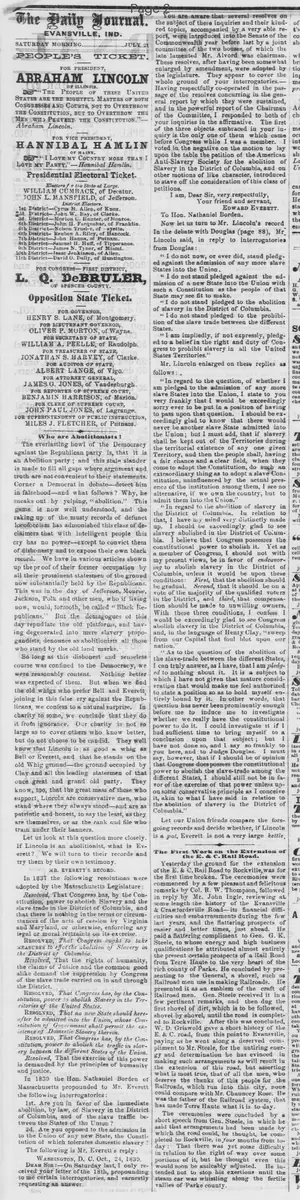
The everlasting howl of the Democracy against the Republican party is, that it is an Abolition party; and this stale slander is made to fill all gaps where argument and truth are not convenient to their statements. Corner a Democrat in debate—detect him in falsehood—and what follows? Why, he sneaks out by yelping, "abolition." This game is now well understood, and the raking up of the musty records of defunct locofocoism has admonished this class of declaimers that with intelligent people this cry has no power—except to convict them of dishonesty and to expose their own black record. We have in various articles shown up the proof of their former occupation by all their prominent statesmen of the ground now substantially held by the Republicans. This was in the day of Jefferson, Monroe, Jackson, Polk and other men, who if living now, would, forsooth, be called "Black Republicans." But the demagogues of this day repudiate the old platforms, and having degenerated into mere slavery propagandists, denounce as abolitionists all those who stand by the old land marks.
So long as this dishonest and senseless course was confined to the Democracy, we were reasonably content. Nothing better was expected of them. But when we find the old whigs who prefer Bell and Everett joining in this false cry against the Republicans, we confess to a natural surprise. In charity to some, we conclude that they do it from ignorance. Our charity is not so large as to cover others who know better, but do not choose to be candid. They well know that Lincoln is as good a whig as Bell or Everett, and that he stands on the old Whig ground—the ground occupied by Clay and all the leading statesmen of that once great and grand old party. They know, too, that the great mass of those who support Lincoln are conservative men, who stand where they always stood—and are as patriotic and honest, to say the least, as they are themselves, or as the rank and file who train under their banners.
Let us look at this question more closely. If Lincoln is an abolitionist, what is Everett? We will turn to their records and try them by their own testimony.
MR. EVERETT'S RECORD,
In 1837 the following resolutions were adopted by the Massachusetts Legislature:
Resolved, That Congress has, by the Constitution, power to abolish Slavery and the slave trade in the District of Columbia, and that there is nothing in the terms or circumstances of the acts of cession by Virginia and Maryland, or otherwise, enforcing any legal or moral restraints on its exercise.
Resolved, That Congress ought to take measures to effect the abolition of Slavery in the District of Columbia.
Resolved, That the rights of humanity, the claims of Justice and the common good alike demand the suppression by Congress of the slave trade carried on in and through the District.
Resolved, That Congress has, by the Constitution, power to abolish Slavery in the Territories of the United States.
Resolved, That no new State should hereafter be admitted into the Union, whose Constitution of Government shall permit the existence of Domestic Slavery therein.
Resolved, That Congress has, by the Constitution, power to abolish the traffic in slavery between the different States of the Union.
Resolved, That the exercise of this power is demanded by the principles of humanity and justice.
In 1839 the Hon. Nathaniel Borden of Massachusetts propounded to Mr. Everett the following interrogatories:
1st. Are you in favor of the immediate abolition, by law, of Slavery in the District of Columbia, and of the slave traffic between the States of the Union?
2d. Are you opposed to the admission into the Union of any new State, the Constitution of which tolerates domestic slavery?
The following is Mr. Everett's reply:
WASHINGTON, D. C., Oct. 24, 1839.
Dear Sir: On Saturday last, I only received your letter of the 18th, propounding to me certain interrogatories, and earnestly requesting an answer.
You are aware that several resolves on the subject of these inquiries and their kindred topics, accompanied by a very able report, were introduced into the Senate of the Commonwealth year before last by a joint committee of the two houses, of which the late lamented Mr. Alvord was chairman. These resolves, after having been somewhat enlarged by amendment, were adopted by the legislature. They appear to cover the whole ground of your interrogatories. Having respectfully co-operated in the passage of the resolves concurring in the general report by which they were sustained, and in the powerful report of the Chairman of the Committee, I responded to both of your inquiries in the affirmative. The first of the three objects embraced in your inquiry is the only one of them which came before Congress while I was a member. I voted in the negative on the motion to lay upon the table the petition of the American Anti-Slavery Society for the abolition of Slavery in the District of Columbia, and on other motions of like character, introduced to stave off the consideration of this class of petitions.
I am, Dear Sir, very respectfully,
Your friend and servant,
Edward Everett.
To Hon. Nathaniel Borden.
Now let us turn to Mr. Lincoln's record. In the debate with Douglas (page 88), Mr. Lincoln said, in reply to interrogatories from Douglas:
"I do not now, or ever did, stand pledged against the admission of any more slave States into the Union.
"I do not stand pledged against the admission of a new State into the Union with such a Constitution as the people of that State may see fit to make.
"I do not stand pledged to the abolition of slavery in the District of Columbia.
"I do not stand pledged to the prohibition of the slave trade between the different States.
"I am impliedly, if not expressly, pledged to a belief in the right and duty of Congress to prohibit slavery in all the United States Territories."
Mr. Lincoln enlarged on these replies as follows:
"In regard to the question, of whether I am pledged to the admission of any more slave States into the Union, I state to you very frankly that I would be exceedingly sorry ever to be put in a position of having to pass upon that question. I should be exceedingly glad to know that there would never be another slave State admitted into the Union; but I must add, that if slavery shall be kept out of the Territories during the territorial existence of any one given Territory, and then the people shall, having a fair chance and a clear field, when they come to adopt the Constitution, do such an extraordinary thing as to adopt a slave Constitution, uninfluenced by the actual presence of the institution among them, I see no alternative, if we own the country, but to admit them into the Union."
"In regard to the abolition of slavery in the District of Columbia, in relation to that, I have my mind very distinctly made up. I should be exceedingly glad to see slavery abolished in the District of Columbia. I believe that Congress possesses the constitutional power to abolish it. Yet as a member of Congress, I should not with my present views, be in favor of endeavoring to abolish slavery in the District of Columbia, unless it would be upon these conditions: First, that the abolition should be gradual. Second, that it should be on a vote of the majority of the qualified voters in the District, and third, that compensation should be made to unwilling owners. With these three conditions, I confess I would be exceedingly glad to see Congress abolish slavery in the District of Columbia, and, in the language of Henry Clay, "sweep from our Capital that foul blot upon our nation."
"As to the question of the abolition of the slave-trade between the different States, I can truly answer, as I have, that I am pledged to nothing about it. It is a subject to which I have not given that mature consideration that would make me feel authorized to state a position so as to hold myself entirely bound by it. In other words, that question has never been prominently enough before me to induce me to investigate whether we really have the constitutional power to do it. I could investigate it if I had sufficient time to bring myself to a conclusion upon that subject; but I have not done so, and I say so frankly to you here, and to Judge Douglas. I must say, however, that if I should be of opinion that Congress does possess the constitutional power to abolish the slave-trade among the different States, I should still not be in favor of the exercise of that power unless upon some conservative principle as I conceive it, akin to what I have said in relation to the abolition of slavery in the District of Columbia."
Let our Union friends compare the foregoing records and decide whether, if Lincoln is a pot, Everett is not a very large kettle.
The everlasting howl of the Democracy against the Republican party is, that it is an Abolition party; and this stale slander is made to fill all gaps where argument and truth are not convenient to their statements. Corner a Democrat in debate—detect him in falsehood—and what follows? Why, he sneaks out by yelping, "abolition." This game is now well understood, and the raking up of the musty records of defunct locofocoism has admonished this class of declaimers that with intelligent people this cry has no power—except to convict them of dishonesty and to expose their own black record. We have in various articles shown up the proof of their former occupation by all their prominent statesmen of the ground now substantially held by the Republicans. This was in the day of Jefferson, Monroe, Jackson, Polk and other men, who if living now, would, forsooth, be called "Black Republicans." But the demagogues of this day repudiate the old platforms, and having degenerated into mere slavery propagandists, denounce as abolitionists all those who stand by the old land marks.
So long as this dishonest and senseless course was confined to the Democracy, we were reasonably content. Nothing better was expected of them. But when we find the old whigs who prefer Bell and Everett joining in this false cry against the Republicans, we confess to a natural surprise. In charity to some, we conclude that they do it from ignorance. Our charity is not so large as to cover others who know better, but do not choose to be candid. They well know that Lincoln is as good a whig as Bell or Everett, and that he stands on the old Whig ground—the ground occupied by Clay and all the leading statesmen of that once great and grand old party. They know, too, that the great mass of those who support Lincoln are conservative men, who stand where they always stood—and are as patriotic and honest, to say the least, as they are themselves, or as the rank and file who train under their banners.
Let us look at this question more closely. If Lincoln is an abolitionist, what is Everett? We will turn to their records and try them by their own testimony.
MR. EVERETT'S RECORD,
In 1837 the following resolutions were adopted by the Massachusetts Legislature:
Resolved, That Congress has, by the Constitution, power to abolish Slavery and the slave trade in the District of Columbia, and that there is nothing in the terms or circumstances of the acts of cession by Virginia and Maryland, or otherwise, enforcing any legal or moral restraints on its exercise.
Resolved, That Congress ought to take measures to effect the abolition of Slavery in the District of Columbia.
Resolved, That the rights of humanity, the claims of Justice and the common good alike demand the suppression by Congress of the slave trade carried on in and through the District.
Resolved, That Congress has, by the Constitution, power to abolish Slavery in the Territories of the United States.
Resolved, That no new State should hereafter be admitted into the Union, whose Constitution of Government shall permit the existence of Domestic Slavery therein.
Resolved, That Congress has, by the Constitution, power to abolish the traffic in slavery between the different States of the Union.
Resolved, That the exercise of this power is demanded by the principles of humanity and justice.
In 1839 the Hon. Nathaniel Borden of Massachusetts propounded to Mr. Everett the following interrogatories:
1st. Are you in favor of the immediate abolition, by law, of Slavery in the District of Columbia, and of the slave traffic between the States of the Union?
2d. Are you opposed to the admission into the Union of any new State, the Constitution of which tolerates domestic slavery?
The following is Mr. Everett's reply:
WASHINGTON, D. C., Oct. 24, 1839.
Dear Sir: On Saturday last, I only received your letter of the 18th, propounding to me certain interrogatories, and earnestly requesting an answer.
You are aware that several resolves on the subject of these inquiries and their kindred topics, accompanied by a very able report, were introduced into the Senate of the Commonwealth year before last by a joint committee of the two houses, of which the late lamented Mr. Alvord was chairman. These resolves, after having been somewhat enlarged by amendment, were adopted by the legislature. They appear to cover the whole ground of your interrogatories. Having respectfully co-operated in the passage of the resolves concurring in the general report by which they were sustained, and in the powerful report of the Chairman of the Committee, I responded to both of your inquiries in the affirmative. The first of the three objects embraced in your inquiry is the only one of them which came before Congress while I was a member. I voted in the negative on the motion to lay upon the table the petition of the American Anti-Slavery Society for the abolition of Slavery in the District of Columbia, and on other motions of like character, introduced to stave off the consideration of this class of petitions.
I am, Dear Sir, very respectfully,
Your friend and servant,
Edward Everett.
To Hon. Nathaniel Borden.
Now let us turn to Mr. Lincoln's record. In the debate with Douglas (page 88), Mr. Lincoln said, in reply to interrogatories from Douglas:
"I do not now, or ever did, stand pledged against the admission of any more slave States into the Union.
"I do not stand pledged against the admission of a new State into the Union with such a Constitution as the people of that State may see fit to make.
"I do not stand pledged to the abolition of slavery in the District of Columbia.
"I do not stand pledged to the prohibition of the slave trade between the different States.
"I am impliedly, if not expressly, pledged to a belief in the right and duty of Congress to prohibit slavery in all the United States Territories."
Mr. Lincoln enlarged on these replies as follows:
"In regard to the question, of whether I am pledged to the admission of any more slave States into the Union, I state to you very frankly that I would be exceedingly sorry ever to be put in a position of having to pass upon that question. I should be exceedingly glad to know that there would never be another slave State admitted into the Union; but I must add, that if slavery shall be kept out of the Territories during the territorial existence of any one given Territory, and then the people shall, having a fair chance and a clear field, when they come to adopt the Constitution, do such an extraordinary thing as to adopt a slave Constitution, uninfluenced by the actual presence of the institution among them, I see no alternative, if we own the country, but to admit them into the Union."
"In regard to the abolition of slavery in the District of Columbia, in relation to that, I have my mind very distinctly made up. I should be exceedingly glad to see slavery abolished in the District of Columbia. I believe that Congress possesses the constitutional power to abolish it. Yet as a member of Congress, I should not with my present views, be in favor of endeavoring to abolish slavery in the District of Columbia, unless it would be upon these conditions: First, that the abolition should be gradual. Second, that it should be on a vote of the majority of the qualified voters in the District, and third, that compensation should be made to unwilling owners. With these three conditions, I confess I would be exceedingly glad to see Congress abolish slavery in the District of Columbia, and, in the language of Henry Clay, "sweep from our Capital that foul blot upon our nation."
"As to the question of the abolition of the slave-trade between the different States, I can truly answer, as I have, that I am pledged to nothing about it. It is a subject to which I have not given that mature consideration that would make me feel authorized to state a position so as to hold myself entirely bound by it. In other words, that question has never been prominently enough before me to induce me to investigate whether we really have the constitutional power to do it. I could investigate it if I had sufficient time to bring myself to a conclusion upon that subject; but I have not done so, and I say so frankly to you here, and to Judge Douglas. I must say, however, that if I should be of opinion that Congress does possess the constitutional power to abolish the slave-trade among the different States, I should still not be in favor of the exercise of that power unless upon some conservative principle as I conceive it, akin to what I have said in relation to the abolition of slavery in the District of Columbia."
Let our Union friends compare the foregoing records and decide whether, if Lincoln is a pot, Everett is not a very large kettle.
What sub-type of article is it?
Slavery Abolition
Partisan Politics
Constitutional
What keywords are associated?
Abolitionists
Republicans
Democrats
Lincoln
Everett
Slavery
District Of Columbia
Territories
Slave Trade
What entities or persons were involved?
Abraham Lincoln
Edward Everett
Stephen Douglas
John Bell
Henry Clay
Thomas Jefferson
James Monroe
Andrew Jackson
James Polk
Democracy
Republican Party
Whigs
Editorial Details
Primary Topic
Defense Against Accusations Of Republican Abolitionism Via Comparison Of Lincoln And Everett Records
Stance / Tone
Pro Republican Defense, Anti Democratic Slander
Key Figures
Abraham Lincoln
Edward Everett
Stephen Douglas
John Bell
Henry Clay
Thomas Jefferson
James Monroe
Andrew Jackson
James Polk
Democracy
Republican Party
Whigs
Key Arguments
Democrats Falsely Label Republicans As Abolitionists To Avoid Debate
Historical Democratic Leaders Held Anti Slavery Views Similar To Republicans
Everett Supported Resolutions For Abolishing Slavery In D.C. And Territories
Lincoln's Positions Are More Moderate Than Everett's On Key Slavery Issues
Republicans Stand On Conservative, Traditional Grounds Like Old Whigs