Thank you for visiting SNEWPapers!
Sign up free
Editorial
March 28, 1843
Southport Telegraph
Kenosha, Southport, Kenosha County, Wisconsin
What is this article about?
Editorial from Albany Argus expresses disappointment in Whig Congress for failing to reduce high postage rates, calling it an oppressive tax that drives users to cheaper private expresses, impairs postal revenues, and burdens Western states where crop prices have fallen.
Clipping
OCR Quality
98%
Excellent
Full Text
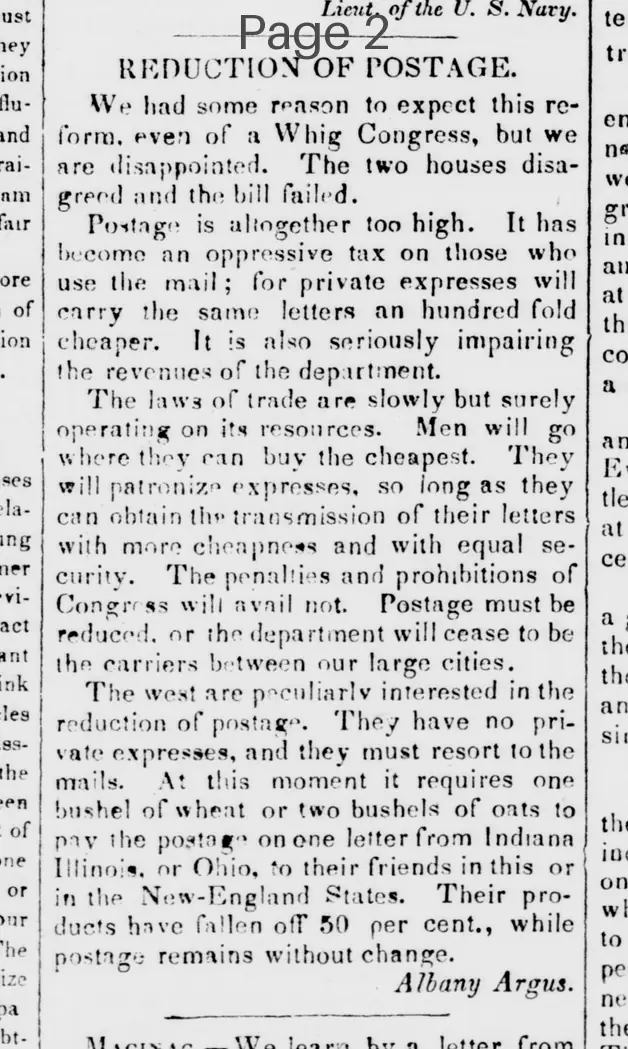
REDUCTION OF POSTAGE.
We had some reason to expect this reform, even of a Whig Congress, but we are disappointed. The two houses disagreed and the bill failed.
Postage is altogether too high. It has become an oppressive tax on those who use the mail; for private expresses will carry the same letters a hundred fold cheaper. It is also seriously impairing the revenues of the department.
The laws of trade are slowly but surely operating on its resources. Men will go where they can buy the cheapest. They will patronize expresses, so long as they can obtain the transmission of their letters with more cheapness and with equal security. The penalties and prohibitions of Congress will avail not. Postage must be reduced, or the department will cease to be the carriers between our large cities.
The west are peculiarly interested in the reduction of postage. They have no private expresses, and they must resort to the mails. At this moment it requires one bushel of wheat or two bushels of oats to pay the postage on one letter from Indiana Illinois, or Ohio, to their friends in this or in the New-England States. Their products have fallen off 50 per cent., while postage remains without change.
Albany Argus.
We had some reason to expect this reform, even of a Whig Congress, but we are disappointed. The two houses disagreed and the bill failed.
Postage is altogether too high. It has become an oppressive tax on those who use the mail; for private expresses will carry the same letters a hundred fold cheaper. It is also seriously impairing the revenues of the department.
The laws of trade are slowly but surely operating on its resources. Men will go where they can buy the cheapest. They will patronize expresses, so long as they can obtain the transmission of their letters with more cheapness and with equal security. The penalties and prohibitions of Congress will avail not. Postage must be reduced, or the department will cease to be the carriers between our large cities.
The west are peculiarly interested in the reduction of postage. They have no private expresses, and they must resort to the mails. At this moment it requires one bushel of wheat or two bushels of oats to pay the postage on one letter from Indiana Illinois, or Ohio, to their friends in this or in the New-England States. Their products have fallen off 50 per cent., while postage remains without change.
Albany Argus.
What sub-type of article is it?
Economic Policy
Taxation
Infrastructure
What keywords are associated?
Postage Reduction
Whig Congress
Private Expresses
Postal Revenues
Western Burden
Oppressive Tax
What entities or persons were involved?
Whig Congress
Private Expresses
Postal Department
West
Editorial Details
Primary Topic
Reduction Of Postage Rates
Stance / Tone
Disappointed Advocacy For Reform
Key Figures
Whig Congress
Private Expresses
Postal Department
West
Key Arguments
Congress Failed To Pass Postage Reduction Bill Due To Disagreement Between Houses
High Postage Acts As An Oppressive Tax On Mail Users
Private Expresses Offer Cheaper And Secure Letter Transmission
High Rates Impair Postal Department Revenues
Consumers Prefer Cheaper Options Per Laws Of Trade
Penalties Against Expresses Will Not Work
Postage Must Be Reduced To Maintain Postal Service Between Cities
Western States Heavily Burdened By High Rates Relative To Falling Crop Prices