Thank you for visiting SNEWPapers!
Sign up free
The Enquirer
Richmond, Henrico County, Virginia
What is this article about?
European war updates from London papers to Jan 31, 1805: Britain declares war on Portugal, seizes Madeira. Contradictory reports on continental alliances (Russia, Prussia, Austria vs. France). Spain, under Prince of Peace, prepares vigorous attack on Gibraltar with large forces. France builds army in Hanover; naval fittings and diplomatic maneuvers ongoing.
Clipping
OCR Quality
Full Text
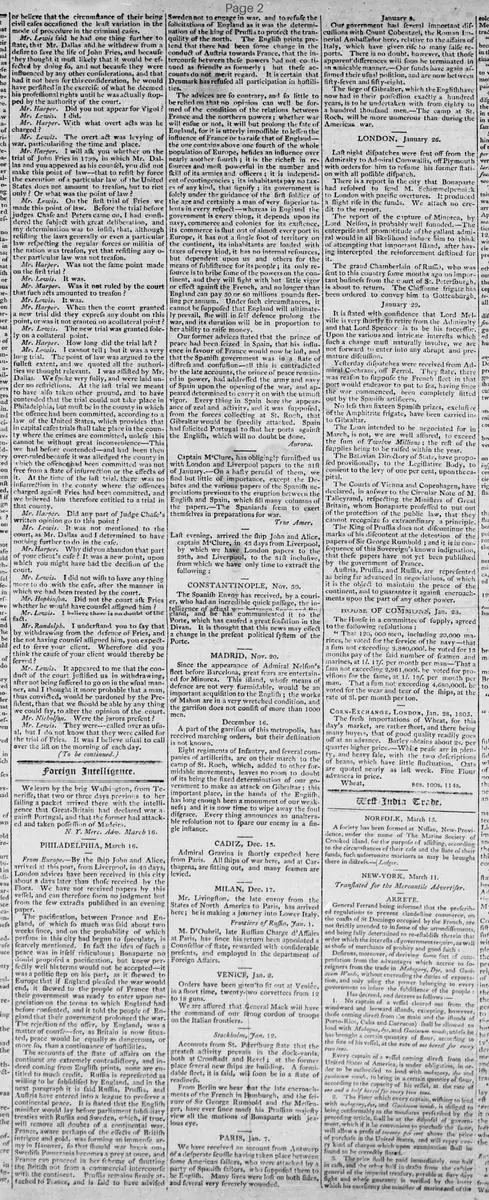
We learn by the brig Washington, from Teneriffe, that two or three days previous to her sailing a packet arrived there with the intelligence that Great-Britain had declared war against Portugal, and that the former had attacked and taken possession of Madeira.
N. Y. Merc. Adv. March 16.
PHILADELPHIA, March 16.
From Europe.—By the ship John and Alice, arrived at this port, from Liverpool, in 45 days, London advices have been received in this city about 8 days later than those received by the Flora. We have not received papers by this vessel, and can therefore form no judgment but from the few extracts published in an evening paper.
The pacification, between France and England, of which so much was said about two weeks since, and on the probability of which persons in this city had begun to speculate, is scarcely mentioned. In fact the idea of such a peace was in itself ridiculous; Bonaparte no doubt proposed a pacification, but knew perfectly well his terms would not be accepted—it was a politic step on his part, as it showed to Europe that if England pleased the war would end, it showed to the people of France that their government was ready to enter upon negotiation on the terms to which England had before consented, and it told the people of England that their government prolonged the war. The rejection of the offer, by England, was a matter of course—for, as Britain is now situated, peace would be equally as dangerous, or more so, than a continuance of hostilities.
The accounts of the state of affairs on the continent are extremely contradictory, and indeed coming from English prints, none are entitled to much credit. Russia is represented as willing to be subsidized by England, and in the next paragraph it is said Russia, Prussia, and Austria have entered into a league to preserve a continental peace. It is stated that the English minister would lay before parliament subsidiary treaties with Russia and Sweden, which, if true, will remove all doubts of a continental war.
France, aware perhaps of the effects of British intrigue and gold, was forming an immense army in Hanover, so that should war break out, Swedish Pomerania becomes a prey at once, and France can proceed in her scheme of shutting the British out from a commercial intercourse with the continent, Prussia remains firmly attached to France, and is said to have advised Sweden not to engage in war, and to refuse the solicitations of England as it was the determination of the king of Prussia to protect the tranquility of the north. The English prints pretend that there had been some change in the conduct of Austria towards France, that the intercourse between these powers had not continued as friendly as formerly: but these accounts do not merit regard. It is certain that Denmark has refused all participation in hostilities.
The advices are so contrary, and so little to be relied on that no opinion can well be formed of the condition of the relations between France and the northern powers: whether war will ensue or not, it will but prolong the fate of England, for it is utterly impossible to lessen the influence of France or to raise that of England—the one contains above one fourth of the whole population of Europe, besides an influence over nearly another fourth; it is the richest in resources and most powerful in the number and skill of its armies and officers: it is independent of contingencies; its inhabitants pay no taxes of any kind, that signify; its government is solely under the guidance of the first soldier of the age and certainly a man of very superior talents in every respect—whereas in England the government is every thing, it depends upon its navy, commerce and colonies for its existence, its commerce is shut out of almost every port in Europe, it has not a single foot of territory on the continent, its inhabitants are loaded with taxes of every kind, it has no internal resources, but dependent upon us and others for the means of subsistence for its people; its only resource is to bribe some of the powers on the continent, and they will fight with but little vigor or effect against the French, and no longer than England can pay 50 or 60 millions pounds sterling per annum. Under such circumstances, it cannot be supposed that England will ultimately prevail, she will in self defence prolong the war, and its duration will be in proportion to her ability to raise money.
Our former advices stated that the prince of peace had been seized in Spain, that his influence in favour of France would now be lost, and that the Spanish government was in a state of distress and confusion—all this is contradicted by the late accounts, the prince of peace remained in power, had addressed the army and navy of Spain upon the opening of the war, and appeared determined to carry it on with the utmost vigor. Every thing in Spain bore the appearance of zeal and activity, and it was supposed, from the forces collecting at St. Roch, that Gibraltar would be speedily attacked. Spain had solicited Portugal to shut her ports against the English, which will no doubt be done.
Aurora.
Captain M'Clure, has obligingly furnished us with London and Liverpool papers to the 31st of January.—On a hasty perusal of them, we find but little of importance, except the Debates and the various papers of the Spanish negotiations previous to the eruption between the English and Spain, which fill many columns of the papers.—The Spaniards seem to exert themselves in preparations for war.
True Amer.
Last evening, arrived the ship John and Alice, captain M'Clure, in 45 days from Liverpool, by which we have London papers to the 29th, and Liverpool, to the 31st inclusive, from which we have only time to extract the following:
CONSTANTINOPLE, Nov. 30.
The Spanish Envoy has received, by a courier, who had an incredible quick passage, the intelligence of actual war between Spain and England, and he has communicated it to the Porte, which has caused a great sensation in the Divan. It is thought that this news may effect a change in the present political system of the Porte.
MADRID, Nov. 20.
Since the appearance of Admiral Nelson's fleet before Barcelona, great fears are entertained for Minorca. This island, whose means of defence are not very formidable, would be an important acquisition to the English; the works of Mahon are in a very wretched condition, and the garrison does not consist of more than 1000 men.
December 16.
A part of the garrison of this metropolis, has received marching orders, but their destination is not known.
Eight regiments of Infantry, and several companies of artillery, are on their march to the camp of St. Roch, which, added to other formidable movements, leaves no room to doubt of its being the fixed determination of our government to make an attack on Gibraltar: this important place, in the hands of the English, has long enough been a monument of our weakness; and it is now time to wipe away the foul disgrace. Every thing announces an unalterable resolution not to spare our enemy in a single instance.
CADIZ, Dec. 15.
Admiral Gravina is shortly expected here from Paris. All ships of war here, and at Carthagena, are fitting out, and many seamen are levied.
MILAN, Dec. 17.
Mr. Livingston, the late envoy from the States of North America to Paris, has arrived here; he is making a journey into Lower Italy.
Frontiers of Russia, Jan. 1.
M. D'Oubril, late Russian Charge d'Affairs at Paris, has since his return been appointed a Counsellor of state, rewarded with considerable presents, and employed in the department of Foreign Affairs.
VENICE, Jan. 2.
Orders have been given to fit out at Venice, in a short time, twenty-two corvettes from 12 to 18 guns.
We are assured that General Mack will have the command of our strong cordon of troops on the Italian frontiers.
Stockholm, Jan. 12.
Accounts from St. Petersburg state that the greatest activity prevails in the dock-yards, both at Cronstadt and Revel; at the former place several new ships are building. A formidable fleet, it is said, will soon be in a state of readiness.
From Berlin we hear that the late encroachments of the French in Hamburgh, and the seizure of Sir George Rumbold and the Messenger, have ever since made his Prussian majesty view all the motions of Bonaparte with jealous eye.
PARIS, Jan. 7.
We have received an account from Antwerp of a desperate scuffle having taken place between some American sailors, who were attacked by a party of Spanish Sailors, who supposed them to be English. Many lives were lost on both sides, and several very severely wounded.
Our government had several important discussions with Count Cobentzel, the Roman Imperial Ambassador here, relative to the affairs of Italy, which have given rise to many false reports. There is no doubt, however, that those apparent differences will soon be terminated in an amicable manner.—Our funds have again assumed their usual position, and are now between fifty-seven and fifty-eight.
The siege of Gibraltar, which the English have now had in their possession exactly a hundred years, is to be undertaken with from eighty to a hundred thousand men.—The camp at St. Roch, will be more numerous than during the American war.
LONDON, January 26.
Last night dispatches were sent off from the Admiralty to Admiral Cornwallis, off Plymouth with orders for him to resume his former station with all possible dispatch.
There is a report in the city that Bonaparte had resolved to send M. Schimmelpenninck to London with pacific overtures. It produced a slight rise in the funds. We attach no credit to the report.
The report of the capture of Minorca, by Lord Nelson, is probably well founded.—The enterprise and promptitude of the gallant admiral would in all likelihood induce him to think of attempting that important Island, after having intercepted the reinforcement destined for it.
The grand Chamberlain of Russia, who was sent to this country some months ago on important business from the court of St. Petersburgh, is about to return. The Chiffonne frigate has been ordered to convey him to Gottenburg.
January 29.
It is stated with confidence that Lord Melville is very shortly to retire from the Admiralty and that Lord Spencer is to be his successor.
Upon the various and intricate interests which such a change must naturally involve, we are not forward to enter into any abrupt and premature discussion.
Yesterday dispatches were received from Admiral Cochrane, off Ferrol. They state, there was reason to suppose the French fleet in that port would endeavor to put to sea, having since the war commenced, been completely fitted out by the Spanish artificers.
No less than sixteen Spanish prizes, exclusive of the Amphitrite frigate, have been carried into Gibraltar.
The Loan intended to be negotiated for in March, is not, we are well assured, to exceed the sum of Twelve Millions; the rest of the supplies being to be raised within the year.
The Batavian Directory of State, have proposed provisionally, to the Legislative Body, to consent to the levy of one per cent, upon the capital.
The Courts of Vienna and Copenhagen, have declared, in answer to the Circular Note of M. Talleyrand, respecting the Ministers of Great Britain, whom Bonaparte professed to put out of the protection of the public law, that they cannot recognize so extraordinary a principle.
The King of Prussia does not discontinue the marks of his discontent at the detention of the papers of Sir George Rumbold; and it is in consequence of this Sovereign's known indignation, that these papers have not yet been published by the government of France.
Austria, Prussia, and Russia, are represented as being far advanced in negotiations, of which it is the object to maintain the peace of the continent, and to guarantee it against encroachments upon the part of any other power.
HOUSE OF COMMONS, Jan. 23.
The House in a committee of supply, agreed to the following resolutions:
"That 120,000 men, including 20,000 marines, be voted for the service of the navy—that a sum not exceeding 3,380,000l. be voted for 13 months pay of the said number of seamen and marines, at 1l. 17s. per month per man—That a sum not exceeding 2,961,000l. be voted for provisions for the same, at 1l. 18s. per month per man. That a sum not exceeding 4,680,000l. be voted for the wear and tear of the ships, at the rate of 5s. per month per ton."
Corn-Exchange, London, Jan. 28, 1805.
The fresh importations of Wheat, for this day's market, are rather short, and there being many buyers, that of good quality readily goes off at an advance. Barley obtains about 2s. per quarter higher price.—White pease are in plenty, and heavy sale, with the two descriptions of beans, which have little fluctuation. Oats are quoted nearly as last week. Fine Flour advances in price.
Wheat,
86s. 100s. 114s.
What sub-type of article is it?
What keywords are associated?
What entities or persons were involved?
Where did it happen?
Foreign News Details
Primary Location
Europe
Event Date
London Papers To The 31st Of January 1805
Key Persons
Outcome
britain declares war on portugal and takes possession of madeira; spain mobilizes 80-100,000 men for gibraltar siege; 16 spanish prizes taken into gibraltar; contradictory alliance reports; no peace between france and england; british navy funded for 120,000 men
Event Details
Reports detail Britain's declaration of war on Portugal and seizure of Madeira. Contradictory European accounts: Russia may ally with Britain or form continental peace league with Prussia and Austria; France builds army in Hanover to block British trade; Prussia supports France; Denmark neutral. Spain, led by Prince of Peace, actively prepares war, assembling forces at St. Roch for Gibraltar attack and fitting out ships at Cadiz and Cartagena. Fears for Minorca's defense; Nelson's fleet nearby. Russian and Swedish naval preparations; Venetian corvettes fitted. Diplomatic discussions in Paris with Austria; Prussian discontent over Hamburg seizures. London: Admiralty dispatches to Cornwallis; possible French fleet sortie from Ferrol; uncredited peace rumors; naval funding resolutions in Commons. Minor Antwerp scuffle between American and Spanish sailors. Constantinople reacts to Spain-England war.