Thank you for visiting SNEWPapers!
Sign up free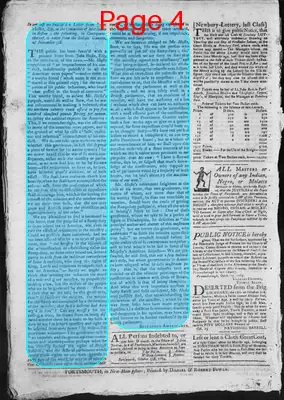
Editorial
November 16, 1764
The New Hampshire Gazette And Historical Chronicle
Portsmouth, Greenland, Rockingham County, New Hampshire
What is this article about?
Editorial in Boston Gazette critiques John Huske's letter to Boston merchants, defending colonial rights against taxation without representation. It disputes Huske's claims of influencing the postponement of the Stamp Act and argues that Parliament lacks authority to impose internal taxes on America without consent.
Clipping
OCR Quality
95%
Excellent
Full Text
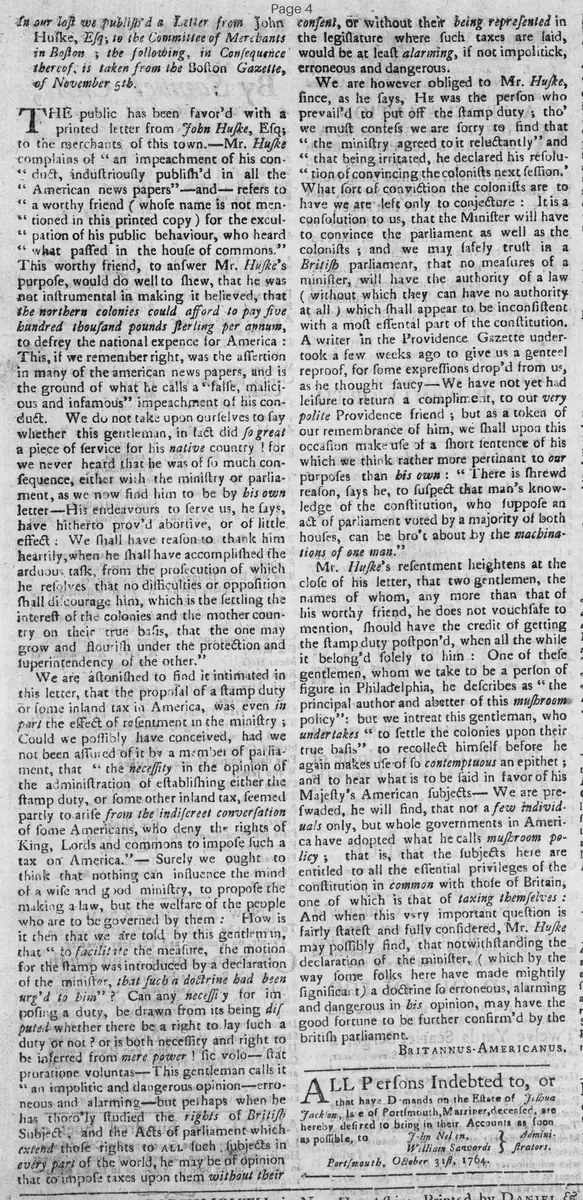
In our last we published a Letter from John Huske, Esq; to the Committee of Merchants in Boston; the following, in Consequence thereof; is taken from the Boston Gazette, of November 5th
The public has been favor'd with a printed letter from John Huske, Eq; to the merchants of this town.--Mr. Huske complains of "an impeachment of his conduct, industriously publish'd in all the American news papers" -and-- refers to "a worthy friend (whose name is not mentioned in this printed copy) for the exculpation of his public behaviour, who heard what passed in the house of commons."
This worthy friend, to answer Mr. Huske's purpose, would do well to show, that he was not instrumental in making it believed, that the northern colonies could afford to pay five hundred thousand pounds sterling per annum, to defray the national expence for America: This, if we remember right, was the assertion in many of the american news papers, and is the ground of what he calls a "false, malicious and infamous" impeachment of his conduct. We do not take upon ourselves to say whether this gentleman, in fact did so great a piece of service for his native country! for we never heard that he was of so much consequence, either with the ministry or parliament, as we now find him to be by his own letter --His endeavours to serve us, he says, have hitherto prov'd abortive, or of little effect: We shall have reason to thank him heartily, when he shall have accomplished the arduous task, from the prosecution of which he resolves that no difficulties or opposition Shall discourage him, which is the settling the interest of the colonies and the mother country on their true basis, that the one may grow and flourish under the protection and superintendency of the other.
We are astonished to find it intimated in this letter, that the proposal of a stamp duty or some inland tax in America, was even in part the effect of resentment in the ministry: Could we possibly have conceived, had we not been assured of it by a member of parliament, that the necessity in the opinion of the administration of establishing either the stamp duty, or some other inland tax, seemed partly to arise from the indiscreet conversation of some Americans, who deny the rights of King, Lords and commons to impose such a tax on America."-- Surely we ought to think that nothing can influence the mind of a wise and good ministry, to propose the making a law, but the welfare of the people who are to be governed by them: "How is it then that we are told- by this gentleman. that-" to facilitate the measure, the motion for the stamp was introduced by a declaration of the minister, that such a doctrine had been urg'd to him"? Can any necessity for imposing a duty, be drawn from its being disputed whether there be a right to lay such a duty or not? or is both necessity and right to be inferred from mere power! sic volo-- stat proratione voluntas-- This gentleman calls it "an impolitic and dangerous opinion--erroneous and alarming--but perhaps when he has thoroughly studied the rights of British Subject, and the Acts of parliament which- extend those rights to All such subjects in every part of the world, he may be of opinion that to impose taxes upon them without their consent, or without their being represented in the legislature where such taxes are laid, would be at least alarming, if not impolitick, erroneous and dangerous.
We are however obliged to Mr. Huske, since, as he says. He was the person who prevail'd to put off the stamp duty; tho' we must confess we are sorry to find that "the ministry- agreed to it reluctantly" and "that being irritated, he declared his resolution of convincing the colonists next session.' What sort of conviction the colonists are to have we are left only to conjecture: It is a consolation to us, that the Minister will have to convince the parliament as well as the colonists; and we may safely trust in a British parliament, that no measures of a minister, will have the authority of a law (without which they can have no authority at all) which shall appear to be inconsistent with a most essential part of the constitution.
A writer in the Providence Gazette undertook a few weeks ago to give us a genteel reproof, for some expressions drop'd from us, as he thought saucy-- We have not yet had leisure to return a compliment, to our very polite Providence friend; but as a token of our remembrance of him, we shall upon this occasion make use of a short sentence of his which we think rather more pertinent to our purposes than his own: "There is shrewd reason, says he, to suspect that man's knowledge of the constitution, who supposes an act of parliament voted by a majority of both houses, can be bro't about by the machinations of one man.'
Mr. Huske's resentment heightens at the close of his letter, that two gentlemen, the names of whom, any more than that of his worthy friend, he does not vouchsafe to mention, should have the credit of getting the stamp duty postpon'd, when all the while it belong'd solely to him: One of these gentlemen, whom we take to be a person of figure in Philadelphia, he describes as "the principal author and abetter of this mushroom policy": but we intreat this gentleman, who undertakes to settle the colonies upon their true basis" to recollect himself before he again makes use of so contemptuous an epithet: and to hear what is to be said in favor of his Majesty's American subjects-- We are persuaded. he will find, that not a few individuals only, but whole governments in America. ca have adopted what he calls mushroom policy; that is, that the subjects here are entitled to all the essential privileges of the constitution in common with those of Britain. one of which is that of taxing themselves: And when this very important question is fairly stated and fully considered, Mr. Huske may possibly find, that notwithstanding the declaration of the minister, (which by the way some folks here have made mightily significant) a doctrine so erroneous, alarming and dangerous in his opinion, may have the good fortune to be further confirm'd by the british parliament.
Britannus-Americanus.
The public has been favor'd with a printed letter from John Huske, Eq; to the merchants of this town.--Mr. Huske complains of "an impeachment of his conduct, industriously publish'd in all the American news papers" -and-- refers to "a worthy friend (whose name is not mentioned in this printed copy) for the exculpation of his public behaviour, who heard what passed in the house of commons."
This worthy friend, to answer Mr. Huske's purpose, would do well to show, that he was not instrumental in making it believed, that the northern colonies could afford to pay five hundred thousand pounds sterling per annum, to defray the national expence for America: This, if we remember right, was the assertion in many of the american news papers, and is the ground of what he calls a "false, malicious and infamous" impeachment of his conduct. We do not take upon ourselves to say whether this gentleman, in fact did so great a piece of service for his native country! for we never heard that he was of so much consequence, either with the ministry or parliament, as we now find him to be by his own letter --His endeavours to serve us, he says, have hitherto prov'd abortive, or of little effect: We shall have reason to thank him heartily, when he shall have accomplished the arduous task, from the prosecution of which he resolves that no difficulties or opposition Shall discourage him, which is the settling the interest of the colonies and the mother country on their true basis, that the one may grow and flourish under the protection and superintendency of the other.
We are astonished to find it intimated in this letter, that the proposal of a stamp duty or some inland tax in America, was even in part the effect of resentment in the ministry: Could we possibly have conceived, had we not been assured of it by a member of parliament, that the necessity in the opinion of the administration of establishing either the stamp duty, or some other inland tax, seemed partly to arise from the indiscreet conversation of some Americans, who deny the rights of King, Lords and commons to impose such a tax on America."-- Surely we ought to think that nothing can influence the mind of a wise and good ministry, to propose the making a law, but the welfare of the people who are to be governed by them: "How is it then that we are told- by this gentleman. that-" to facilitate the measure, the motion for the stamp was introduced by a declaration of the minister, that such a doctrine had been urg'd to him"? Can any necessity for imposing a duty, be drawn from its being disputed whether there be a right to lay such a duty or not? or is both necessity and right to be inferred from mere power! sic volo-- stat proratione voluntas-- This gentleman calls it "an impolitic and dangerous opinion--erroneous and alarming--but perhaps when he has thoroughly studied the rights of British Subject, and the Acts of parliament which- extend those rights to All such subjects in every part of the world, he may be of opinion that to impose taxes upon them without their consent, or without their being represented in the legislature where such taxes are laid, would be at least alarming, if not impolitick, erroneous and dangerous.
We are however obliged to Mr. Huske, since, as he says. He was the person who prevail'd to put off the stamp duty; tho' we must confess we are sorry to find that "the ministry- agreed to it reluctantly" and "that being irritated, he declared his resolution of convincing the colonists next session.' What sort of conviction the colonists are to have we are left only to conjecture: It is a consolation to us, that the Minister will have to convince the parliament as well as the colonists; and we may safely trust in a British parliament, that no measures of a minister, will have the authority of a law (without which they can have no authority at all) which shall appear to be inconsistent with a most essential part of the constitution.
A writer in the Providence Gazette undertook a few weeks ago to give us a genteel reproof, for some expressions drop'd from us, as he thought saucy-- We have not yet had leisure to return a compliment, to our very polite Providence friend; but as a token of our remembrance of him, we shall upon this occasion make use of a short sentence of his which we think rather more pertinent to our purposes than his own: "There is shrewd reason, says he, to suspect that man's knowledge of the constitution, who supposes an act of parliament voted by a majority of both houses, can be bro't about by the machinations of one man.'
Mr. Huske's resentment heightens at the close of his letter, that two gentlemen, the names of whom, any more than that of his worthy friend, he does not vouchsafe to mention, should have the credit of getting the stamp duty postpon'd, when all the while it belong'd solely to him: One of these gentlemen, whom we take to be a person of figure in Philadelphia, he describes as "the principal author and abetter of this mushroom policy": but we intreat this gentleman, who undertakes to settle the colonies upon their true basis" to recollect himself before he again makes use of so contemptuous an epithet: and to hear what is to be said in favor of his Majesty's American subjects-- We are persuaded. he will find, that not a few individuals only, but whole governments in America. ca have adopted what he calls mushroom policy; that is, that the subjects here are entitled to all the essential privileges of the constitution in common with those of Britain. one of which is that of taxing themselves: And when this very important question is fairly stated and fully considered, Mr. Huske may possibly find, that notwithstanding the declaration of the minister, (which by the way some folks here have made mightily significant) a doctrine so erroneous, alarming and dangerous in his opinion, may have the good fortune to be further confirm'd by the british parliament.
Britannus-Americanus.
What sub-type of article is it?
Constitutional
Taxation
What keywords are associated?
Stamp Act
Taxation Without Representation
Colonial Rights
John Huske
Parliament Authority
British Constitution
What entities or persons were involved?
John Huske
Ministry
Parliament
Boston Merchants
Committee Of Merchants
King, Lords And Commons
Editorial Details
Primary Topic
Critique Of John Huske's Letter Defending Colonial Rights Against Stamp Act Taxation
Stance / Tone
Strongly Pro Colonial Rights, Anti Taxation Without Representation
Key Figures
John Huske
Ministry
Parliament
Boston Merchants
Committee Of Merchants
King, Lords And Commons
Key Arguments
Parliament Has No Right To Impose Internal Taxes On Colonies Without Representation
Huske's Claims Of Influencing Stamp Act Postponement Are Exaggerated
Colonial Assertions Of Rights Stem From British Constitutional Privileges
Ministry's Resentment Over Colonial Doctrines Does Not Justify Taxation
Trust In British Parliament To Uphold Constitution Against Ministerial Overreach