Thank you for visiting SNEWPapers!
Sign up free
The Daily Cincinnati Republican, And Commercial Register
Cincinnati, Hamilton County, Ohio
What is this article about?
In this first letter on the economic times, 'Civis' argues that the 1837 crisis in the US, particularly Virginia, results from over-banking and over-trading rather than government actions like the specie circular, deposit removal, or US Bank dechartering, which only revealed weak foundations of credit and capital.
Clipping
OCR Quality
Full Text
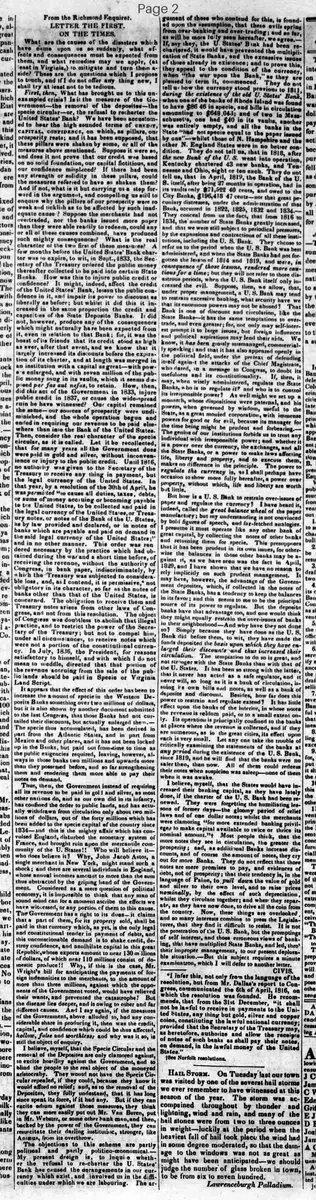
LETTER THE FIRST
ON THE TIMES
What are the causes of the disasters which have come upon us so suddenly, what effects and consequences must be expected from them, and what remedies may we apply, (at least in Virginia,) to mitigate and turn them aside? These are the questions which I propose to touch, and if I do not offer any thing new, I shall try at least not to be tedious.
First, then, What has brought us to this unexampled crisis? Is it the measure of the Government—the removal of the deposites—the specie circular—or, the refusal to recharter the United States' Bank? We have been accustomed to hear the high sounded terms of credit, CAPITAL, CONFIDENCE, on which, as pillars, our prosperity rests; and it has been supposed, that these pillars were shaken by some, or all of the measures above mentioned. Suppose it were so, and does it not prove that our credit was based on no solid foundation, our capital fictitious, and our confidence misplaced? If there had been any strength or solidity in these pillars, could the measures referred to have so shaken them? And if not, what is it but carrying us a step forward in the argument, and compelling us still to enquire why the pillars of our prosperity were so weak and ticklish as to be affected by such inadequate cause? Suppose the merchants had not overtraded, nor the banks issued more paper than they were able readily to redeem, could any or all of these causes combined, have produced such mighty consequences? What is the real character of the two first of these measures? A few months before the United States' Bank charter was to expire, to wit, in Sept., 1833, the Secretary of the Treasury ordered the public money thereafter collected to be paid into certain State Banks. How was this to injure public credit or confidence? It might, indeed, affect the credit of the United States' Bank, lessen the public confidence in it, and impair its power to discount as liberally as before; but whilst it did this it increased in the same proportion the credit and capacities of the State Deposite Banks. It did not, however, produce any of the consequences which might naturally have been expected from it, even in relation to that Bank; for, it was the boast of its friends that its credit stood as high as ever, after that event, and we know that it largely increased its discounts before the expiration of its charter, and at length was merged in an institution with a capital as great—with powers enlarged, and with seven million of the public money snug in its vaults, which it seems disposed per fas aut nefas, to retain. How, then, did this act of the Government in 1833, injure public credit in 1837, or cause the wide-spread ruin we have witnessed? Our capital remained the same—our sources of prosperity were undiminished, and the whole operation begun and ended in requiring our revenue to be paid elsewhere than into the Bank of the United States.
Then, consider the real character of the specie circular, as it is called. Let it be recollected, that for many years all the Government dues were paid in gold and silver, without inconvenience or injury to the public credit. Until 1816. no authority was given to the Secretary of the Treasury to receive any thing in payment, but the legal currency of the United States. In that year, by a resolution of the 30th of April, he was permitted "to cause all duties, taxes, debts, or sums of money accruing or becoming payable to the United States, to be collected and paid in the legal currency of the United States, or Treasury notes, or notes of the Bank of the U. States, as by law provided and declared, or in notes of banks which are payable and paid on demand in the said legal currency of the United States;" and in no other manner. This order was rendered necessary by the practice which had obtained during the war and a short time before, of receiving the revenue, without the authority of Congress, in bank paper, indiscriminately, by which the Treasury was subjected to considerable loss, and, as I contend, it is permissive,* not obligatory in its character, so far as the notes of banks other than that of the United States, is concerned. The obligation to receive them and Treasury notes arises from other laws of Congress, and not from this resolution. The object of Congress was doubtless to abolish that illegal practice, and to restrict the power of the Secretary of the Treasury; but not to compel him, under all circumstances, to receive notes which were not a portion of the constitutional currency. In July, 1836, the President, for reasons satisfactory to himself, and with which I do not mean to meddle, directed that that portion of the revenue accruing from the sale of the public lands should be paid in Specie or Virginia Land Script.
It appears that the effect of this order has been to increase the amount of specie in the Western Deposite Banks something over two millions of dollars, but it is also shown by another document submitted to the last Congress, that those Banks had not curtailed their discounts, but actually enlarged them.—The specie thus accumulated, has been derived in part from the Atlantic States, and in part from Mexico and other places, and it has not been locked up in the Banks, but paid out from time to time as the public exigencies required, leaving, however, always in those banks two millions and upwards more than they possessed before, and so far strengthening them and rendering them more able to pay their notes on demand.
Thus, then, the Government instead of requiring all its revenue to be paid in gold and silver, as most other nations do, and as our own did in its infancy, has confined the Order to public lands, and has actually withdrawn from circulation only about two millions of dollars, out of the forty millions which has been added to the specie capital of the country since 1834—and this is the mighty affair which has convulsed England, disturbed the monetary system of France, and brought ruin upon the mercantile community of the U. States!! Who will believe it—who does believe it? Why, John Jacob Astor, a single merchant in New York, might stand such a shock; and there are several individuals in England, whose annual incomes amount to more than the sum thus abstracted by the griping hand of the Government. Considered as a mere question of political economy, it is impossible to think that any man of sound mind can for a moment ascribe the effects we have witnessed, or any portion. of them to this cause. The Government has a right to its dues—it claims that a part of them, for its property sold, shall be paid in that currency which, as yet, is the only legal and constitutional tender in payment of debts, and this unconscionable demand is to shake credit, destroy confidence, and annihilate capital in this great Republic, whose exports amount to near 130 millions of dollars, of which near 110 millions consist of domestic produce!! Why, if this is the case, Mr. Wright's bill for anticipating the payments of foreign indemnities to the merchants, to the amount of more than three millions, against which the opponents of the Government voted, would have relieved their wants, and prevented the catastrophe! But the disease lies deeper, and is owing to other and far different causes. And I say again, if the measures of the Government, above alluded to, had any considerable share in producing it, then was the credit, capital, and confidence which could be thus affected, hollow, false and worthless; and why was it so, is still the object of enquiry.
I believe, myself, that the Specie Circular and the removal of the Deposites are only clamored against, to excite hostility against the Government, and to blind the people to the real object of the moneyed aristocracy. They would not have the Specie Circular repealed, if they could, because they know it would afford no relief; and, as to the removal of the Deposites, they fully understand, that it has long since spent its force, if it had any. But if they can excite odium against those measures, they think they can more easily put out Mr. Van Buren, put in Mr. Webster, or some other bank man, and then, backed by the power of the Government, they can resuscitate their darling institution, stronger, like Antaeus, from its overthrow.
The objections to this scheme are partly political and partly politico-economical.—My present design is. to enquire whether the refusal to re-charter the U. States Bank has caused the derangement in our currency which exist, and involved us in the difficulties under which we are labouring. The argument of those who contend for this, is founded upon the assumption, that these evils spring from over-banking and over-trading; and so far, as will be more fully seen hereafter, we agree.—If, say they, the U. States' Bank had been re-chartered, it would have prevented the multiplication of State Banks, and the excessive issues of those already in existence; and to prove this, they appeal to the condition of the currency when "the war upon the Bank," as they are pleased to term it, commenced. They do not tell us—how the currency stood previous to 1811, during the existence of the old U. States' Bank. when one of the banks of Rhode Island was found to have $86 46 in specie, and bills in circulation amounting to $648,043; and of two in Massachusetts, one had $40 in its vaults, another was entirely empty, and all the banks in the State "had not specie equal to the paper issued by one"—whilst those of N. Hampshire and the other N. England States were in no better condition. They do not tell us, that in 1818, after the new Bank of the U. S. went into operation, Kentucky chartered 43 new banks, and Tennessee and Ohio, eight or ten each. They do not tell us, that in April, 1819, the Bank of the U. S. itself, after being 27 months in operation, had in its vaults only $71,522 40 cents, and owed to the City Banks, $196,418 47 cents—nor that great pecuniary distresses, under the administration of that Bank, occurred in 1822, 1825, 1832 and 1834.—They conceal from us the fact, that from 1816 to 1834, the number of State Banks greatly increased, and that we were still subject to periodical pressures, by the expansions and contractions of all these institutions, including the U. S. Bank. They choose to refer us to the period when the U. S. Bank was best administered, and when the State Banks had not forgotten the lesson of 1814 and 1819, and were, in consequence of those lessons, rendered more cautious for a time; but they will not refer to those disastrous periods, when the U. S. Bank itself only increased the evil. Suppose, then, we allow, that, under proper management, a U.S. Bank may tend to restrain excessive banking, what security have we that its enormous powers may not be abused? That Bank is one of discount and circulation, like the State Banks—it has the same temptations to over-trade, and even greater; for, not only may self-interest prompt it to large issues, but foreign influences and political aspirations may lend their aids. We know, it has been grossly mismanaged, commercially speaking: and that it has also appeared openly in the political field, under the pretext of defending itself against the attacks of the Chief Magistrate, who dared, in a message to Congress, to doubt its usefulness and its constitutionality. If, then, it may, when wisely administered, regulate the State Banks, who is to regulate it? and who is to control its irresponsible power? As well might we set up a monarch, whose dispositions were paternal, and his powers, when governed by wisdom, useful to the State, as a great monied corporation, with immense powers for good or for evil, because its manager for the time being might be prudent and forbearing.—The genius of our institutions forbids us to trust any individual with irresponsible power; and whether it is a power over the currency, the exchanges, and all the State Banks, or a power to make laws affecting life, liberty and property, and to execute them, makes no difference in the principle. The power to regulate the currency is, as I shall perhaps have occasion to show more fully hereafter, a power over property, without which, life and liberty are worth but little.
But how is a U. S. Bank to restrain over-issues of paper and regulate the currency? I have heard it, indeed, called the great balance wheel of the paper manufactory: but my understanding is not convinced by bold figures of speech, and far-fetched analogies. I presume it must operate like any other bank of great capital, by collecting the notes of other banks and returning them for specie. This presupposes that it has been prudent in its own issues, for otherwise the balances in those other banks may be against it, as we have seen was the fact in April, 1829, and I have shown that we have no reason to rely implicitly on such prudent management. It may have, however, the advantage of the Government deposites, which, if collected in the notes of the State Banks, has a tendency to keep the balances in its favor; and this seems to me to be the principal source of its power to regulate. But the deposite banks have that advantage too, and one would think they might equally restrain the over-issues of banks in their neighborhood—And why have they not done so? Simply because they have done as the U. S. Bank did before them, to wit, they have made the funds deposited the basis upon which they have enlarged their discounts and thus increased their circulation. The temptation to do so is great, and not stronger with the State Banks than with that of the U. States. It has been so strong with the latter, that it never has acted as a safe regulator, and it never will, so long as it is a bank of circulation, issuing its own bills and notes, as well as a bank of deposite and discount. Besides, how far does this power to restrain and regulate extend? It has little effect upon the banks of the interior, in whose notes the revenue is seldom paid, or to a small extent only. Its operation is principally confined to the banks at places where the revenue is collected, and if they are numerous, as in the great cities, its effect upon each is very small. Let any one take the trouble of critically examining the statements of the banks at any period during the existence of the U. S. Bank, since 1819, and he will find that the banks were no safer then, than now. All of them could redeem their notes when suspicion was asleep—none of them when it was awake.
I believe, myself, that the States would have increased their banking capital, as they have lately done, if the charter of the U. S. Bank had been renewed. They were forgetting the humiliating lessons of former days—the gloomy period of relief laws and of one dollar notes; whilst the merchants were clamoring "for more extended banking privileges to make capital available to twice or thrice its nominal amount."+ Most people think, that the more notes they see in circulation, the greater the prosperity; and, as additional Banks increase discounts, and of course the amount of notes, they cry out for more Banks. They do not reflect that those notes are mere promises to pay, and evidences of debt, not of prosperity; that their tendency is, in the language of Paine, to pull down the value of gold and silver to their own level, and to raise prices nominally, by the effect of such depreciation, whilst they circulate together; and when they separate, as they have now done, to drive all the coin from the country. Now, these things are overlooked and so many interests combine to press the Legislatures, that they find it difficult to resist. It is not the prostration of the U. S. Bank, but the promptings of self interest, and those erroneous views of banking, that have multiplied State Banks, and led, thro' their improper management, to our present deplorable situation.—But this subject requires a minute examination, which I will defer to another letter.
CIVIS.
*I infer this, not only from the language of the resolution, but from Mr. Dallas's report to Congress, communicated the 6th of April, 1816, on which the resolution was founded. He recommends, that from the 31st December, "it shall not be lawful to receive in payments to the United States, any thing but gold, silver and copper coins, constituting the lawful national currency; provided that the Secretary of the Treasury may, as heretofore, authorize and allow the receipts of notes of such banks as shall pay their notes, on demand, in the lawful money of the United States."
+ See Norfolk resolutions.
What sub-type of article is it?
What themes does it cover?
What keywords are associated?
What entities or persons were involved?
Letter to Editor Details
Author
Civis.
Main Argument
the economic disasters of 1837 are not caused by government measures such as the removal of deposits, the specie circular, or the refusal to recharter the united states bank, which merely exposed the fragility of fictitious credit and capital; instead, they stem from over-trading by merchants and excessive issuance of paper by state banks.
Notable Details