Thank you for visiting SNEWPapers!
Sign up free
The Providence Journal, And Town And Country Advertiser
Providence, Providence County, Rhode Island
What is this article about?
British and Turkish forces under General Hutchinson capture Rosetta and Fort St. Julien in Egypt, securing the Nile's western branch. French losses exceed 5,000 with four generals killed. Hutchinson advances on Rahmanieh while Grand-Vizier approaches Cairo unopposed. Army in high spirits with local support.
Clipping
OCR Quality
Full Text
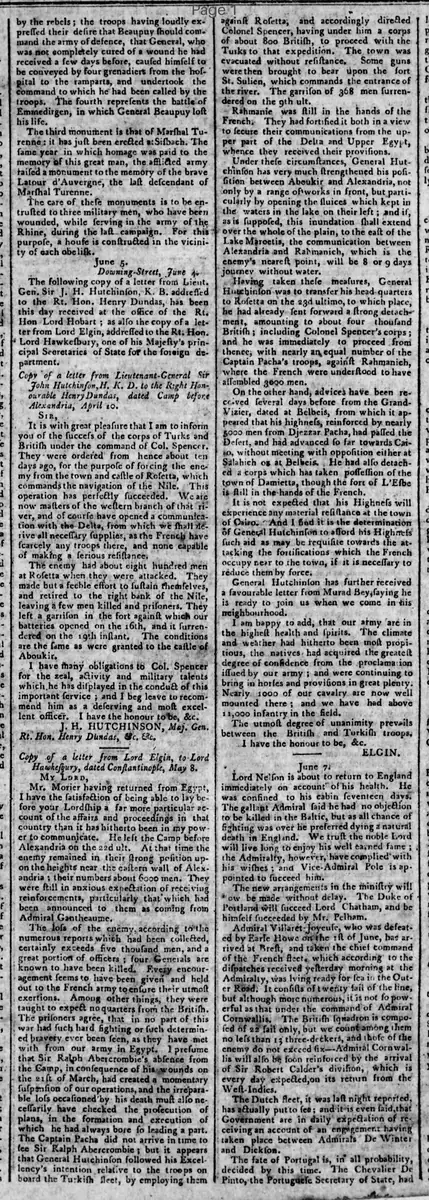
The following copy of a letter from Lieut. Gen. Sir J. H. Hutchinson, K. B. addressed to the Rt. Hon. Henry Dundas, has been this day received at the office of the Rt. Hon Lord Hobart; as also the copy of a letter from Lord Elgin, addressed to the Rt. Hon. Lord Hawkesbury, one of his Majesty's principal Secretaries of State for the foreign department.
Copy of a letter from Lieutenant-General Sir John Hutchinson, K. B. to the Right Honourable Henry Dundas, dated Camp before Alexandria, April 20.
SIR,
It is with great pleasure that I am to inform you of the success of the corps of Turks and British under the command of Col. Spencer.
They were ordered from hence about ten days ago, for the purpose of forcing the enemy from the town and castle of Rosetta, which commands the navigation of the Nile. This operation has perfectly succeeded. We are now masters of the western branch of that river. and of course have opened a communication with the Delta, from which we shall receive all necessary supplies, as the French have scarcely any troops there, and none capable of making a serious resistance.
The enemy had about eight hundred men at Rosetta when they were attacked. They made but a feeble effort to sustain themselves, and retired to the right bank of the Nile, leaving a few men killed and prisoners. They left a garrison in the fort against which our batteries opened on the 16th, and it surrendered on the 19th instant. The conditions are the same as were granted to the castle of Aboukir.
I have many obligations to Col. Spencer for the zeal, activity and military talents which he has displayed in the conduct of this important service; and I beg leave to recommend him as a deserving and most excellent officer.
I have the honour to be, &c.
J. H. HUTCHINSON, Maj. Gen.
Rt. Hon. Henry Dundas, &c. &c.
Copy of a letter from Lord Elgin, to Lord Hawkesbury, dated Constantinople, May 8.
My LORD,
Mr. Morier having returned from Egypt. I have the satisfaction of being able to lay before your Lordship a far more particular account of the affairs and proceedings in that country than it has hitherto been in my power to communicate. He left the Camp before Alexandria on the 22d ult. At that time the enemy remained in their strong position upon the heights near the eastern wall of Alexandria; their numbers about 6000 men. They were still in anxious expectation of receiving reinforcements, particularly that which had been announced to them as coming from Admiral Gantheaume.
The loss of the enemy, according to the numerous reports which had been collected, certainly exceeds five thousand men, and a great portion of officers: four Generals are known to have been killed. Every encouragement seems to have been given and held out to the French army to ensure their utmost exertions. Among other things; they were taught to expect no quarter from the British.
The prisoners agree, that in no part of this war had such hard fighting or such determined bravery ever been seen, as they have met with from our army in Egypt. I presume that Sir Ralph Abercrombie's absence from the Camp, in consequence of his wounds on the 21st of March, had created a momentary suspension of our operations, and the irreparable loss occasioned by his death must also necessarily have checked the prosecution of plans, in the formation and execution of which he had always borne so leading a part.
The Captain Pacha did not arrive in time to see Sir Ralph Abercrombie; but it appears that General Hutchinson followed his Excellency's intention relative to the troops on board the Turkish fleet, by employing them against Rosetta, and accordingly directed Colonel Spencer, having under him a corps of about 800 British, to proceed with the Turks to that expedition. The town was evacuated without resistance. Some guns were then brought to bear upon the fort St. Julien, which commands the entrance of the river. The garrison of 368 men surrendered on the 9th ult.
Rahmanieh was still in the hands of the French, They had fortified it both in a view to secure their communications from the upper part of the Delta and Upper Egypt, whence they received their provisions.
Under these circumstances, General Hutchinson has very much strengthened his position between Aboukir and Alexandria, not only by a range of works in front, but particularly by opening the sluices which kept in the waters in the lake on their left; and if, as is supposed, this inundation shall extend over the whole of the plain, to the east of the Lake Mareotis, the communication between Alexandria and Rahmanieh, which is the enemy's nearest point, will be 8 or 9 days journey without water.
Having taken these measures, General Hutchinson was to transfer his head-quarters to Rosetta on the 23d ultimo, to which place, he had already sent forward a strong detachment, amounting to about four thousand British; including Colonel Spencer's corps; and he was immediately to proceed from thence; with nearly an equal number of the Captain Pacha's troops, against Rahmanieh, where the French were understood to have assembled 3000 men.
On the other hand, advices have been received several days before from the Grand-Vizier, dated at Belbeis, from which it appeared that his highness, reinforced by nearly 5000 men from Djezzar Pacha, had passed the Desert. and had advanced so far towards Cairo, without meeting with opposition either at Salahieh or at Belbeis. He had also detached a corps which has taken possession of the town of Damietta, though the fort of L'Esbe is still in the hands of the French,
It is not expected that his Highness will experience any material resistance at the town of Cairo. And I find it is the determination of General Hutchinson to afford his Highness such aid as may be requisite towards the attacking the fortifications which the French occupy near to the town, if it is necessary to reduce them by force:
General Hutchinson has further received a favourable letter from Murad Bey saying he is ready to join us when we come in his neighbourhood.
I am happy to add; that our army are in the highest health and spirits. The climate and weather had hitherto been most propitious. the natives, had acquired the greatest degree of confidence from the proclamation issued by our army; and were continuing to bring in horses and provisions in great plenty.
Nearly 1000 of our cavalry are now well mounted there; and we have had above 11,000 infantry in the field.
The utmost degree of unanimity prevails between the British and Turkish troops.
I have the honour to be, &c.
ELGIN.
What sub-type of article is it?
What keywords are associated?
What entities or persons were involved?
Where did it happen?
Foreign News Details
Primary Location
Egypt
Event Date
April 20 To May 8
Key Persons
Outcome
french losses exceed 5,000 men including four generals killed; rosetta and fort st. julien captured with 800 enemy at rosetta (few killed, prisoners taken), fort garrison of 368 surrendered; advancing on rahmanieh (3,000 french) and cairo with minimal expected resistance.
Event Details
British-Turkish corps under Col. Spencer captured Rosetta on April 16-19, securing Nile navigation and Delta supplies. French evacuated town, feeble resistance, fort surrendered. Hutchinson strengthens position near Alexandria, floods plain to hinder French. HQ moves to Rosetta with 4,000 British and equal Turkish to attack Rahmanieh. Grand-Vizier advances to Cairo, takes Damietta. Murad Bey to join. French hold position near Alexandria (6,000 men), expect reinforcements. Abercrombie died from wounds.