Thank you for visiting SNEWPapers!
Sign up free
Story
June 12, 1788
The New York Journal, And Daily Patriotic Register
New York, New York County, New York
What is this article about?
Discussion on the advantages of mowing wheat with a scythe rather than a sickle in regions like the Rhine, Flanders, and France, highlighting labor savings and a protective stacking method adopted in southern England.
Clipping
OCR Quality
95%
Excellent
Full Text
The Utility of Mowing Wheat.
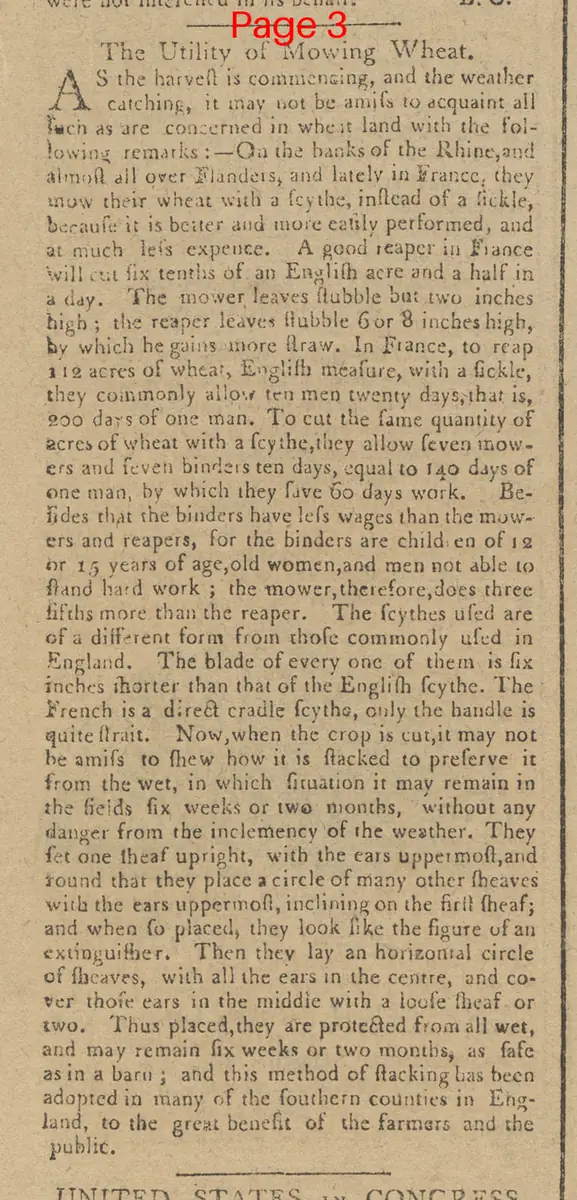
As the harvest is commencing, and the weather catching, it may not be amiss to acquaint all such as are concerned in wheat land with the following remarks:—On the banks of the Rhine, and almost all over Flanders, and lately in France, they mow their wheat with a scythe, instead of a sickle, because it is better and more easily performed, and at much less expense. A good reaper in France will cut six tenths of an English acre and a half in a day. The mower leaves stubble but two inches high; the reaper leaves stubble 6 or 8 inches high, by which he gains more straw. In France, to reap 12 acres of wheat, English measure, with a sickle, they commonly allow ten men twenty days, that is, 200 days of one man. To cut the same quantity of acres of wheat with a scythe, they allow six mowers and seven binders ten days, equal to 140 days of one man, by which they save 60 days work. Besides that the binders have less wages than the mowers and reapers, for the binders are children of 12 or 15 years of age, old women, and men not able to stand hard work; the mower, therefore, does three fifths more than the reaper. The scythes used are of a different form from those commonly used in England. The blade of every one of them is six inches shorter than that of the English scythe. The French is a direct cradle scythe, only the handle is quite straight. Now, when the crop is cut, it may not be amiss to show how it is stacked to preserve it from the wet, in which situation it may remain in the fields six weeks or two months, without any danger from the inclemency of the weather. They set one sheaf upright, with the ears uppermost, and round that they place a circle of many other sheaves with the ears uppermost, inclining on the first sheaf; and when so placed, they look like the figure of an extinguisher. Then they lay a horizontal circle of sheaves, with all the ears in the centre, and cover those ears in the middle with a loose sheaf or two. Thus placed, they are protected from all wet, and may remain six weeks or two months, as safe as in a barn; and this method of stacking has been adopted in many of the southern counties in England, to the great benefit of the farmers and the public.
As the harvest is commencing, and the weather catching, it may not be amiss to acquaint all such as are concerned in wheat land with the following remarks:—On the banks of the Rhine, and almost all over Flanders, and lately in France, they mow their wheat with a scythe, instead of a sickle, because it is better and more easily performed, and at much less expense. A good reaper in France will cut six tenths of an English acre and a half in a day. The mower leaves stubble but two inches high; the reaper leaves stubble 6 or 8 inches high, by which he gains more straw. In France, to reap 12 acres of wheat, English measure, with a sickle, they commonly allow ten men twenty days, that is, 200 days of one man. To cut the same quantity of acres of wheat with a scythe, they allow six mowers and seven binders ten days, equal to 140 days of one man, by which they save 60 days work. Besides that the binders have less wages than the mowers and reapers, for the binders are children of 12 or 15 years of age, old women, and men not able to stand hard work; the mower, therefore, does three fifths more than the reaper. The scythes used are of a different form from those commonly used in England. The blade of every one of them is six inches shorter than that of the English scythe. The French is a direct cradle scythe, only the handle is quite straight. Now, when the crop is cut, it may not be amiss to show how it is stacked to preserve it from the wet, in which situation it may remain in the fields six weeks or two months, without any danger from the inclemency of the weather. They set one sheaf upright, with the ears uppermost, and round that they place a circle of many other sheaves with the ears uppermost, inclining on the first sheaf; and when so placed, they look like the figure of an extinguisher. Then they lay a horizontal circle of sheaves, with all the ears in the centre, and cover those ears in the middle with a loose sheaf or two. Thus placed, they are protected from all wet, and may remain six weeks or two months, as safe as in a barn; and this method of stacking has been adopted in many of the southern counties in England, to the great benefit of the farmers and the public.
What sub-type of article is it?
Curiosity
Historical Event
What themes does it cover?
Triumph
What keywords are associated?
Wheat Mowing
Scythe Vs Sickle
Harvesting Efficiency
Stacking Method
Agricultural Practice
Where did it happen?
Banks Of The Rhine, Flanders, France, Southern Counties In England
Story Details
Location
Banks Of The Rhine, Flanders, France, Southern Counties In England
Story Details
Comparison of scythe vs sickle for wheat harvesting in Europe, showing labor savings and a stacking method to protect crops from weather.