Thank you for visiting SNEWPapers!
Sign up free
Portland Gazette
Portland, Cumberland County, Maine
What is this article about?
James Elliot's Letter V to constituents defends his congressional votes against extinguishing state balances from the Revolutionary War, arguing it violates public faith and constitutional principles, citing historical settlements and Gen. Varnum's speech.
Merged-components note: These three sequential components form the complete LETTER V from Mr. ELLIOT to his constituents, with continuous text across them.
Clipping
OCR Quality
Full Text
Mr. ELLIOT to his Constituents.
LETTER V.
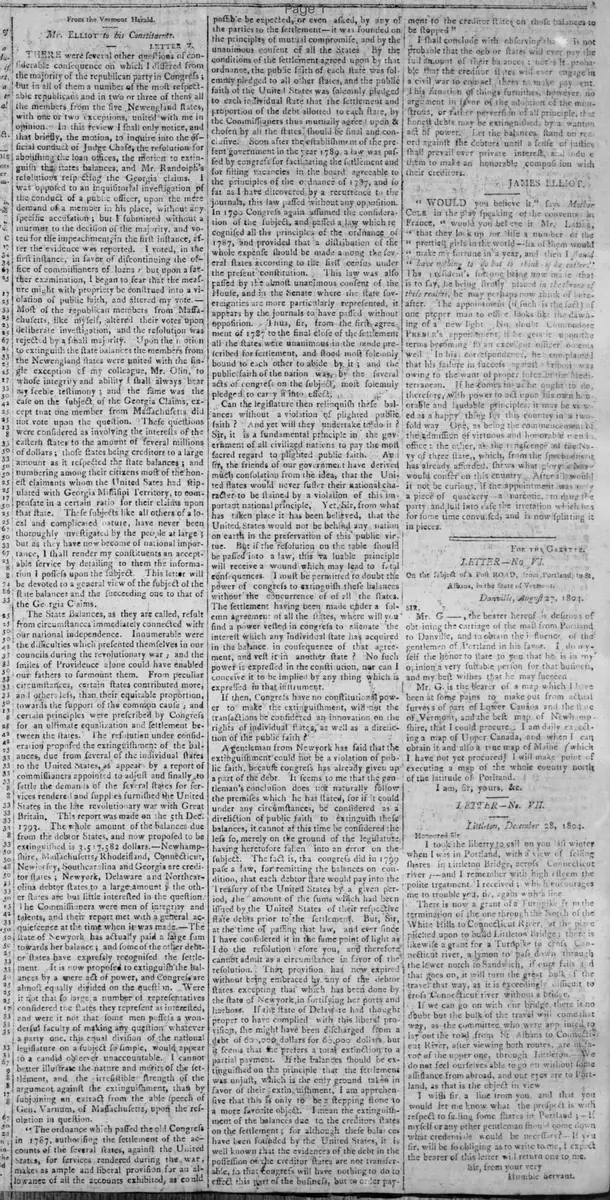
THERE were several other questions of considerable consequence on which I differed from the majority of the republican party in Congress; but in all of them a number of the most respectable republicans and in two or three of them all the members from the five New England states, with one or two exceptions, united with me in opinion. In this review I shall only notice, and that briefly, the motion, to inquire into the judicial conduct of Judge Chase, the resolution for abolishing the loan offices, the motion to extinguish the state balances, and Mr. Randolph's resolutions respecting the Georgia claims. I was opposed to an inquisitorial investigation of the conduct of a public officer, upon the mere demand of a member in his place, without any specific accusation; but I submitted without a murmur to the decision of the majority. and voted for the impeachment, in the first instance, after the evidence was reported. I voted, in the first instance, in favor of discontinuing the office of commissioners of loans: but upon a further examination, I began to fear that the measure might with propriety be construed into a violation of public faith, and altered my vote.
Most of the republican members from Massachusetts, like myself, altered their votes upon deliberate investigation, and the resolution was rejected by a small majority. Upon the motion to extinguish the state balances the members from the New England states were united with the single exception of my colleague, Mr. Olin, to whose integrity and ability I shall always bear my feeble testimony; and the same was the case on the subject of the Georgia Claims, except that one member from Massachusetts did not vote upon the question. These questions were considered as involving the interests of the eastern states to the amount of several millions of dollars; those states being creditors to a large amount as it respected the state balances; and numbering among their citizens most of the honest claimants whom the United States had stipulated with Georgia Mississippi Territory, to compensate in a certain ratio for their claims upon that state. These subjects like all others of a local and complicated nature, have never been thoroughly investigated by the people at large; but as they have now become of national importance, I shall render my constituents an acceptable service by detailing to them the information I possess upon the subject. This letter will be devoted to a general view of the subject of the state balances and the succeeding one to that of the Georgia Claims.
The State Balances, as they are called, result from circumstances immediately connected with our national independence. Innumerable were the difficulties which presented themselves in our councils during the revolutionary war; and the smiles of Providence alone could have enabled our fathers to surmount them. From peculiar circumstances, certain states contributed more. and others less, than their equitable proportion, towards the support of the common cause: and certain principles were prescribed by Congress for an ultimate equalization and settlement between the states. The resolution under consideration proposed the extinguishment of the balances, due from several of the individual states to the United States, as appear by a report of commissioners appointed to adjust and finally to settle the demands of the several states for services rendered and supplies furnished the United States in the late revolutionary war with Great Britain. This report was made on the 5th Dec 1793. The whole amount of the balances due from the debtor States, and now proposed to be extinguished is 3,557,582 dollars.—New Hampshire, Massachusetts, Rhode Island, Connecticut, New Jersey, South Carolina and Georgia are creditor states; New York, Delaware and North Carolina debtor states to a large amount; the other states are but little interested in the question.
The Commissioners were men of integrity and talents, and their report met with a general acquiescence at the time when it was made.—The state of New York has actually paid a large sum towards her balance; and some of the other debtor states have expressly recognised the settlement.
It is now proposed to extinguish the balances by a mere act of power, and Congress almost equally divided on the question. Were it not that so large a number of representatives considered the states they represent as interested. and were it not that some men possess a wonderful faculty of making any question whatever a party one. this equal division of the national legislature on a subject so simple, would appear to a candid observer unaccountable. I cannot better illustrate the nature and merits of the settlement, and the irresistible strength of the argument against the extinguishment, than by subjoining an extract from the able speech of Gen. Varnum, of Massachusetts, upon the resolution in question.
"The ordinance which passed the old Congress in 1787, authorizing the settlement of the accounts of the several states, against the United States, for services rendered during the. war, makes as ample and liberal provision for an allowance of all the accounts exhibited, as could possible be expected, or even asked, by any of the parties to the settlement—it was founded on the principles of mutual compromise. and by the unanimous consent of all the States By the conditions of the settlement agreed upon by that ordinance, the public faith of each state was solemnly pledged to all other states, and the public faith of the United States was solemnly pledged to each individual state that the settlement and proportion of the debt allotted to each state, by the Commissioners thus mutually agreed / upon & chosen by all the states should be final and conclusive. Soon after the establishment of the present government in the year 1789. a law was passed by congress for facilitating the settlement and for filling vacancies in the board agreeable to the principles of the ordinance of 1787, and so far as I have discovered by a recurrence to the journals, this law passed without any opposition.
In 1800 Congress again assumed the consideration of the subject, and passed a law which recognized all the principles of the ordinance of 1787, and provided that a distribution of the whole expense should be made among the several states according to the last census under the present constitution. This law was also passed by the almost unanimous consent of the House, and in the Senate where the state sovereignties are more particularly represented, it appears by the journals to have passed without opposition. Thus, r, from the first agreement of 1787 to the final close of the settlement all the states were unanimous in the mode prescribed for settlement, and stood most solemnly bound to each other to abide by. it ; and the public faith of the nation .was,by the several acts of congress: on the subject, most solemnly pledged to carry it into effect. .
Can the legislature then relinquish these balances without a violation of plighted public faith ? And yet will they undertake to do it ?
Sir, it is a fundamental principle in the government of all civilized nations to pay the most sacred regard to plighted public faith. And from the friends of our government have derived much consolation from the idea, that the United states would never suffer their national character—to be stained by a violation of this important national principle. Yet, Sir, from what has taken place it has been believed, that the United States would not be behind any nation on earth in the preservation of this public virtue. But if the resolution on the table should be passed into a law; this valuable principle will receive a wound which may lead to fatal consequences. I must be permitted to doubt the power of congress to extinguish these balances without'the concurrence of all the states.
The settlement having been made under a solemn agreement: of all the states, where will you find a power vested in congress to alienate the interest which any individual state has acquired in the balance. in consequence of that agreements, and vest it in another state ? No such power is expressed in the constitution, nor can I conceive it to be implied by any thing which is expressed in that instrument.
:i
If then, Congress have no constitutional power to make the extinguishment, will-not the transactions be considered an innovation on the rights of individual states, as well as a direliction of the public faith ?
A gentleman from New York has said that the extinguishment could not be a violation of public faith, because congress has already given up a part of the debt. It seems to me that the gentleman's conclusion does not naturally follow the premises which he has stated, for if it could under any circumstances, be considered as a direliction of public faith to extinguish these balances, it cannot at this time be considered the less so, merely on the ground of the legislature having heretofore fallen into an error on the subject. The fact is, that congress did in 1799 pass a law, for remitting the balances on condition, that each debtor state would pay into the Treasury of the United States by a given period, the amount of the sums which had been issued by the United States of their respective state debts prior to the settlement. But, Sir at the'time of passing that law, and ever since I have considered it in the same point of light as I do the resolution before you, and therefore cannot admit as a circumstance in favor of the resolution.; That provision has now expired without being embraced by. any of the debtor states. excepting that which has been done by the state of New York,in fortifying her ports and harbors. If the state of Delaware had thought proper to have complied with this liberal provision, she might have been discharged from a debt of 60,000.dollars for 65,000 dollars, but it seems that she prefers a total extinction to a partial payment. If the balances should be extinguished on the principle that the settlement was unjust, which is the only ground taken in favor of their extinction, I am apprehensive that this is only to be a stepping stone to a more favorite object. I mean the extinguishment of the balances due to the creditor states on the settlement; for although these balances have been funded by the United States, it is well known that the evidences of the debt in the possession of the creditor states are not transferable, to that congress will have nothing to do to effect this part o the business, but te order payment to the creditor states on those balances to be stopped "
I shall conclude with observing that is not probable that the debtor states will ever pay the full amount of their balances : nor's It probable that the creditor states will ever engage in a civil war to compel , them to make payment.
This situation of things furnishes, however no argument in favor of the adoption of the monstrous. or rather perversion of all principle, that honest debts may be extinguished. by a wanton act of power. Let the balances. stand on record against the debtors until a sense of justice shall prevail over private interest, and induce them to make an honorable composition with their creditors.
JAMES ELLIOT.
What sub-type of article is it?
What themes does it cover?
What keywords are associated?
What entities or persons were involved?
Letter to Editor Details
Author
James Elliot
Recipient
His Constituents
Main Argument
the author opposes the congressional motion to extinguish state balances from the revolutionary war settlements, arguing that it would violate plighted public faith, lack constitutional authority, and undermine national principles of justice and integrity.
Notable Details