Thank you for visiting SNEWPapers!
Sign up free
Herald Of The United States
Warren, Bristol County, Rhode Island
What is this article about?
Proceedings of the U.S. House of Representatives, Ninth Congress, Second Session, from December 15-22, 1806. Key topics include Mr. Elliot's speech on national defense and naval augmentation; debates on prohibiting slave importation after 1807; resolutions for fortifications, coast surveys, and volunteers; and various petitions and bills on infrastructure and expenditures.
Merged-components note: Continuation of congressional proceedings across pages, same topic on national defense and House sessions.
Clippings
1 of 2
OCR Quality
Full Text
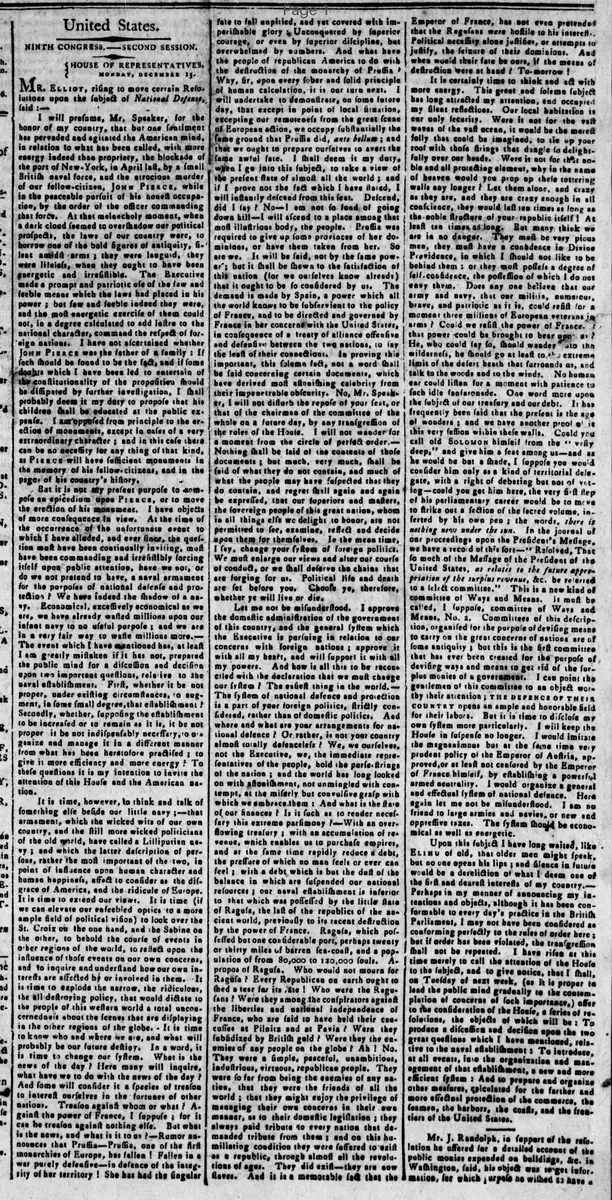
NINTH CONGRESS. SECOND SESSION.
HOUSE OF REPRESENTATIVES
MONDAY, DECEMBER 15.
MR. Elliot, rising to move certain Resolutions upon the subject of National Defence, said:
I will presume, Mr. Speaker, for the honor of my country, that but one sentiment has pervaded and inspired the American mind, in relation to what has been called, with more energy indeed than propriety, the blockade of the port of New-York, in April last, by a small British naval force, and the atrocious murder of our fellow-citizen, John Pierce, while in the peaceable pursuit of his honest occupation, by the order of the officer commanding that force. At that melancholy moment, when a dark cloud seemed to overshadow our political prospects, the laws of our country were, to borrow one of the bold figures of antiquity, silent amidst arms: they were languid: they were listless, when they ought to have been energetic and irresistible. The Executive made prompt and patriotic use of the law and feeble means which the laws had placed in his power; but few and feeble indeed they were, and the most energetic exercise of them could not, in a degree calculated to add lustre to the national character command the respect of foreign nations I have not ascertained whether John Pierce was the father of a family: If such should be found to be the fact and if some doubt which I have been led to entertain of the constitutionality of the proposition should be dissipated by further investigation, I shall probably deem it my duty to propose that his children shall be educated at the public expense. I am opposed from principle to the erection of monuments, except in cases of a very extraordinary character: and in this case there can be no necessity for anything of that kind, as Pierce will have sufficient monuments in the memory of his fellow-citizens, and in the pages of his country's history.
But it is not my present purpose to compose an epicedium upon Pierce, or to move the erection of his monument. I have objects of more consequence in view. At the time of the occurrence of the unfortunate event to which I have alluded, and ever since, the question must have been continually inviting, must have been commanding and irresistibly forcing itself upon public attention, have we not, or do we not pretend to have, a naval armament for the purposes of national defense and protection? We have indeed the shadow of a navy. Economical, excessively economical as we are, we have already wasted millions upon our infant navy to no useful purpose; and we are in a very fair way to waste millions more.-- The event which I have mentioned has, at least I am greatly mistaken if it has not, prepared the public mind for a discussion and decision upon two important questions, relative to the naval establishment. First, whether it be not proper, under existing circumstances, to augment, in some small degree,that establishment t Secondly, whether, supposing the establishment to be increased or to remain as it is, it be not indispensably necessary, to organize and manage it in a different manner from what has been heretofore practised; to give it more efficiency and more energy? To these questions it is my intention to invite the attention of this House and the American nation.
It is time, however, to think and talk of something else beside our little navy ;--that armament, which the wicked wits of our own country, and the still more wicked politicians of the old world, have called a Lilliputian navy; and which the latter description of persons, rather the most important of the two, in point of influence upon human character and human happiness, affect to consider as the disgrace of America, and the ridicule of Europe. It is time to extend our views. It is time (if we can elevate our enfeebled optics to a more ample field of political vision) to look over the St. Croix on the one hand, and the Sabine on the other, to behold the course of events in other regions of the world, to reflect upon the influence of those events on our own concerns, and to inquire and understand how our own interests are affected by or involved in them. -It is time to explode the narrow,the ridiculous,the all destroying policy, that would dictate to the people of this western world a nonchalance. concernedness about the scenes that are displaying in the other regions of the globe. - It is time to know who and where we are, and what will probably be our future destiny. In a word, it is time to change Our System. What is the news of the day? Here many will inquire, what have we to do with the news of the day? And some will consider it a species of treason to interest ourselves in the fortunes of other nations. Treason against whom or what? A- gainst the power of France, I suppose; for it can be treason against nothing else. But what is the news, and what is it to us ?-Rumor an- nounces that Prussia--Prussia, one of the first monarchies of Europe, has fallen! Fallen in a war purely defensive-in defence of the integ- rity of her territory! She has had the glory to fall unpitied. and yet covered with im- perishable glory : Unconquered by superior courage, or even by superior discipline, but overwhelmed by numbers. And what have the people of republican America to do with the destruction of the monarchy of Prussia? Why, sir, upon every sober and solid principle of human calculation,-it is Our turn next. I will undertake to demonstrate, on some future day, that except in point of local situation, excepting our remoteness from the great scene of European action, we occupy substantially the same ground that Prussia did, ante bellum; and that we ought to prepare ourselves to avert the same awful fate. I shall deem it my duty. when I go into this subject, to take a view of the present state of almost all the world; and if I prove not the fact which I have stated, I will instantly descend from this seat. Descend did I say? No--I am not so fond of going down hill-I will ascend to a place among that most illustrious body, the people. Prussia was required to give up some provinces of her do- minions, or have them taken from her. So are we. It will be said, not by the same pow- er': but it shall be shewn to the satisfaction of this nation (for we ourselves know already,) that it ought to be so considered by us. The demand is made by Spain, a power which all the world knows to be subservient to the policy of France, and to be directed and governed by France in her concerns with the United States, in consequence of a treaty of alliance offensive and defensive between the two nations, to say the least of their connections. In proving this important, this solemn fact, not a word shall be said concerning certain documents, which have derived most astonishing celebrity from their impenetrable obscurity. No, Mr. Speak- er, I will not disturb the repose of your seat, or that of the chairman of the committee of the whole on a future day, by any transgression of the rules of the House. I will not wander for a moment from the circle of perfect order.- Nothing shall be said of the contents of those documents : but much, very much, shall be said of what they do not contain, and much of what the people may have supposed that they do contain, and regret shall again and again be expressed, that our superiors and masters, the sovereign people of this great nation, whom in all things else we delight to honor, are not permitted to see, examine, reflect and decide upon them for themselves, In the mean time; I say. change your system of foreign politics. We must enlarge our views and alter our course of conduct, or we shall deserve the chains that are forging for us. Political life and death are set before you. Choose ye, therefore, whether ye will live or die.
Let me not be misunderstood. I approve the domestic administration of the government of this country, and the general System which the Executive is pursuing in relation to our concerns with foreign Nations; approve it with all my heart, and will support it with all my power. And how is all this to be recon- ciled with the declaration that we must change our System? The easiest thing in the world.- The system of national defence and protection is a part of your foreign politics, truly con- sidered, rather than of domestic politics. And where and what are your arrangements for na- tional defence? Or rather, is not your country almost totally defenceless? We, we ourselves, not the Executive, we, the immediate repre- sentatives of the people, hold the purse-strings of the nation; and the world has long looked on with astonishment, not unmingled with con- tempt, at the miserly but convulsive grasp with which we embrace them : And what is the state of our finances? Is it such as to render neces- sary this extreme parsimony ?--With an over- flowing treasury ; with an accumulation of re- venue, which enables us to purchase empires, and at the same time rapidly reduce a debt, the pressure of which no man feels or ever can feel ; with a debt which is but the dust of the balance in which are suspended our national resources ; our naval establishment is inferior to that which was possessed by the little state of Ragusa, the last of the republics of the an- cient world, previously to its recent destruction by the power of France. Ragusa, which pos- sessed but one considerable port, perhaps twenty or thirty miles of barren sea-coast, and a pop- ulation of from 80,000 to 120,000 souls. A- propos of Ragusa. Who would not mourn for Ragusa? Every Republican on earth ought to shed a tear for its fate! Who were the Ragu- sans? Were they among the conspirators against the liberties and national independence of France, who are said to have held their cau- cuses at Pilnitz and at Pavia? Were they subsidized by British gold? Were they the ene- mies of any people on the globe? Ah! No. They were a simple, peaceful, unambitious, industrious, virtuous, republican people. They were so far from being the enemies of any na- tion, that they were the friends of all the world ; that they might enjoy the privilege of managing their own concerns in their own manner, as to their domestic legislation ; they always paid tribute to every nation that de- manded tribute from them : and on this hu- miliating condition they were suffered to exist as a republic, through almost all the revolu- tions of ages. They did exist-they are now slaves.' And is it not memorable fact (that the Emperor of France, has not even pretended that the Ragussans were hostile to his interest.. Political necessity alone justifies, or attempts to justify, the seizure of their dominions. And when would their fate be ours, if the means of destruction were at hand? To-morrow!
It is certainly time to think and act with more energy. This great and solemn subject has long attracted my attention, and occupied my silent reflections. Our local habitation is our only security. Were it not for the vast waves of the vast ocean, it would be the merest folly that could be imagined; to tie up your roof with those strings that dangle delight- fully over our hands. Were it not for that no- ble and all protecting element, why in the name of heaven would you prop up these tottering walls any longer? Let them alone, and crazy as they are, and they are crazy enough in all conscience, they would last ten times as long as the noble structure of your republic itself! At least ten times as long. But many think we are in no danger. They must be very pious men, they must have a confidence in Divine Providence, in which I should not like to be behind them : or they must possess a degree of self-confidence, the possession of which I do not envy them. Does any one believe that our army and navy, that our militia, numerous, brave, and patriotic as it is, could resist for a moment three millions of European veterans in arms? Could we resist the power of France. I that power -could be, brought to bear upon us? He, who could say so, should wander into the wilderness, he should go at least to. the extreme limit of the desert beneath that surrounds us, and talk to the woods and to the winds. No human ear could listen for a moment with patience to such idle gasconade. One word more upon the subject of our treasury and our debt. It has frequently been said that the present is the age of wonders; and we have another proof of it this very session within these walls. Could you call old Solomon himself from the "velly deep," and give him a seat among us-and as he would be but a shade. I suppose you would consider him only as a kind of territorial dele- gate, with a right of debating but not of vot- ing-could you get him here, the very first act of his parliamentary career would be to move to strike out a section of the sacred volume, in- serted by his own pen ; the words, there is nothing new under the sun. In the journal of our proceedings upon the President's Message. we have a record of this order "Resolved, That so much of the Message of the President of the United States, as relates to the future appro- priation of the surplus revenue, &c. be referred to a select committee." This is a new kind of committee of Ways and Means. It must be called, I suppose, committee of Ways and Means, No. 2. Committees of this descrip- tion, organised for the purpose of devising means to carry on the great concerns of nations are of some antiquity ; but this is the first committee that has ever been created for the purpose of deviseing ways and means to get rid of the sur- plus monies of a government. I can point the gentlemen of this committee to an object wor- thy their attention; THE DEFENCE OF THEIR country opens an ample and honorable field for their labors. But it is time to disclose my own views more particularly. I will keep the House in suspense no longer. I would imitate the magnanimous but at the same time very prudent policy of the Emperor of Austria, ap- proved,or at least not censured by the Emperor of France himself, by establishing a powerful armed neutrality. I would organize a general and effectual system of national defence. Here again let me not be misunderstood. I am no friend to large armies and navies. or new and oppressive taxes. The system should be eco- nomical as well as energetic.
Upon this subject I have long waited, like Ezra of old, that older men might speak, but no one opens his lips ; and silence in future would be a dereliction of what I deem one of the first and dearest interests of my country.--- Perhaps in my manner of announcing my in- tentions and objects, although it has been con- formable to every day's practice in the British Parliament, I may not have been considered as conforming perfectly to the rules of order here: but if order has been violated, the transgression shall not be repeated. I have risen at this time merely to call the attention of the House to the subject, and-to give notice, that I shall, on Tuesday of next week, (as it is proper to lead the public mind gradually to the con- templation of concerns of such importance,) offer to the consideration of the House, a series of res- olutions, the objects of which will be : To produce a discussion and decision upon the two great questions which I have mentioned, rela- tive to the naval establishment : To introduce, at all events, into the organization and man- agement of that establishment, a new and more efficient system : And to prepare and organize other measures, calculated for the farther and more effectual protection of the commerce, the seamen, the harbors, the coasts, and the free- holders of the United States.
Mr. J. Randolph, in support of the reso- lution he offered for a detailed account of the public monies expended on buildings, &c. in Washington, said, his object was merely infor- mation, for which purpose he wished to have - Condensed view of the whole expenditures within the city of Washington. At present when an appropriation for a particular object was called for, he posed no standard of comparison whereby to determine its propriety. He wished to know the aggregate amount which this job of increasing expense had cost the nation, together with the several items of expenditure. He desired this information to guide him in judging of the future appropriations that might be asked. Suppose the House should undertake to build a University—he understood there was such a project—and they should have an estimate for it—by knowing what the buildings had cost, the frequent appropriations called for, and recollecting that every appropriation was the last, they would know how to act, and whether they were about to be involved in a sea of expense, the confines of which they could never learn. He believed this had been the case, in the building in which they sat, the conduct of the person employed on it having always fallen short of the promise made.
TUESDAY, DEC. 16.
Several petitions were presented; and several reports made; but on subjects only of local importance.
Mr. Dana called up his resolution on the subject of the survey of the coast, to include George's Bank, or any other shoals or banks, that may be dangerous to vessels approaching the coasts of the United States; which was agreed to.
WEDNESDAY, DEC. 17.
The engrossed bill for a Bridge across the Potomac, passed, Yeas 60, Nays 39.
The Speaker said he had received an anonymous communication, addressed to Congress, the writer professing himself a foreigner; and desiring that his communication might be read with closed doors. After a short conversation, it was agreed to take no notice of it.
SLAVE TRADE.
The bill to prohibit the importation of slaves after Dec. 31, 1807, was taken up in committee of the whole, Mr. Varnum in the chair; debated, and amended; but not finished. The committee rose, and obtained leave to sit again. The bill contains six sections. By it, every person building or using a vessel in the Slave Trade shall forfeit $8000. A vessel, having slaves on board, if found within the waters of the United States, after said 31 Dec. 1807, to be forfeited, with her cargo, and the owner and master to forfeit $10000. All negroes, mulattoes, or persons of color, imported as slaves after said time, become forfeit; and the persons who buy or sell them forfeit $800 for each negro, &c.
In a part of the debate, it was moved, that the slaves forfeited, should be entitled to their freedom. This amendment was supported by Messrs. Sloan, Barker, Bidwell, and Smilie; and opposed by Messrs. Alston, Elmer, Early, Macon, J. Clay, Quincy, and Cook; and disagreed to—Ayes 19.
THURSDAY, DEC. 18.
Mr. Clinton presented a memorial from New-York, praying that measures may be taken more effectually to fortify that port.—Referred to the committee on Fortifications.
The bill for the prohibition of the importation of Slaves, was again taken up, in committee of the whole, and debated.—The committee rose, and asked leave to sit again, which was refused; and the bill was recommitted to a select committee for amendment.
Mr. Dawson, from a committee, reported a bill, providing for the punishment of certain crimes against the United States, which was read, as usual.
Mr. J. Randolph, from a committee, reported two Resolutions; one, setting, That provision ought to be made to fortify and defend such portion of the Mississippi, below New Orleans, as the President shall designate for the protection at that city: and that further provision ought to be made by law for guarding the approaches to the same from the east.—The other authorizing the President to accept of any volunteers (not exceeding one thousand) who shall offer their services, to be clothed and furnished with horses, at their own expense, and armed at the expense of the United States, &c. While in service, to receive the same pay, rations, forage and allowance for clothing with the regular troops of the United States. Referred to the committee of the whole, for to-morrow.
Petitions from New-Bedford, and Martha's Vineyard, praying for a light-house in Taupaulin Cove, were referred to the proper committee.
The committee of Commerce, &c. on motion of Mr. Crowninshield, were instructed to report on the expediency of providing for the erection of buoys and beacons in Salem harbor.
FRIDAY, DEC. 19.
The Slave Trade prohibitory bill was again reported amended.—One amendment provides the punishment of Death for being concerned in the importation of Slaves; and that in those States where Slavery is permitted, all imported Slaves shall be forfeited.
The Committee of Commerce, was instructed to report on the expediency of reducing the duties on foreign refined Sugar, and sugar candy.
An order passed, for an account to be exhibited of the amount of the Land Tax.
A petition from collectors of revenue, in Maine, praying an augmentation of compensation, was committed.
Some private bills, petitions, &c. were acted upon.
MONDAY, DEC. 22.
A favorable report on the petition of George Little, was made, and selected for to-morrow.
What sub-type of article is it?
What keywords are associated?
What entities or persons were involved?
Where did it happen?
Domestic News Details
Primary Location
Washington
Event Date
December 15 22, 1806
Key Persons
Event Details
Proceedings include Mr. Elliot's speech advocating for naval augmentation and national defense reforms in response to British blockade and murder of John Pierce; discussions on foreign policy implications from European events; Mr. Randolph's call for detailed Washington expenditures; passage of Potomac bridge bill; debates and amendments to slave trade prohibition bill post-1807 with forfeitures and penalties; resolutions for coast surveys, fortifications in New York and Mississippi, volunteers; petitions for lighthouses, buoys, revenue compensation; reports on crimes bill and George Little's petition.