Thank you for visiting SNEWPapers!
Sign up free
The Enquirer
Richmond, Henrico County, Virginia
What is this article about?
This editorial discusses recent European military developments in the Napoleonic Wars, including Russian advances, French reinforcements, Jerome Bonaparte's occupation of Breslau, and the Russian declaration of war on the Ottoman Porte. It critiques Napoleon's Berlin Decree blockading British Isles, warning of threats to neutral trade. It reflects on Poland's potential revival, historical partitions, and the role of virtue in national prosperity, contrasting with American stability.
Clipping
OCR Quality
Full Text
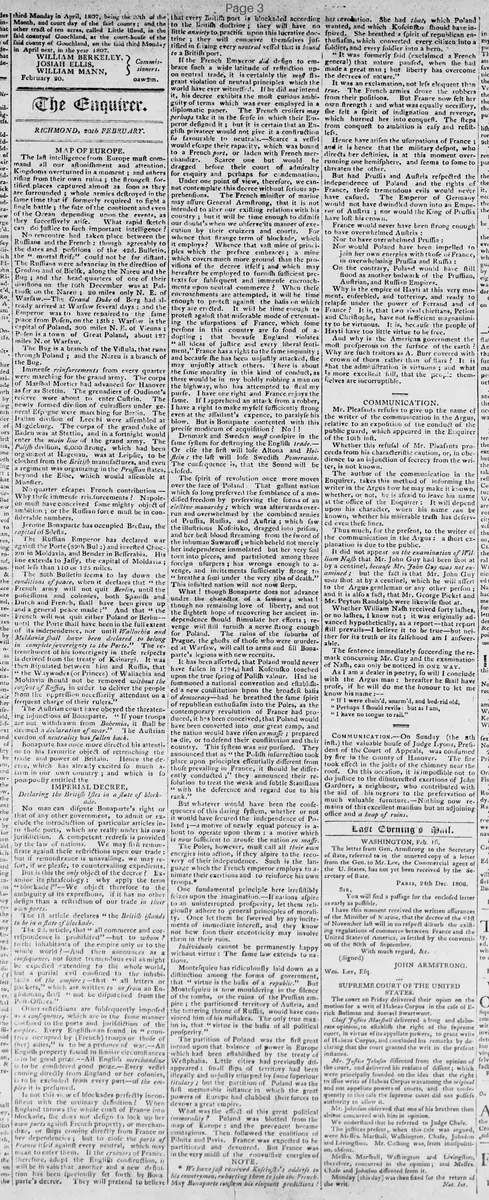
RICHMOND, 20th FEBRUARY.
MAP OF EUROPE.
The last intelligence from Europe must command all our astonishment and attention. Kingdoms overturned in a moment: and others rising from their own ruins; the strongest fortified places captured almost as soon as they are surrounded; whole armies destroyed in the same time that it formerly required to fight a single battle; the fate of the continent and even of the ocean depending upon the events, as they successively arise.
What rapid sketch can do justice to such important intelligence?
No rencontre had taken place between the Russians and the French: though agreeably to the dates and positions of the 42d. Bulletin, the "mortal strife" could not be far distant. The Russians were advancing in the direction of Grodno and of Bielsk, along the Narew and the Bug; and the head-quarters of one of their divisions on the 10th December was at Paltauk on the Narew; 20 miles only N. E. of Warsaw.--The Grand Duke of Berg had already arrived at Warsaw several days; and the Emperor was to have repaired to the same place from Posen, on the 15th: Warsaw is the capital of Poland, 300 miles N. E. of Vienna: Posen is a town of Great Poland, about 127 miles N. of Warsaw. The Bug is a branch of the Vistula, that runs through Poland; and the Narew is a branch of the Bug.
Immense reinforcements from every quarter were marching for the grand army. The corps of Marshal Mortier had advanced for Hanover as far as Stettin. The grenadiers of Oudinot's reserve were about to enter Custrin. The newly formed division of cuirassiers under general Espaigne were marching for Berlin. The Italian division of Lecchi were assembled at Magdeburg. The corps of the grand duke of Baden was at Stettin, and in a fortnight would enter the main line of the grand army. The Polish division, 6000 strong, which had been organized at Hagenau, was at Leipsic, to be clothed from the British manufactures, and even a regiment was organizing in the Prussian states, beyond the Elbe, which would assemble at Munster.
No quarter escapes French contribution--Why these immense reinforcements? Napoleon must have conceived some mighty object of ambition; or the Russian force must be in considerable numbers.
Jerome Bonaparte has occupied Breslau, the capital of Silesia.
The Russian Emperor has declared war against the Porte (29th Bul:) and invested Choczin in Moldavia, and Bender in Bessarabia. His line extends to Jassy, the capital of Moldavia; not less than 110 or 125 miles.
The 50th Bulletin seems to lay down the conditions of peace, when it declares that "the French army will not quit Berlin, until the possessions and colonies, both Spanish and Dutch and French, shall have been given up and a general peace made:" And that "the French will not quit either Poland or Berlin--until the Porte shall have been in the fullest extent of its independence, nor until Wallachia and Moldavia shall have been declared to belong in complete sovereignty to the Porte." The retrenchment of his sovereignty in these respects is derived from the treaty of Kainardji. It was then stipulated between him and Russia, that "the Waywodes (or Princes) of Wallachia and Moldavia should not be removed without the consent of Russia, in order to deliver the people from the oppression necessarily attendant on a frequent change of their rulers."
The Austrian court have obeyed the threatening injunctions of Bonaparte. "If your troops are not withdrawn from Bohemia, it shall be deemed a declaration of war." The Austrian cordon of neutrality has fallen back.
Bonaparte has once more directed his attention to his favourite object of retrenching the trade and power of Britain. Hence the decree, which has already excited so much alarm in our own country; and which is so pompously entitled the
IMPERIAL DECREE,
Declaring the British Isles in a state of blockade.
No man can dispute Bonaparte's right or that of any other government, to admit or exclude the introduction of particular articles into those ports, which are really under his own jurisdiction. A competent redress is provided by the law of nations. We may first remonstrate against these restrictions upon our trade: but if remonstrance is unavailing, we may resort, if we please, to countervailing expedients. But is this the only object of the decree? Examine its phraseology: why apply the term "blockade?"--We object therefore to the ambiguity of its expressions, if it has no other design than a restriction of our trade in their own ports.
The 1st article declares "the British islands to be in a state of blockade. The 2d. article, that "all commerce and correspondence is prohibited"-but to whom? to the inhabitants of the empire only or to the whole world?-And then announces as a consequence, not some tremendous evil as might be expected extending to the whole world, but a partial evil confined to the inhabitants of the empire;-that "all letters or packets," which are written to or from an Englishman, shall "not be dispatched from the Post-Offices."
Other restrictions are subsequently imposed as a consequence, which are in the same manner confined to the ports and jurisdiction of the empire. Every Englishman found in "countries occupied by (French) troops or those of (her) allies," is to be a prisoner of war.--Ah English property found in similar circumstances, to be good prize.--All English merchandize is to be considered good prize.-Every vessel coming directly from England or her colonies, i. to be excluded from every port of the empire it is presumed.
Is not this view of blockades perfectly inconsistent with the ordinary definition? When England throws the whole coast of France into blockade, she does not design to lock up her own ports against French property, or merchandize, or ships coming directly from France or her dependencies; but to close the ports of France itself against every neutral, which may mean to enter them. If the cruizers of France. therefore, adopt the English construction, it will be in vain that another and a new definition has been speciously set forth by Bonaparte's decree. They will pretend to believe that every British port is blockaded according to the British doctrine; they will have no little anxiety to practise upon this lucrative doctrine; they will conceive themselves justified in seizing every neutral vessel that is bound to a British port.
If the French Emperor did design to embrace such a wide latitude of restriction upon neutral trade, it is certainly the most flagrant violation of neutral principles which the world have ever witnessed. If he did not intend it, his decree exhibits the most curious ambiguity of terms which was ever employed in a diplomatic paper. The French cruizers may perhaps take it in the sense in which their Emperor designed it: but it is certain that an English privateer would not give it a construction so favourable to neutrals. -Scarce a vessel would escape their rapacity, which was bound to a French port, or laden with French merchandize. Scarce one but would be dragged before their court of admiralty for enquiry and perhaps for condemnation.
Under one point of view, therefore, we cannot contemplate this decree without serious apprehensions. The French minister of marine may assure General Armstrong, that it is not intended to alter our existing relations with his country; but it will be time enough to dismiss our doubts when we observe its manner of execution by their cruizers and courts. For whence that strange term of blockade, which it employs? Whence that vast mine of principles which the preface embraces; a mine which covers much more ground than the provisions of the decree itself; and which may hereafter be employed to furnish sufficient pretexts for subsequent and immense encroachments upon neutral commerce? When these encroachments are attempted, it will be time enough to protest against the basis on which they are erected. It will be time enough to protest against that miserable mode of extenuating the usurpations of France, which some persons in this country are so fond of adopting: that because England violates "all ideas of justice and every liberal sentiment," France has a right to the same impunity; and because she has been unjustly attacked, she may unjustly attack others. There is about the same morality in this kind of conduct, as there would be in my boldly robbing a man on the highway, who has attempted to steal my purse. I have one right and France enjoys the same. If I apprehend an attack from a robber, I have a right to make myself sufficiently strong even at the assailant's expense, to paralyse his blow. But is Bonaparte contented with this precise modicum of acquisition? No!! Denmark and Sweden must conspire in the same system for destroying the English trade.-Or else the first will lose Altona and Holstein: the last will lose Swedish Pomerania. The consequence is, that the Sound will be closed.
The spirit of revolution once more moves over the face of Poland. That gallant nation which so long preserved the semblance of a modified freedom by preserving the forms of an elective monarchy: which was afterwards overrun and overwhelmed by the combined armies of Prussia, Russia, and Austria; which saw the illustrious Kosciuszko, dragged into prison. and her best blood streaming from the sword of the inhuman Suwarrow; which beheld not merely her independence immolated but her very soil torn into pieces, and partitioned among three foreign usurpers; has wrongs enough to avenge, and incitements sufficiently strong to "breathe a soul under the very ribs of death." This insulted nation will not now sleep. What! though Bonaparte does not advance under the character of a saviour: what! though no remaining love of liberty, and not the slightest hope of recovering her ancient independence should stimulate her efforts: revenge will still furnish a nerve strong enough for Poland. The ruins of the suburbs of Prague, the ghosts of those who were murdered at Warsaw, will call to arms and fill Bonaparte's legions with new recruits.
It has been asserted, that Poland would never have fallen in 1794, had Kosciuszko touched upon the true spring of Polish valour. Had he summoned a national convention and established a new constitution upon the broadest basis of democracy—had he breathed the same spirit of republican enthusiasm into the Poles, as the contemporary revolution of France had produced, it has been conceived, that Poland would have been converted into one great camp, and the nation would have risen en masse; prepared to die, or to defend their constitution and their country. This system was not pursued. They announced that as "the Polish insurrection took place upon principles essentially different from those prevailing in France, it should be differently conducted;" they announced their resolution to treat the weak and subtle Stanislaus "with the deference and regard due to his rank."
But whatever would have been the consequences of this daring system, whether or not it would have secured the independence of Poland;-a motive of nearly equal potency is about to operate upon them: a motive which is now sufficient to arouse the nation en masse. The Poles, however, must call all their own energies into action, if they aspire to the recovery of their independence. Such is the language which the French emperor employs to animate their exertions and to reinforce his own troops.
One fundamental principle here irresistibly seizes upon the imagination.-If nations aspire to an uninterrupted prosperity, let them religiously adhere to general principles of morality. Once let them be swerved by any incitements of immediate interest, and they know not how soon their eccentricity may involve them in their ruin.
Individuals cannot be permanently happy without virtue: The same law extends to nations.
Montesquieu has ridiculously laid down as a distinction among the forms of government, that "virtue is the basis of a republic." But Montesquieu is now mouldering "in the silence of the tombs, or the ruins of the Prussian empire; the partitioned territory of Austria, and the tottering throne of Russia, would have convinced him of his mistakes. The only true maxim is, that "virtue is the basis of all political prosperity."
The partition of Poland was the first great inroad upon that balance of power in Europe which had been established by the treaty of Westphalia. Little cities had previously disappeared: small slips of territory had been illegally and unjustly usurped by some superior titulary; but the partition of Poland was the first memorable instance in which the great powers of Europe had clubbed their forces to devour a great empire.
What was the effect of this great political immorality? Poland was blotted from the map of Europe: and the precedent became contagious. Then followed the coalitions of Pilnitz and Pavia. France was expected to be partitioned and devoured. But France was in the very midst of the convulsive energies of her revolution. She had that which Poland wanted, and which Kosciuszko should have inspired. She breathed a spirit of republican enthusiasm, which converted every citizen into a soldier, and every soldier into a hero.
"It was formerly said (exclaimed a French general) that nature paused, when she had made a great man; but liberty has overcome the decrees of nature."
It was an exclamation, not less eloquent than true. The French armies drove the robbers from their possessions. But France now felt her own strength: and what was equally necessary. she felt a spirit of indignation and revenge, which hurried her into conquest. The step from conquest to ambition is easy and resistless.
Hence have arisen the usurpations of France; and it is hence that the military despot, who directs her destinies, is at this moment overrunning one hemisphere, and seems to some to threaten the other.
But had Prussia and Austria respected the independence of Poland and the rights of France, these tremendous evils would never have ensued. The Emperor of Germany would not have dwindled down into an Emperor of Austria; nor would the King of Prussia have lost his crown.
France would never have been strong enough to have overwhelmed Austria:
Nor to have overwhelmed Prussia:
Nor would Poland have been impelled to join her own energies with those of France, in overwhelming Prussia and Russia:
On the contrary, Poland would have still stood as another bulwark of the Prussian, Austrian, and Russian Empires.
Why is the empire of Hayti at this very moment, enfeebled, and tottering, and ready to relapse under the power of Ferrand and of France? It is. that two rival chieftains. Petion and Christophe, have not sufficient magnanimity to be virtuous. It is, because the people of Hayti have too little virtue to be free.
And why is the American government the most prosperous on the surface of the earth? Why are such traitors as A. Burr covered with crowns of thorn rather than of laurels? It is that the administration is virtuous; and what is more excellent still, that the people themselves are incorruptible.
NOTE.
* We have just received Kosciuszko's address to his countrymen, exhorting them to join the French. May Bonaparte confirm his eloquent predictions!
What sub-type of article is it?
What keywords are associated?
What entities or persons were involved?
Editorial Details
Primary Topic
Napoleonic Campaigns In Europe, Berlin Decree Blockade, And Polish Revival
Stance / Tone
Critical Of Napoleon's Ambitions And Ambiguities In Blockade Decree; Moralistic On Virtue's Role In National Stability; Hopeful For Polish Resistance
Key Figures
Key Arguments