Thank you for visiting SNEWPapers!
Sign up free
New Hampshire Statesman
Concord, Merrimack County, New Hampshire
What is this article about?
Account of the 1824 trial and conviction of Thomas Jones for the murder of Captain Samuel Brown, his mate Henry Dulett, and passenger Captain Humphreys aboard the brig Holkar in late 1818, following a crew conspiracy after a quarrel in Curacao. Witness Oliver King testified against him.
Clipping
OCR Quality
Full Text
April 27.
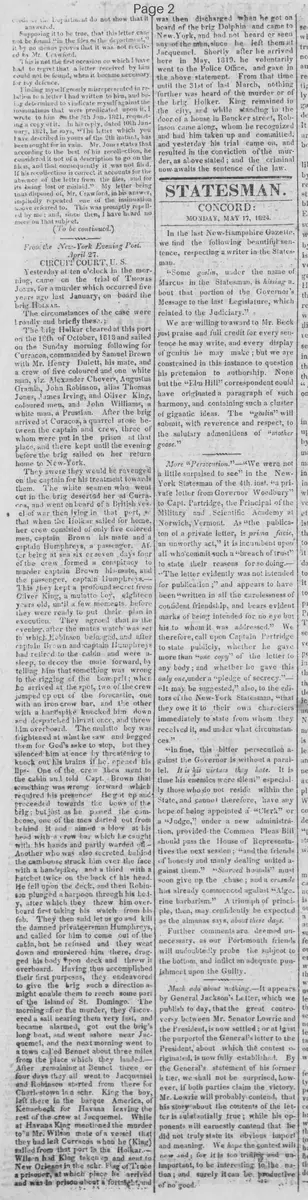
CIRCUIT COURT, U. S.
Yesterday at ten o'clock in the morning, came on the trial of Thomas Jones, for a murder which occurred five years ago last January, on board the brig HOLKAR.
The circumstances of the case were broadly and briefly these.
The brig Holkar cleared at this port on the 18th of October, 1818, and sailed on the Sunday morning following for Curacoa, commanded by Samuel Brown with Mr. Henry Dulett, his mate, and a crew of five coloured and one white man, viz. Alexander Chevers, Augustus Gramin, John Robinson, alias Thomas Jones, James Irving, and Oliver King, coloured men, and John Williams, a white man, a Prussian. After the brig arrived at Curacoa, a quarrel arose between the captain and crew, three of whom were put in the prison at that place, and there kept until the evening before the brig sailed on her return home to New-York.
They swore they would be revenged on the captain for his treatment towards them. The white seamen who went out in the brig deserted her at Curacoa, and went onboard of a British vessel of war then lying in that port, so that when the Holkar sailed for home, her crew consisted of only five colored men, captain Brown, his mate and a captain Humphreys, a passenger. After being at sea six or seven days four of the crew formed a conspiracy to murder captain Brown his mate, and the passenger, captain Humphreys.
This they kept a profound secret from Oliver King, a mulatto boy, eighteen years old, until a few moments before they were ready to put their plan in execution. They agreed that in the evening, after the mate's watch was set to which Robinson belonged, and after captain Brown and captain Humphreys had retired to the cabin and were asleep, to decoy the mate forward, by telling him that something was wrong in the rigging of the bowsprit; when he arrived at the spot, two of the crew jumped up out of the forecastle, one with an iron crow bar, and the other with a handspike knocked him down and despatched him at once, and threw him overboard. The mulatto boy was frightened at what he saw and begged them for God's sake to stop, but they silenced him at once by threatening to knock out his brains if he opened his lips. One of the crew then went to the cabin and told Capt. Brown that something was wrong forward which required his presence. He got up and proceeded towards the bows of the brig; but just as he passed the camboose, one of the men darted out from behind it and aimed a blow at his head with a crow bar which he caught with his hands and partly warded off. Another who was also secreted behind the camboose struck him over the face with a handspike, and a third with a hatchet twice on the back of his head.
He fell upon the deck, and then Robinson plunged a harpoon through his body, after which they threw him overboard first taking his watch from his fob. They then said let us go and kill the damned privateersman Humphreys, and called on him to come out of the cabin, but he refused and they went down and murdered him there, dragged his body on deck and threw it overboard. Having thus accomplished their first purposes, they endeavored to give the brig such a direction as might enable them to reach some part of the Island of St. Domingo. The morning after the murder, they discovered a sail nearing them very fast, and became alarmed, got out the brig's long boat, and went ashore near Jacquemel, and the next morning went to a town called Bennet about three miles from the place which they landed.
After remaining at Bennet three or four days they all went to Jacquemel and Robinson started from there for Charlestown in a schr. King the boy, left there in the barque America, of Kennebeck for Havana leaving the rest of the crew at Jacquemel. While at Havana King mentioned the murder to a Mr. Wilson mate of a vessel that they had left Curacoa when he (King) sailed from that port in the Holkar.
Wilson had King taken up and sent to New Orleans in the schr. Flag of Truce a prisoner, at which place he arrived and was in prison about a fortnight, and was then discharged when he got on board of the brig Dolphin and came to New York, and had not heard or seen any of the men, since he left them at Jacquemel. Shortly after he arrived here in May, 1819, he voluntarily went to the Police Office, and gave in the above statement. From that time until the 31st of last March, nothing further was heard of the murder or of the brig Holkar. King remained in the city, and while standing in the door of a house in Bancker street, Robinson came along, whom he recognized and had him taken up and committed. And yesterday his trial came on, and resulted in the conviction of the murder, as above stated; and the criminal now awaits the sentence of the law.
What sub-type of article is it?
What themes does it cover?
What keywords are associated?
What entities or persons were involved?
Where did it happen?
Story Details
Key Persons
Location
On Board The Brig Holkar At Sea, Curacoa, Jacquemel, St. Domingo, New York
Event Date
Five Years Ago Last January, Brig Cleared October 18, 1818
Story Details
Crew of brig Holkar, after quarrel in Curacao, conspired to murder Captain Brown, mate Dulett, and passenger Humphreys at sea in late 1818. They killed them with weapons and threw bodies overboard. Witness Oliver King later reported the crime, leading to the 1824 trial and conviction of Thomas Jones (alias Robinson) in New York.