Thank you for visiting SNEWPapers!
Sign up free
Story
August 12, 1841
Martinsburg Gazette
Martinsburg, Berkeley County, West Virginia
What is this article about?
Report on successful experiments with an atmospheric railway invention by Clegg and Samuda, propelling carriages via atmospheric pressure in a pipe using a stationary engine, achieving speeds up to 25.7 mph; advantages include lighter rails and no locomotive weight.
Clipping
OCR Quality
98%
Excellent
Full Text
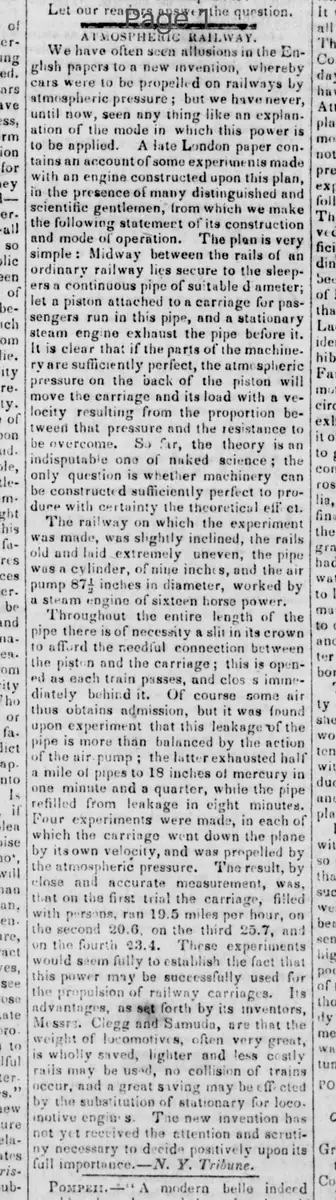
ATMOSPHERIC RAILWAY.
We have often seen allusions in the English papers to a new invention, whereby cars were to be propelled on railways by atmospheric pressure; but we have never, until now, seen any thing like an explanation of the mode in which this power is to be applied. A late London paper contains an account of some experiments made with an engine constructed upon this plan, in the presence of many distinguished and scientific gentlemen, from which we make the following statement of its construction and mode of operation. The plan is very simple: Midway between the rails of an ordinary railway lies secure to the sleepers a continuous pipe of suitable diameter; let a piston attached to a carriage for passengers run in this pipe, and a stationary steam engine exhaust the pipe before it. It is clear that if the parts of the machinery are sufficiently perfect, the atmospheric pressure on the back of the piston will move the carriage and its load with a velocity resulting from the proportion between that pressure and the resistance to be overcome. So far, the theory is an indisputable one of naked science; the only question is whether machinery can be constructed sufficiently perfect to produce with certainty the theoretical effect.
The railway on which the experiment was made, was slightly inclined, the rails old and laid extremely uneven, the pipe was a cylinder, of nine inches, and the air pump 8 1/2 inches in diameter, worked by a steam engine of sixteen horse power. Throughout the entire length of the pipe there is of necessity a slit in its crown to afford the needful connection between the piston and the carriage; this is opened as each train passes, and closed immediately behind it. Of course some air thus obtains admission, but it was found upon experiment that this leakage of the pipe is more than balanced by the action of the air pump; the latter exhausted half a mile of pipe to 18 inches of mercury in one minute and a quarter, while the pipe refilled from leakage in eight minutes.
Four experiments were made, in each of which the carriage went down the plane by its own velocity, and was propelled by the atmospheric pressure. The result, by close and accurate measurement, was, that on the first trial the carriage, filled with persons, ran 19.5 miles per hour, on the second 20.6, on the third 25.7, and on the fourth 23.4. These experiments would seem fully to establish the fact that this power may be successfully used for the propulsion of railway carriages. Its advantages, as set forth by its inventors, Messrs. Clegg and Samuda, are that the weight of locomotives, often very great, is wholly saved, lighter and less costly rails may be used, no collision of trains occur, and a great saving may be effected by the substitution of stationary for locomotive engines. The new invention has not yet received the attention and scrutiny necessary to decide positively upon its full importance.—N. Y. Tribune.
We have often seen allusions in the English papers to a new invention, whereby cars were to be propelled on railways by atmospheric pressure; but we have never, until now, seen any thing like an explanation of the mode in which this power is to be applied. A late London paper contains an account of some experiments made with an engine constructed upon this plan, in the presence of many distinguished and scientific gentlemen, from which we make the following statement of its construction and mode of operation. The plan is very simple: Midway between the rails of an ordinary railway lies secure to the sleepers a continuous pipe of suitable diameter; let a piston attached to a carriage for passengers run in this pipe, and a stationary steam engine exhaust the pipe before it. It is clear that if the parts of the machinery are sufficiently perfect, the atmospheric pressure on the back of the piston will move the carriage and its load with a velocity resulting from the proportion between that pressure and the resistance to be overcome. So far, the theory is an indisputable one of naked science; the only question is whether machinery can be constructed sufficiently perfect to produce with certainty the theoretical effect.
The railway on which the experiment was made, was slightly inclined, the rails old and laid extremely uneven, the pipe was a cylinder, of nine inches, and the air pump 8 1/2 inches in diameter, worked by a steam engine of sixteen horse power. Throughout the entire length of the pipe there is of necessity a slit in its crown to afford the needful connection between the piston and the carriage; this is opened as each train passes, and closed immediately behind it. Of course some air thus obtains admission, but it was found upon experiment that this leakage of the pipe is more than balanced by the action of the air pump; the latter exhausted half a mile of pipe to 18 inches of mercury in one minute and a quarter, while the pipe refilled from leakage in eight minutes.
Four experiments were made, in each of which the carriage went down the plane by its own velocity, and was propelled by the atmospheric pressure. The result, by close and accurate measurement, was, that on the first trial the carriage, filled with persons, ran 19.5 miles per hour, on the second 20.6, on the third 25.7, and on the fourth 23.4. These experiments would seem fully to establish the fact that this power may be successfully used for the propulsion of railway carriages. Its advantages, as set forth by its inventors, Messrs. Clegg and Samuda, are that the weight of locomotives, often very great, is wholly saved, lighter and less costly rails may be used, no collision of trains occur, and a great saving may be effected by the substitution of stationary for locomotive engines. The new invention has not yet received the attention and scrutiny necessary to decide positively upon its full importance.—N. Y. Tribune.
What sub-type of article is it?
Curiosity
Historical Event
What themes does it cover?
Triumph
What keywords are associated?
Atmospheric Railway
Invention
Experiments
Steam Engine
Propulsion
Atmospheric Pressure
What entities or persons were involved?
Messrs. Clegg
Samuda
Story Details
Key Persons
Messrs. Clegg
Samuda
Story Details
Experiments with an atmospheric railway system, using a piston in a pipe exhausted by a stationary steam engine, propelled a carriage at speeds of 19.5 to 25.7 miles per hour down an inclined plane, demonstrating the viability of atmospheric pressure for railway propulsion.