Thank you for visiting SNEWPapers!
Sign up free
Editorial
October 12, 1934
The Wrangell Sentinel
Wrangell, Alaska
What is this article about?
Editorial defends newspapers' role in the Lindbergh kidnapping case, refuting early accusations of interference. It highlights press cooperation with police and family, including suppressing information and publishing fake news to mislead the kidnapper, and notes authorities crediting the press for aiding the investigation's solution.
Clipping
OCR Quality
98%
Excellent
Full Text
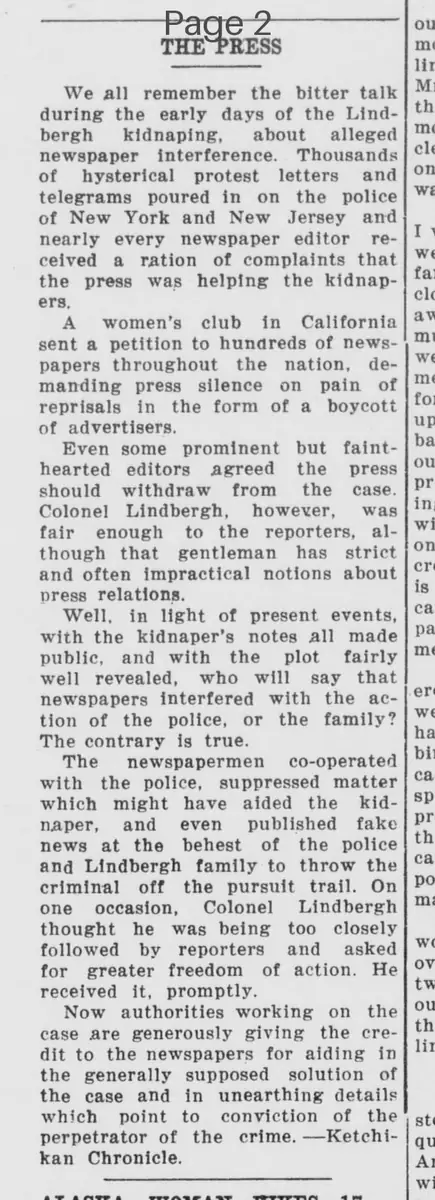
THE PRESS
We all remember the bitter talk during the early days of the Lindbergh kidnaping, about alleged newspaper interference. Thousands of hysterical protest letters and telegrams poured in on the police of New York and New Jersey and nearly every newspaper editor received a ration of complaints that the press was helping the kidnappers.
A women's club in California sent a petition to hundreds of newspapers throughout the nation, demanding press silence on pain of reprisals in the form of a boycott of advertisers.
Even some prominent but faint-hearted editors agreed the press should withdraw from the case.
Colonel Lindbergh, however, was fair enough to the reporters, although that gentleman has strict and often impractical notions about press relations.
Well, in light of present events, with the kidnaper's notes all made public, and with the plot fairly well revealed, who will say that newspapers interfered with the action of the police, or the family?
The contrary is true.
The newspapermen co-operated with the police, suppressed matter which might have aided the kidnaper, and even published fake news at the behest of the police and Lindbergh family to throw the criminal off the pursuit trail.
On one occasion, Colonel Lindbergh thought he was being too closely followed by reporters and asked for greater freedom of action. He received it, promptly.
Now authorities working on the case are generously giving the credit to the newspapers for aiding in the generally supposed solution of the case and in unearthing details which point to conviction of the perpetrator of the crime. -Ketchikan Chronicle.
We all remember the bitter talk during the early days of the Lindbergh kidnaping, about alleged newspaper interference. Thousands of hysterical protest letters and telegrams poured in on the police of New York and New Jersey and nearly every newspaper editor received a ration of complaints that the press was helping the kidnappers.
A women's club in California sent a petition to hundreds of newspapers throughout the nation, demanding press silence on pain of reprisals in the form of a boycott of advertisers.
Even some prominent but faint-hearted editors agreed the press should withdraw from the case.
Colonel Lindbergh, however, was fair enough to the reporters, although that gentleman has strict and often impractical notions about press relations.
Well, in light of present events, with the kidnaper's notes all made public, and with the plot fairly well revealed, who will say that newspapers interfered with the action of the police, or the family?
The contrary is true.
The newspapermen co-operated with the police, suppressed matter which might have aided the kidnaper, and even published fake news at the behest of the police and Lindbergh family to throw the criminal off the pursuit trail.
On one occasion, Colonel Lindbergh thought he was being too closely followed by reporters and asked for greater freedom of action. He received it, promptly.
Now authorities working on the case are generously giving the credit to the newspapers for aiding in the generally supposed solution of the case and in unearthing details which point to conviction of the perpetrator of the crime. -Ketchikan Chronicle.
What sub-type of article is it?
Press Freedom
Crime Or Punishment
What keywords are associated?
Lindbergh Kidnapping
Press Interference
Newspaper Cooperation
Crime Investigation
Kidnapper Notes
What entities or persons were involved?
Newspapers
Police Of New York And New Jersey
Colonel Lindbergh
Lindbergh Family
Kidnapper
Ketchikan Chronicle
Editorial Details
Primary Topic
Defense Of Press Role In Lindbergh Kidnapping
Stance / Tone
Supportive Of Press Cooperation
Key Figures
Newspapers
Police Of New York And New Jersey
Colonel Lindbergh
Lindbergh Family
Kidnapper
Ketchikan Chronicle
Key Arguments
- early accusations of press interference were unfounded
- press received complaints and boycott threats but cooperated
- newspapers suppressed information that could aid the kidnapper
- published fake news at police and family's request to mislead criminal
- authorities credit newspapers for aiding case solution and conviction