Thank you for visiting SNEWPapers!
Sign up free
Story
June 2, 1865
The Weekly Pioneer And Democrat
Saint Paul, Ramsey County, Minnesota
What is this article about?
Chief Justice Chase delivers a speech in Charleston at Zion Church to thousands of freed Black people and whites, advocating emancipation, Black military service, suffrage, hard work, and patience for rights post-Civil War.
Clipping
OCR Quality
98%
Excellent
Full Text
FROM SOUTH CAROLINA.
Speech of Justice Chase at Charleston.
His Views on the Federal Relations of Seceded States and Negro Suffrage.
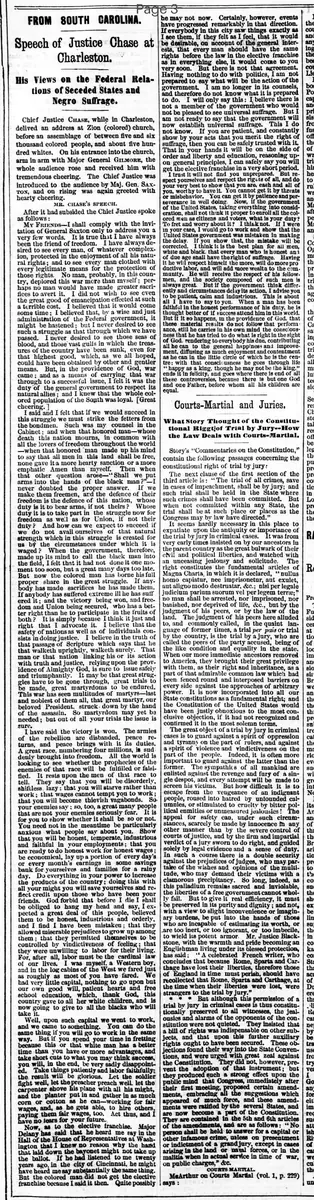
Chief Justice Chase, while in Charleston, delivered an address at Zion (colored) church, before an assemblage of between five and six thousand colored people, and about five hundred whites. On his entrance into the church, arm in arm with Major General Gilmore, the whole audience rose and received him with tremendous cheering. The Chief Justice was introduced to the audience by Maj. Gen. Saxton, and on rising was again greeted with hearty cheering.
MR. CHASE'S SPEECH.
After it had subsided the Chief Justice spoke as follows:
My Friends—I shall comply with the invitation of General Saxton only to address you a very few words. It is true that I have always been the friend of freedom. I have always desired to see every man, of whatever complexion, protected in the enjoyment of all his natural rights; and to see every man clothed with every legitimate means for the protection of those rights. No man, probably, in this country, deplored this war more than myself; perhaps no man would have made greater sacrifices to avert it. I did not wish to see even the great good of emancipation effected at such a terrible cost. I believed that it would come some time; I believed that, by a wise and just administration of the Federal government, it might be hastened; but I never desired to see such a struggle as that through which we have passed. I never desired to see those seas of blood, and those vast gulfs in which the treasures of the country have been sunk, even for that highest good, which, as we all hoped, could have been obtained by other and gentler means. But, in the providence of God, war came; and as a means of carrying that war through to a successful issue, I felt it was the duty of the general government to respect its natural allies: and I knew that the whole colored population of the South was loyal. [Great cheering.]
I said and I felt that if we would succeed in this struggle we must strike the fetters from the bondmen. Such was my counsel in the Cabinet; and when that honored man—whose death this nation mourns, in common with all the lovers of freedom throughout the world—when that honored man made up his mind to say that all men in this land shall be free, none gave it a more hearty sanction or a more emphatic Amen than myself. Then when that other question arose—'Shall we put arms into the hands of the black man?' I never doubted the proper answer. If we make them freemen, and the defence of their freedom is the defence of this nation, whose duty is it to bear arms, if not theirs? Whose duty it is to take part in the struggle now for freedom as well as for Union, if not their duty? And how can we expect to succeed if we do not avail ourselves of that natural strength which in this struggle is created for us by the circumstances under which it is waged? When the government, therefore, made up its mind to call the black man into the field, I felt that it had not done it one moment too soon, but a great many days too late. But now the colored man has borne his full proper share in the great struggle. If anybody has made sacrifices he has made them. If anybody has suffered extreme ill he has suffered it; and the victory being won, and freedom and Union being secured, who has a better right than he to participate in the fruits of both? It is simply because I think it just and right that I advocate it. I believe that the safety of nations as well as of individuals consists in doing justice. I believe in the truth of that passage of Scripture which says that he that walketh uprightly, walketh surely. That man or that nation linking his or its action with truth and justice, relying upon the providence of Almighty God, is sure to issue safely and triumphantly. It may be that great struggles have to be gone through, great trials to be made, great martyrdoms to be endured. This war has seen multitudes of martyrs—last and noblest of them all, that great martyr, our beloved President, struck down by the hand of the assassin. So martyrdom may yet be needed; but out of all your trials the issue is sure.
I have said the victory is won. The armies of the rebellion are disbanded, peace returns, and peace brings with it its duties. A great race, numbering four millions, is suddenly brought into freedom. All the world is looking to see whether the prophecies of the enemies of that race will be fulfilled or falsified. It rests upon the men of that race to tell. They say that you will be disorderly, shiftless, lazy; that you will starve rather than work; that wages cannot tempt you to work; that you will become thievish vagabonds. So your enemies say; so, too, a great many people that are not your enemies seriously fear. It is for you to show whether it shall be so or not. You need not in the meantime be particularly anxious what people say about you. Show that you will be honest, temperate, industrious and faithful in your employments; that you are ready to do honest work for honest wages; be economical, lay up a portion of every day's or every month's earnings in some savings bank for yourselves and families for a rainy day. Do everything in your power to increase the products of the country; doing this with all your might you will save yourselves and reflect credit upon those who have been your friends. God forbid that before I die I shall be obliged to hang my head and say, I expected a great deal of this people, believed them to be honest, industrious and orderly, and I find I have been mistaken; that they allowed miserable prejudices to grow up among them; that they permitted themselves to be controlled by vindictiveness of feeling; that they were unwilling to labor for their living. For, after all, labor must be the cardinal law of our lives. I was myself, a Western boy, and in the log cabins of the West we fared just as roughly as most of you have fared. We had very little capital, nothing to go upon but our own good will, patient hearts and free school education, which, thank God, this country gave to all her white children, and is now going to give to all the blacks who will take it.
Well, upon such capital we went to work, and we came to something. You can do the same thing if you will go to work in the same way. But if you spend your time in fretting because this or that white man has a better time than you have or more advantages, and take short cuts to what you may think success, you will, in the end, be very sadly disappointed. Take things patiently and labor faithfully; the result will be glorious. Let the soldier fight well, let the preacher preach well, let the carpenter shove his plane with all his might, and the planter put in and gather in as much corn or cotton as he can—working for fair wages, and, as he gets able, to hire others, paying them fair wages, too. Act thus, and I have no tears for your future.
Now, as to the elective franchise. Major Delany has said that he heard me say in the Hall of the House of Representatives at Washington that I knew no reason why the hand that laid down the bayonet might not take up the ballot. If he had listened to me twenty years ago, in the city of Cincinnati, he might have heard me say substantially the same thing. But the colored man did not get the elective franchise because I said it then. Quite possibly he may not now. Certainly, however, events have progressed remarkably in that direction. If everybody in this city saw things exactly as I see them, if they felt as I feel, that it would be desirable, on account of the general interests, that every man should have the same rights before the law in the elective franchise as in everything else, it would come to you very soon. But there is not that agreement. Having nothing to do with politics, I am not prepared to say what will be the action of the government. I am no longer in its counsels, and therefore do not know what it is prepared to do. I will only say this: I believe there is not a member of the government who would not be pleased to see universal suffrage. But I am not ready to say that the government will now establish universal suffrage. This I do not know. If you are patient, and constantly show by your acts that you merit the right of suffrage, then you can be safely trusted with it. That in your hands it will be on the side of order and liberty and education, reasoning upon general principles, I can safely say you will get the elective franchise in a very short period. I trust it will not find you unprepared. But respect yourselves and respect the rights of all, and do your very best to show that you are, each and all of you, worthy to have it. You cannot get it by threats or misbehavior. You can get it by patience and perseverance in well doing. Now, if the government of the United States, taking everything into consideration, shall not think it proper to enroll all the colored men as citizens and voters, what is your duty? To fret and worry about it? I think not. If I were in your care, I would go to work and show that the United States government was mistaken in making the delay. If you show that, the mistake will be corrected. I think it is the best plan for all men, white and black, that every man who is honest and of due age shall have the right of suffrage. Having it he will respect himself the more, will do more productive labor, and will add more wealth to the community. He will receive the respect of his fellow men, and the society composed of such men is always great. But if the government think differently and circumstances delay its action, I advise you to be patient, calm and industrious. This is about all I have to say to you. When a man has been faithful in the honest performance of his duty, he is thought better of if success attend him in this world. But if it so happens, in the providence of God, that these material results do not follow that performance, still he carries in his own mind the consciousness that he has tried to do what is right in the sight of God, rendering to everybody his due, contributing all he can to the general happiness and improvement, diffusing as much enjoyment and contentment as he can in the little circle of which he is the centre: with that consciousness he goes through life 'happy as a king, though he may not be the king,' ends it in felicity, and goes where there is end of all these controversies, because there is but one God and one Father, before whom all his children are equal.
Speech of Justice Chase at Charleston.
His Views on the Federal Relations of Seceded States and Negro Suffrage.
Chief Justice Chase, while in Charleston, delivered an address at Zion (colored) church, before an assemblage of between five and six thousand colored people, and about five hundred whites. On his entrance into the church, arm in arm with Major General Gilmore, the whole audience rose and received him with tremendous cheering. The Chief Justice was introduced to the audience by Maj. Gen. Saxton, and on rising was again greeted with hearty cheering.
MR. CHASE'S SPEECH.
After it had subsided the Chief Justice spoke as follows:
My Friends—I shall comply with the invitation of General Saxton only to address you a very few words. It is true that I have always been the friend of freedom. I have always desired to see every man, of whatever complexion, protected in the enjoyment of all his natural rights; and to see every man clothed with every legitimate means for the protection of those rights. No man, probably, in this country, deplored this war more than myself; perhaps no man would have made greater sacrifices to avert it. I did not wish to see even the great good of emancipation effected at such a terrible cost. I believed that it would come some time; I believed that, by a wise and just administration of the Federal government, it might be hastened; but I never desired to see such a struggle as that through which we have passed. I never desired to see those seas of blood, and those vast gulfs in which the treasures of the country have been sunk, even for that highest good, which, as we all hoped, could have been obtained by other and gentler means. But, in the providence of God, war came; and as a means of carrying that war through to a successful issue, I felt it was the duty of the general government to respect its natural allies: and I knew that the whole colored population of the South was loyal. [Great cheering.]
I said and I felt that if we would succeed in this struggle we must strike the fetters from the bondmen. Such was my counsel in the Cabinet; and when that honored man—whose death this nation mourns, in common with all the lovers of freedom throughout the world—when that honored man made up his mind to say that all men in this land shall be free, none gave it a more hearty sanction or a more emphatic Amen than myself. Then when that other question arose—'Shall we put arms into the hands of the black man?' I never doubted the proper answer. If we make them freemen, and the defence of their freedom is the defence of this nation, whose duty is it to bear arms, if not theirs? Whose duty it is to take part in the struggle now for freedom as well as for Union, if not their duty? And how can we expect to succeed if we do not avail ourselves of that natural strength which in this struggle is created for us by the circumstances under which it is waged? When the government, therefore, made up its mind to call the black man into the field, I felt that it had not done it one moment too soon, but a great many days too late. But now the colored man has borne his full proper share in the great struggle. If anybody has made sacrifices he has made them. If anybody has suffered extreme ill he has suffered it; and the victory being won, and freedom and Union being secured, who has a better right than he to participate in the fruits of both? It is simply because I think it just and right that I advocate it. I believe that the safety of nations as well as of individuals consists in doing justice. I believe in the truth of that passage of Scripture which says that he that walketh uprightly, walketh surely. That man or that nation linking his or its action with truth and justice, relying upon the providence of Almighty God, is sure to issue safely and triumphantly. It may be that great struggles have to be gone through, great trials to be made, great martyrdoms to be endured. This war has seen multitudes of martyrs—last and noblest of them all, that great martyr, our beloved President, struck down by the hand of the assassin. So martyrdom may yet be needed; but out of all your trials the issue is sure.
I have said the victory is won. The armies of the rebellion are disbanded, peace returns, and peace brings with it its duties. A great race, numbering four millions, is suddenly brought into freedom. All the world is looking to see whether the prophecies of the enemies of that race will be fulfilled or falsified. It rests upon the men of that race to tell. They say that you will be disorderly, shiftless, lazy; that you will starve rather than work; that wages cannot tempt you to work; that you will become thievish vagabonds. So your enemies say; so, too, a great many people that are not your enemies seriously fear. It is for you to show whether it shall be so or not. You need not in the meantime be particularly anxious what people say about you. Show that you will be honest, temperate, industrious and faithful in your employments; that you are ready to do honest work for honest wages; be economical, lay up a portion of every day's or every month's earnings in some savings bank for yourselves and families for a rainy day. Do everything in your power to increase the products of the country; doing this with all your might you will save yourselves and reflect credit upon those who have been your friends. God forbid that before I die I shall be obliged to hang my head and say, I expected a great deal of this people, believed them to be honest, industrious and orderly, and I find I have been mistaken; that they allowed miserable prejudices to grow up among them; that they permitted themselves to be controlled by vindictiveness of feeling; that they were unwilling to labor for their living. For, after all, labor must be the cardinal law of our lives. I was myself, a Western boy, and in the log cabins of the West we fared just as roughly as most of you have fared. We had very little capital, nothing to go upon but our own good will, patient hearts and free school education, which, thank God, this country gave to all her white children, and is now going to give to all the blacks who will take it.
Well, upon such capital we went to work, and we came to something. You can do the same thing if you will go to work in the same way. But if you spend your time in fretting because this or that white man has a better time than you have or more advantages, and take short cuts to what you may think success, you will, in the end, be very sadly disappointed. Take things patiently and labor faithfully; the result will be glorious. Let the soldier fight well, let the preacher preach well, let the carpenter shove his plane with all his might, and the planter put in and gather in as much corn or cotton as he can—working for fair wages, and, as he gets able, to hire others, paying them fair wages, too. Act thus, and I have no tears for your future.
Now, as to the elective franchise. Major Delany has said that he heard me say in the Hall of the House of Representatives at Washington that I knew no reason why the hand that laid down the bayonet might not take up the ballot. If he had listened to me twenty years ago, in the city of Cincinnati, he might have heard me say substantially the same thing. But the colored man did not get the elective franchise because I said it then. Quite possibly he may not now. Certainly, however, events have progressed remarkably in that direction. If everybody in this city saw things exactly as I see them, if they felt as I feel, that it would be desirable, on account of the general interests, that every man should have the same rights before the law in the elective franchise as in everything else, it would come to you very soon. But there is not that agreement. Having nothing to do with politics, I am not prepared to say what will be the action of the government. I am no longer in its counsels, and therefore do not know what it is prepared to do. I will only say this: I believe there is not a member of the government who would not be pleased to see universal suffrage. But I am not ready to say that the government will now establish universal suffrage. This I do not know. If you are patient, and constantly show by your acts that you merit the right of suffrage, then you can be safely trusted with it. That in your hands it will be on the side of order and liberty and education, reasoning upon general principles, I can safely say you will get the elective franchise in a very short period. I trust it will not find you unprepared. But respect yourselves and respect the rights of all, and do your very best to show that you are, each and all of you, worthy to have it. You cannot get it by threats or misbehavior. You can get it by patience and perseverance in well doing. Now, if the government of the United States, taking everything into consideration, shall not think it proper to enroll all the colored men as citizens and voters, what is your duty? To fret and worry about it? I think not. If I were in your care, I would go to work and show that the United States government was mistaken in making the delay. If you show that, the mistake will be corrected. I think it is the best plan for all men, white and black, that every man who is honest and of due age shall have the right of suffrage. Having it he will respect himself the more, will do more productive labor, and will add more wealth to the community. He will receive the respect of his fellow men, and the society composed of such men is always great. But if the government think differently and circumstances delay its action, I advise you to be patient, calm and industrious. This is about all I have to say to you. When a man has been faithful in the honest performance of his duty, he is thought better of if success attend him in this world. But if it so happens, in the providence of God, that these material results do not follow that performance, still he carries in his own mind the consciousness that he has tried to do what is right in the sight of God, rendering to everybody his due, contributing all he can to the general happiness and improvement, diffusing as much enjoyment and contentment as he can in the little circle of which he is the centre: with that consciousness he goes through life 'happy as a king, though he may not be the king,' ends it in felicity, and goes where there is end of all these controversies, because there is but one God and one Father, before whom all his children are equal.
What sub-type of article is it?
Historical Event
Biography
What themes does it cover?
Justice
Moral Virtue
Providence Divine
What keywords are associated?
Chief Justice Chase
Speech Charleston
Negro Suffrage
Emancipation
Civil War
Black Rights
Providence God
What entities or persons were involved?
Chief Justice Chase
Maj. Gen. Saxton
Major General Gilmore
Major Delany
Where did it happen?
Charleston, South Carolina, Zion (Colored) Church
Story Details
Key Persons
Chief Justice Chase
Maj. Gen. Saxton
Major General Gilmore
Major Delany
Location
Charleston, South Carolina, Zion (Colored) Church
Story Details
Chief Justice Chase addresses a large audience of freed Black people in Charleston, reflecting on the Civil War, supporting emancipation and Black enlistment, urging hard work and patience for suffrage rights.