Thank you for visiting SNEWPapers!
Sign up free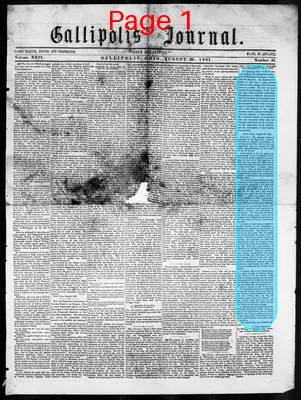
Domestic News
August 29, 1861
Gallipolis Journal
Gallipolis, Gallia County, Ohio
What is this article about?
In 1861, J. Scott Harrison declines the Democratic nomination for Ohio Lieutenant-Governor, urging focus on suppressing the rebellion and preserving the Union over party divisions amid the Civil War.
Clipping

OCR Quality
100%
Excellent
Full Text
HON. J. SCOTT HARRISON DECLINES THE DEMOCRATIC NOMINATION.
The following letter of Mr. Harrison, declining the Democratic nomination for Lieutenant-Governor, is copied from the Enquirer. Mr. Harrison declines to enter into a party contest when the very existence of the Government is at stake. He does not avail himself of the stratagem of Mr. Jewell, who, while ostensibly repudiating the platform on which he was nominated, and on which any honorable nominee could only accept or decline, makes a new platform in his letter of acceptance, to be presented as an alternative and a war platform to the weaker brethren—that is, to those whose partyism is not superior to their loyalty.—Mr. Harrison refuses to be identified with any movement which does not sink party and stand up for the country, the suppression of the rebellion, and the enforcement of the Constitution and laws:
Point Farm, August 13, 1861.
DEAR SIR: The extreme illness of a member of my family has, for several weeks, so engaged my attention, as to leave me but little time for other engagements, and will account for this tardy acknowledgment of your favor of the 8th instant.
I had noticed in the city papers the proceedings of the Democratic Union Convention, lately assembled at Columbus, and was not a little surprised to find that my name had been used in connection with the Lieutenant-Governorship of the State. I deeply regretted that I had not been consulted in the matter, and now desire to say, that I respectfully decline the nomination.
I have no inclination to be a candidate for any office. If I ever cherished ambition for such distinction I have been cured of it, and feel entirely reconciled to the quiet and retirement of private life. But it is, perhaps, due myself to say that if this was not the case, and I felt entirely free to enter again the field of political conflict, I could not consent to be a party candidate for office, in the present condition of the country. Party spirit, in my opinion, has done more than anything—and the poison which has induced this national paralysis would not prove an efficient remedy in the restoration of the patient. The time has come when we should forget party, throw off its trammels and obligations, and stand up for the country, its Union, Constitution and laws.
I was not, as you know, a supporter of Mr. Lincoln for the Presidency—neither do I approve of all the acts of his administration. But it seems to me this is not the proper time to arraign the Administration for these errors of policy; and that it is neither the part of wisdom nor patriotism to assail the Government when the enemy is thundering at the gates of the capital. Let us first settle the great question of Country or no Country, Government or no Government, Union or Disunion; and having accomplished this great work of duty and patriotism, we will have ample time to inquire into these alleged delinquencies of our rulers; and if we find them wanting in the Jeffersonian requirements for office, let them be condemned by a verdict of the people.
I certainly owe to the Republicans, as a party, no debt of political obligation, and yet I do not hesitate to say that the Administration has my warmest sympathies in its efforts to put down this rebellion, and I am in favor of doing this effectively and permanently—in peace if we can, in war if we must.
A distinguished member of Congress is reported to have said in his place in the House of Representatives, during the last session, that he was for "peace—peace before the Union." I, too, am for peace, but I am for the Union before peace, for I know without the Union we can have no peace.
In repeating my determination to decline the nomination which, as the organ of the Convention, you so kindly tender me, I beg to assure you of my proper appreciation of this mark of respect and confidence on the part of the Convention.
Very respectfully, your obedient servant,
J. Scott Harrison.
To William A. Johnson, Esq., Secretary of State Central Committee.
The following letter of Mr. Harrison, declining the Democratic nomination for Lieutenant-Governor, is copied from the Enquirer. Mr. Harrison declines to enter into a party contest when the very existence of the Government is at stake. He does not avail himself of the stratagem of Mr. Jewell, who, while ostensibly repudiating the platform on which he was nominated, and on which any honorable nominee could only accept or decline, makes a new platform in his letter of acceptance, to be presented as an alternative and a war platform to the weaker brethren—that is, to those whose partyism is not superior to their loyalty.—Mr. Harrison refuses to be identified with any movement which does not sink party and stand up for the country, the suppression of the rebellion, and the enforcement of the Constitution and laws:
Point Farm, August 13, 1861.
DEAR SIR: The extreme illness of a member of my family has, for several weeks, so engaged my attention, as to leave me but little time for other engagements, and will account for this tardy acknowledgment of your favor of the 8th instant.
I had noticed in the city papers the proceedings of the Democratic Union Convention, lately assembled at Columbus, and was not a little surprised to find that my name had been used in connection with the Lieutenant-Governorship of the State. I deeply regretted that I had not been consulted in the matter, and now desire to say, that I respectfully decline the nomination.
I have no inclination to be a candidate for any office. If I ever cherished ambition for such distinction I have been cured of it, and feel entirely reconciled to the quiet and retirement of private life. But it is, perhaps, due myself to say that if this was not the case, and I felt entirely free to enter again the field of political conflict, I could not consent to be a party candidate for office, in the present condition of the country. Party spirit, in my opinion, has done more than anything—and the poison which has induced this national paralysis would not prove an efficient remedy in the restoration of the patient. The time has come when we should forget party, throw off its trammels and obligations, and stand up for the country, its Union, Constitution and laws.
I was not, as you know, a supporter of Mr. Lincoln for the Presidency—neither do I approve of all the acts of his administration. But it seems to me this is not the proper time to arraign the Administration for these errors of policy; and that it is neither the part of wisdom nor patriotism to assail the Government when the enemy is thundering at the gates of the capital. Let us first settle the great question of Country or no Country, Government or no Government, Union or Disunion; and having accomplished this great work of duty and patriotism, we will have ample time to inquire into these alleged delinquencies of our rulers; and if we find them wanting in the Jeffersonian requirements for office, let them be condemned by a verdict of the people.
I certainly owe to the Republicans, as a party, no debt of political obligation, and yet I do not hesitate to say that the Administration has my warmest sympathies in its efforts to put down this rebellion, and I am in favor of doing this effectively and permanently—in peace if we can, in war if we must.
A distinguished member of Congress is reported to have said in his place in the House of Representatives, during the last session, that he was for "peace—peace before the Union." I, too, am for peace, but I am for the Union before peace, for I know without the Union we can have no peace.
In repeating my determination to decline the nomination which, as the organ of the Convention, you so kindly tender me, I beg to assure you of my proper appreciation of this mark of respect and confidence on the part of the Convention.
Very respectfully, your obedient servant,
J. Scott Harrison.
To William A. Johnson, Esq., Secretary of State Central Committee.
What sub-type of article is it?
Politics
Appointment
What keywords are associated?
Democratic Nomination
Lieutenant Governor
Civil War
Union
Ohio Politics
What entities or persons were involved?
J. Scott Harrison
William A. Johnson
Mr. Jewell
Mr. Lincoln
Where did it happen?
Columbus, Ohio
Domestic News Details
Primary Location
Columbus, Ohio
Event Date
August 13, 1861
Key Persons
J. Scott Harrison
William A. Johnson
Mr. Jewell
Mr. Lincoln
Outcome
j. scott harrison declines the democratic nomination for lieutenant-governor.
Event Details
Hon. J. Scott Harrison writes a letter declining the Democratic Union Convention's nomination for Lieutenant-Governor of the State, citing family illness, lack of ambition for office, and the need to prioritize national unity and suppression of the rebellion over party politics during the crisis.