Thank you for visiting SNEWPapers!
Sign up free
Worcester Daily Spy
Worcester, Worcester County, Massachusetts
What is this article about?
In Worcester, a policeman accidentally kills a bystander during a riot and is convicted of manslaughter, sentenced to one year in prison. The article contrasts this with the unpunished police massacre in New Orleans, criticizing national political support for the perpetrators.
Clipping
OCR Quality
Full Text
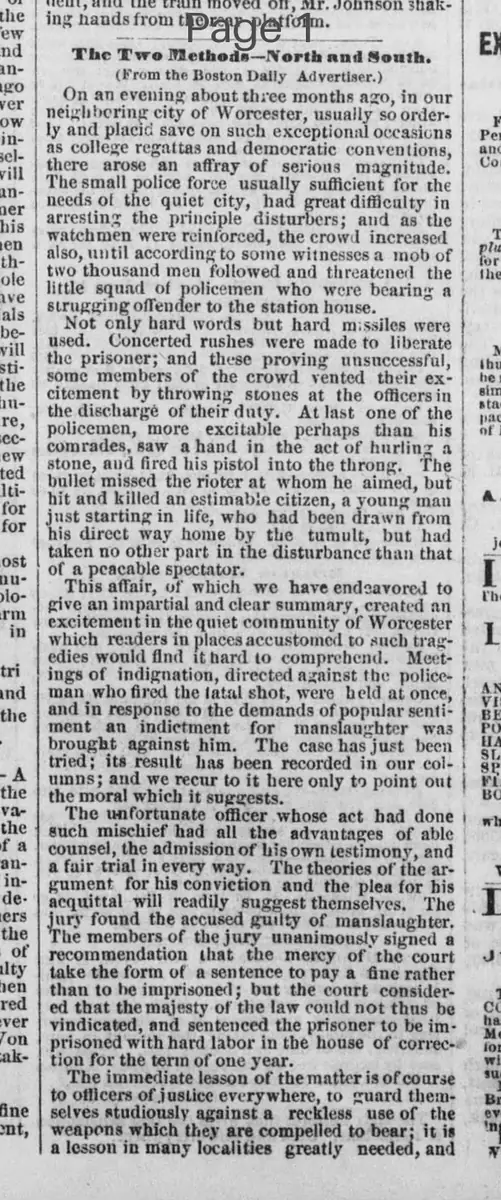
(From the Boston Daily Advertiser.)
On an evening about three months ago, in our neighboring city of Worcester, usually so orderly and placid save on such exceptional occasions as college regattas and democratic conventions, there arose an affray of serious magnitude. The small police force usually sufficient for the needs of the quiet city, had great difficulty in arresting the principal disturbers; and as the watchmen were reinforced, the crowd increased also, until according to some witnesses a mob of two thousand men followed and threatened the little squad of policemen who were bearing a struggling offender to the station house.
Not only hard words but hard missiles were used. Concerted rushes were made to liberate the prisoner; and these proving unsuccessful, some members of the crowd vented their excitement by throwing stones at the officers in the discharge of their duty. At last one of the policemen, more excitable perhaps than his comrades, saw a hand in the act of hurling a stone, and fired his pistol into the throng. The bullet missed the rioter at whom he aimed, but hit and killed an estimable citizen, a young man just starting in life, who had been drawn from his direct way home by the tumult, but had taken no other part in the disturbance than that of a peaceable spectator.
This affair, of which we have endeavored to give an impartial and clear summary, created an excitement in the quiet community of Worcester which readers in places accustomed to such tragedies would find it hard to comprehend. Meetings of indignation, directed against the policeman who fired the fatal shot, were held at once, and in response to the demands of popular sentiment an indictment for manslaughter was brought against him. The case has just been tried; its result has been recorded in our columns; and we recur to it here only to point out the moral which it suggests.
The unfortunate officer whose act had done such mischief had all the advantages of able counsel, the admission of his own testimony, and a fair trial in every way. The theories of the argument for his conviction and the plea for his acquittal will readily suggest themselves. The jury found the accused guilty of manslaughter. The members of the jury unanimously signed a recommendation that the mercy of the court take the form of a sentence to pay a fine rather than to be imprisoned; but the court considered that the majesty of the law could not thus be vindicated, and sentenced the prisoner to be imprisoned with hard labor in the house of correction for the term of one year.
The immediate lesson of the matter is of course to officers of justice everywhere, to guard themselves studiously against a reckless use of the weapons which they are compelled to bear; it is a lesson in many localities greatly needed, and one which in New York especially the press is inculcating now with much emphasis. But it also suggests a contrast between New England and New Orleans, which may give food for reflection. Here a man who when assailed in the discharge of his duty fires a hasty shot which missing its aim sheds the blood of a bystander, is round guilty of a grave offence and pays the full penalty of his carelessness; there a whole police force devotes itself with preconcerted vigor to the work of massacre upon a class of the population whom difference in politics or in color has made offenders,—and a party which calls itself national, with the President of the United States at its head, seeks only to find justification for the deed. Lowell of Worcester, will serve out the full term of the penalty of what was at most an indiscretion; but the Thugs of New Orleans will receive applause from their fellow-citizens, promotion from their mayor, and perhaps federal office from Washington, as a reward for their atrocious and cold-blooded crime. It only remains for the loyal people to say whether the vote of a representative of these opinions and of these unrepented crimes shall be admitted to balance the delegate of twice their number of faithful citizens, in the national councils.
What sub-type of article is it?
What themes does it cover?
What keywords are associated?
What entities or persons were involved?
Where did it happen?
Story Details
Key Persons
Location
Worcester, Massachusetts; New Orleans
Event Date
About Three Months Ago
Story Details
During a riot in Worcester, policeman Lowell fires into a crowd, accidentally killing an innocent bystander. He is tried, convicted of manslaughter, and sentenced to one year in prison. The article contrasts this with the unpunished police massacre in New Orleans, critiquing political support for the perpetrators.