Thank you for visiting SNEWPapers!
Sign up free
Story
August 18, 1884
The Sun
New York, New York County, New York
What is this article about?
Historical account of Spain's exploitative taxation and military costs imposed on Cuba before and after the 1868-1878 insurrection, highlighting the island's economic decline and lack of representation, predicting inevitable ruin under Spanish rule.
Clipping
OCR Quality
95%
Excellent
Full Text
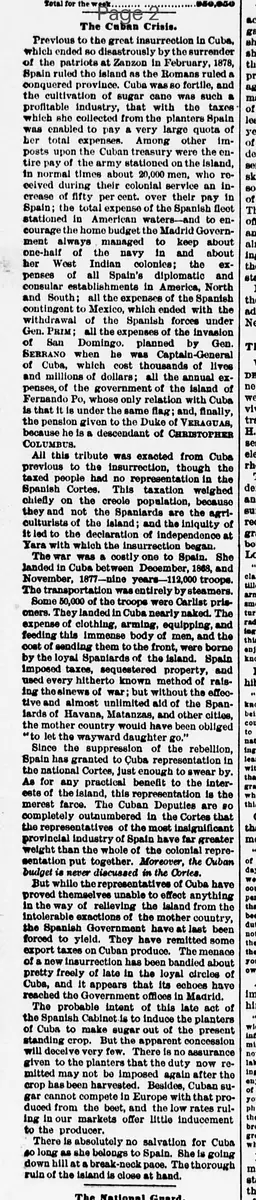
The Cuban Crisis.
Previous to the great insurrection in Cuba which ended so disastrously by the surrender of the patriots at Zanjón in February, 1878, Spain ruled the island as the Romans ruled a conquered province. Cuba was so fertile, and the cultivation of sugar cane was such a profitable industry, that with the taxes which she collected from the planters Spain was enabled to pay a very large quota of her total expenses. Among other impositions upon the Cuban treasury were the entire pay of the army stationed on the island, in normal times about 20,000 men, who received during their colonial service an increase of fifty per cent. over their pay in Spain; the total expense of the Spanish fleet stationed in American waters—and to encourage the home budget the Madrid Government always managed to keep about one-half of the navy in and about her West Indian colonies; the expenses of all Spain's diplomatic and consular establishments in America, North and South; all the expenses of the Spanish contingent to Mexico, which ended with the withdrawal of the Spanish forces under Gen. Prim; all the expenses of the invasion of San Domingo, planned by Gen. Serrano when he was Captain-General of Cuba, which cost thousands of lives and millions of dollars; all the annual expenses of the government of the island of Fernando Po, whose only relation with Cuba is that it is under the same flag; and, finally, the pension given to the Duke of Veraguas, because he is a descendant of CHRISTOPHER COLUMBUS.
All this tribute was exacted from Cuba previous to the insurrection, though the taxed people had no representation in the Spanish Cortes. This taxation weighed chiefly on the creole population, because they and not the Spaniards are the agriculturists of the island; and the iniquity of it led to the declaration of independence at Yara with which the insurrection began.
The war was a costly one to Spain. She landed in Cuba between December, 1868, and November, 1877—nine years—112,000 troops. The transportation was entirely by steamers. Some 50,000 of the troops were Carlist prisoners. They landed in Cuba nearly naked. The expense of clothing, arming, equipping, and feeding this immense body of men, and the cost of sending them to the front, were borne by the loyal Spaniards of the island. Spain imposed taxes, sequestered property, and used every hitherto known method of raising the sinews of war; but without the effective and almost unlimited aid of the Spaniards of Havana, Matanzas, and other cities, the mother country would have been obliged to let the wayward daughter go.
Since the suppression of the rebellion, Spain has granted to Cuba representation in the national Cortes, just enough to swear by. As for any practical benefit to the interests of the island, this representation is the merest farce. The Cuban Deputies are so completely outnumbered in the Cortes that the representatives of the most insignificant provincial industry of Spain have far greater weight than the whole of the colonial representation put together. Moreover, the Cuban budget is never discussed in the Cortes.
But while the representatives of Cuba have proved themselves unable to effect anything in the way of relieving the island from the intolerable exactions of the mother country the Spanish Government have at last been forced to yield. They have remitted some export taxes on Cuban produce. The menace of a new insurrection has been bandied about pretty freely of late in the loyal circles of Cuba, and it appears that its echoes have reached the Government offices in Madrid The probable intent of this late act of the Spanish Cabinet is to induce the planters of Cuba to make sugar out of the present standing crop. But the apparent concession will deceive very few. There is no assurance given to the planters that the duty now remitted may not be imposed again after the crop has been harvested. Besides, Cuban sugar cannot compete in Europe with that produced from the beet, and the low rates ruling in our markets offer little inducement to the producer.
There is absolutely no salvation for Cuba so long as she belongs to Spain. She is going down hill at a break-neck pace. The thorough ruin of the island is close at hand.
Previous to the great insurrection in Cuba which ended so disastrously by the surrender of the patriots at Zanjón in February, 1878, Spain ruled the island as the Romans ruled a conquered province. Cuba was so fertile, and the cultivation of sugar cane was such a profitable industry, that with the taxes which she collected from the planters Spain was enabled to pay a very large quota of her total expenses. Among other impositions upon the Cuban treasury were the entire pay of the army stationed on the island, in normal times about 20,000 men, who received during their colonial service an increase of fifty per cent. over their pay in Spain; the total expense of the Spanish fleet stationed in American waters—and to encourage the home budget the Madrid Government always managed to keep about one-half of the navy in and about her West Indian colonies; the expenses of all Spain's diplomatic and consular establishments in America, North and South; all the expenses of the Spanish contingent to Mexico, which ended with the withdrawal of the Spanish forces under Gen. Prim; all the expenses of the invasion of San Domingo, planned by Gen. Serrano when he was Captain-General of Cuba, which cost thousands of lives and millions of dollars; all the annual expenses of the government of the island of Fernando Po, whose only relation with Cuba is that it is under the same flag; and, finally, the pension given to the Duke of Veraguas, because he is a descendant of CHRISTOPHER COLUMBUS.
All this tribute was exacted from Cuba previous to the insurrection, though the taxed people had no representation in the Spanish Cortes. This taxation weighed chiefly on the creole population, because they and not the Spaniards are the agriculturists of the island; and the iniquity of it led to the declaration of independence at Yara with which the insurrection began.
The war was a costly one to Spain. She landed in Cuba between December, 1868, and November, 1877—nine years—112,000 troops. The transportation was entirely by steamers. Some 50,000 of the troops were Carlist prisoners. They landed in Cuba nearly naked. The expense of clothing, arming, equipping, and feeding this immense body of men, and the cost of sending them to the front, were borne by the loyal Spaniards of the island. Spain imposed taxes, sequestered property, and used every hitherto known method of raising the sinews of war; but without the effective and almost unlimited aid of the Spaniards of Havana, Matanzas, and other cities, the mother country would have been obliged to let the wayward daughter go.
Since the suppression of the rebellion, Spain has granted to Cuba representation in the national Cortes, just enough to swear by. As for any practical benefit to the interests of the island, this representation is the merest farce. The Cuban Deputies are so completely outnumbered in the Cortes that the representatives of the most insignificant provincial industry of Spain have far greater weight than the whole of the colonial representation put together. Moreover, the Cuban budget is never discussed in the Cortes.
But while the representatives of Cuba have proved themselves unable to effect anything in the way of relieving the island from the intolerable exactions of the mother country the Spanish Government have at last been forced to yield. They have remitted some export taxes on Cuban produce. The menace of a new insurrection has been bandied about pretty freely of late in the loyal circles of Cuba, and it appears that its echoes have reached the Government offices in Madrid The probable intent of this late act of the Spanish Cabinet is to induce the planters of Cuba to make sugar out of the present standing crop. But the apparent concession will deceive very few. There is no assurance given to the planters that the duty now remitted may not be imposed again after the crop has been harvested. Besides, Cuban sugar cannot compete in Europe with that produced from the beet, and the low rates ruling in our markets offer little inducement to the producer.
There is absolutely no salvation for Cuba so long as she belongs to Spain. She is going down hill at a break-neck pace. The thorough ruin of the island is close at hand.
What sub-type of article is it?
Historical Event
What themes does it cover?
Misfortune
Fortune Reversal
What keywords are associated?
Cuban Insurrection
Spanish Colonialism
Economic Exploitation
Sugar Industry
Taxation
Zanjón Surrender
Cortes Representation
What entities or persons were involved?
Gen. Prim
Gen. Serrano
Duke Of Veraguas
Christopher Columbus
Where did it happen?
Cuba
Story Details
Key Persons
Gen. Prim
Gen. Serrano
Duke Of Veraguas
Christopher Columbus
Location
Cuba
Event Date
1868 1878
Story Details
Spain's exploitative rule over Cuba, funding military and colonial expenses through heavy taxes on Cuban planters without representation, leading to the 1868 insurrection at Yara, costly suppression, token post-war reforms, and ongoing economic decline predicting ruin.