Thank you for visiting SNEWPapers!
Sign up free
Richmond Daily Times
Richmond, Virginia
What is this article about?
Reminiscences from the Augusta Chronicle and Sentinel detail the Georgia Legislature's 1833 rejection of secessionist resolutions condemning General Jackson's 1832 Proclamation, with Union party leaders supporting it through votes and amendments, refuting claims of unanimous opposition.
Clipping
OCR Quality
Full Text
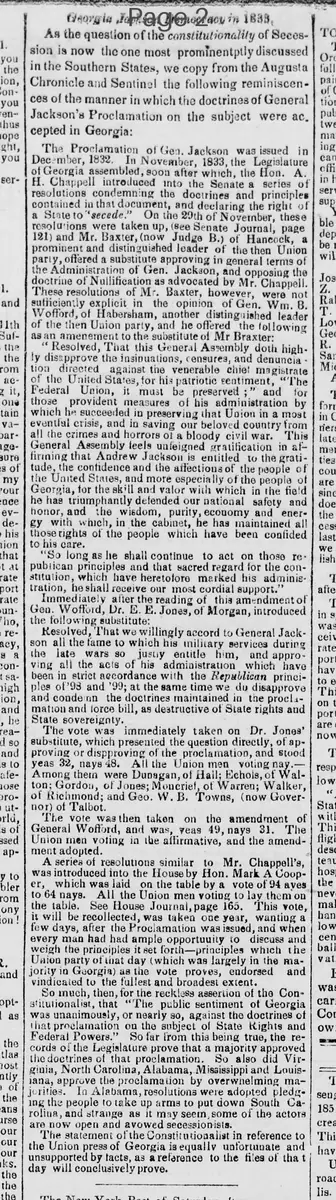
The Proclamation of Gen. Jackson was issued in December, 1832. In November, 1833, the Legislature of Georgia assembled, soon after which, the Hon. A. H. Chappell introduced into the Senate a series of resolutions condemning the doctrines and principles contained in that document, and declaring the right of a State to 'secede.' On the 20th of November, these resolutions were taken up, (see Senate Journal, page 21) and Mr. Baxter, (now Judge B.) of Hancock, a prominent and distinguished leader of the then Union party, offered a substitute approving in general terms of the Administration of Gen. Jackson, and opposing the doctrine of Nullification as advocated by Mr. Chappell. These resolutions of Mr. Baxter, however, were not sufficiently explicit in the opinion of Gen. Wm. B. Wofford, of Habersham, another distinguished leader of the then Union party, and he offered the following as an amendment to the substitute of Mr Baxter:
'Resolved, That this General Assembly doth highly disapprove the insinuations, censures, and denunciation directed against the venerable chief magistrate of the United States, for his patriotic sentiment, 'The Federal Union, it must be preserved ;' and for those provident measures of his administration by which he succeeded in preserving that Union in a most eventful crisis, and in saving our beloved country from all the crimes and horrors of a bloody civil war. This General Assembly feels unfeigned gratification in affirming that Andrew Jackson is entitled to the gratitude, the confidence and the affections of the people of the United States, and more especially of the people of Georgia, for the skill and valor with which in the field he has triumphantly defended our national safety and honor, and the wisdom, purity, economy and energy with which, in the cabinet, he has maintained all those rights of the people which have been confided to his care.
'So long as he shall continue to act on those republican principles and that sacred regard for the constitution, which have heretofore marked his administration, he shall receive our most cordial support.'
Immediately after the reading of this amendment of Gen. Wofford, Dr. E. E. Jones, of Morgan, introduced the following substitute:
Resolved, That we willingly accord to General Jackson all the fame to which his military services during the late wars so justly entitle him, and approving all the acts of his administration which have been in strict accordance with the Republican principles of '93 and '99; at the same time we do disapprove and condemn the doctrines maintained in the proclamation and force bill, as destructive of State rights and State sovereignty.
The vote was immediately taken on Dr. Jones substitute, which presented the question directly, of approving or disapproving of the proclamation, and stood yeas 32, nays 48. All the Union men voting nay.— Among them were Dunagan, of Hall; Echols, of Walton; Gordon, of Jones; Moncrief, of Warren; Walker, of Richmond; and Geo. W. B. Towns, (now Governor) of Talbot.
The vote was then taken on the amendment of General Wofford, and was, yeas 49, nays 31. The Union men voting in the affirmative, and the amendment adopted.
A series of resolutions similar to Mr. Chappell's, was introduced into the House by Hon. Mark A. Cooper, which was laid on the table by a vote of 94 ayes to 64 nays. All the Union men voting to lay them on the table. See House Journal, page 165. This vote, it will be recollected, was taken one year, wanting a few days, after the Proclamation was issued, and when every man had had ample opportunity to discuss and weigh the principles it set forth—principles which the Union party of that day (which was largely in the majority in Georgia) as the vote proves, endorsed and vindicated to the fullest and broadest extent.
So much, then, for the reckless assertion of the Constitutionalist, that 'The public sentiment of Georgia was unanimously, or nearly so, against the doctrines of that proclamation on the subject of State Rights and Federal Powers.' So far from this being true, the records of the Legislature prove that a majority approved the doctrines of that proclamation. So also did Virginia, North Carolina, Alabama, Mississippi and Louisiana, approve the proclamation by overwhelming majorities. In Alabama, resolutions were adopted pledging the people to take up arms to put down South Carolina, and strange as it may seem some of the actors are now open and avowed secessionists
The statement of the Constitutionalist in reference to the Union press of Georgia is equally unfortunate and unsupported by facts, as a reference to the files of that day will conclusively prove.
What sub-type of article is it?
What themes does it cover?
What keywords are associated?
What entities or persons were involved?
Where did it happen?
Story Details
Key Persons
Location
Georgia
Event Date
December 1832 To November 1833
Story Details
In 1833, Georgia's Legislature debated resolutions condemning Jackson's 1832 Proclamation against secession; Union party leaders like Baxter and Wofford supported it via amendments and votes (yeas 49-31 in Senate, 94-64 in House to table secession resolutions), affirming federal union and refuting claims of opposition.