Thank you for visiting SNEWPapers!
Sign up free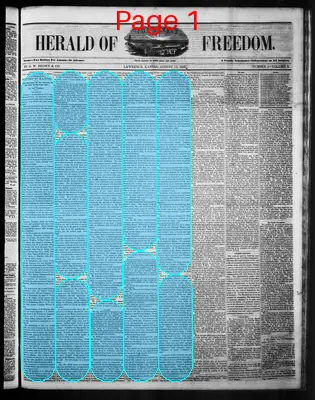
Literary
August 15, 1857
The Kansas Herald Of Freedom
Wakarusa, Lawrence, Shawnee County, Douglas County, Kansas
What is this article about?
Chapter XI of 'A Complete History of Kansas' details the 1855 Territorial Legislature's session at Pawnee, pro-slavery dominance, expulsion of Free State members, adoption of Missouri statutes, relocation to Shawnee Mission despite Governor Reeder's veto, and Free State response in Lawrence.
Clipping
OCR Quality
95%
Excellent
Full Text
COPYRIGHT SEC Fritten expressly for the Herald of Freedom.
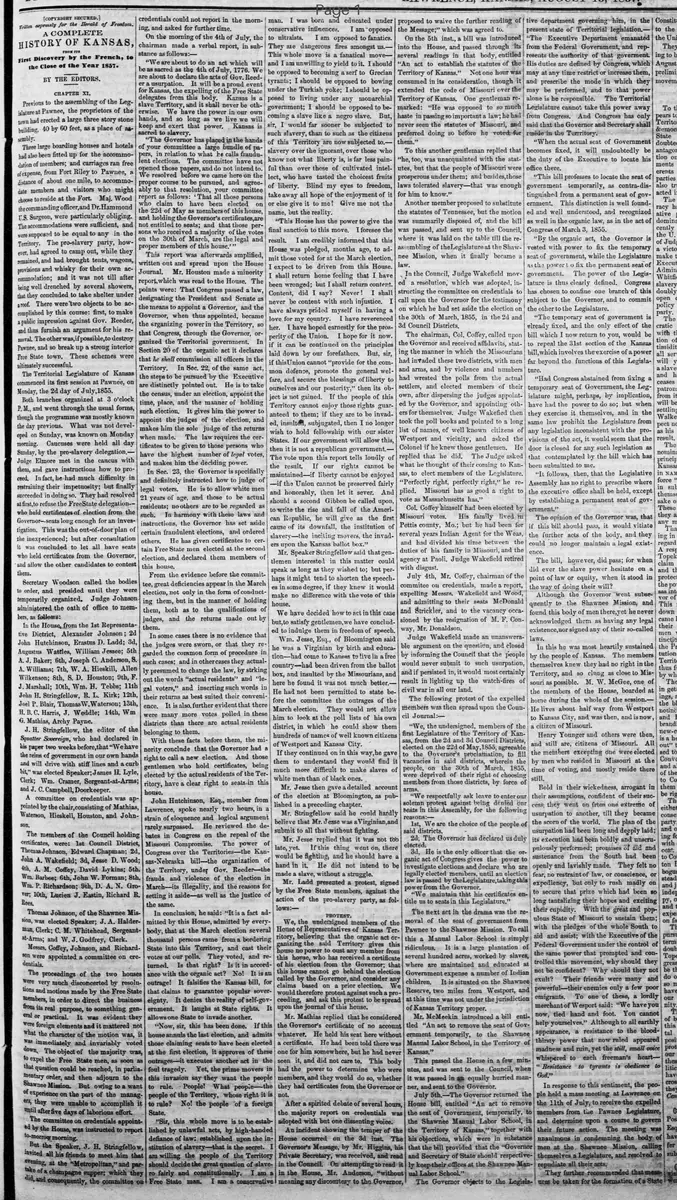
A COMPLETE HISTORY OF KANSAS,
FROM ITS First Discovery by the French, to the Close of the Year 1857.
BY THE EDITORS.
CHAPTER XI.
Previous to the assembling of the Legislature at Pawnee, the proprietors of the town had erected a large three story stone building, 40 by 60 feet, as a place of assembly. Three large boarding houses and hotels had also been fitted up for the accommodation of members; and carriages ran free of expense, from Fort Riley to Pawnee, a distance of about one mile, to accommodate members and visitors who might choose to reside at the Fort. Maj. Wood the commanding officer, and Dr. Hammond U.S. Surgeon, were particularly obliging. The accommodations were sufficient, and were supposed to be equal to any in the Territory. The pro-slavery party, however, had agreed to camp out, while they remained, and had brought tents, wagons, provisions and whisky for their own accommodation; and it was not till after being well drenched by several showers, that they concluded to take shelter under a roof. There were two objects to be accomplished by this course: first, to make a public impression against Gov. Reeder, and thus furnish an argument for his removal. The other was, if possible, to destroy Pawnee, and so break up a strong interior Free State town. These schemes were ultimately successful.
The Territorial Legislature of Kansas commenced its first session at Pawnee, on Monday, the 2d day of July, 1855. Both branches organized at 3 o'clock P. M., and went through the usual forms, though the programme was mostly known the day previous. What was not developed on Sunday, was known on Monday morning. Caucuses were held all day Sunday, by the pro-slavery delegation. Judge Elmore met in the caucus with them, and gave instructions how to proceed. In fact, he had much difficulty in restraining their impetuosity; but finally succeeded in doing so. They had resolved at first, to refuse the Free State delegation-- who held certificates of election from the Governor--seats long enough for an investigation. This was the out-of-door plan of the inexperienced; but after consultation it was concluded to let all have seats who held certificates from the Governor, and allow the other candidates to contest them. Secretary Woodson called the bodies to order, and presided until they were temporarily organized. Judge Johnson administered the oath of office to members, as follows:
In the House from the 1st Representative District, Alexander Johnson; 2d John Hutchinson, Erastus D. Ladd; 3d, Augustus Wattles, William Jessee; 5th A. J. Baker; 6th, Joseph C. Anderson, S. A. Williams; 7th, W. A. Hieskill, Allen Wilkenson; 8th, S. D. Houston; 9th, F. J. Marshall; 10th. Wm. H. Tebbs; 11th John H. Stringfellow, R. L. Kirk; 12th, Joel P. Blair, Thomas W. Waterson; 13th, H. B. C. Harris, J. Weddle; 14th, Wm G. Mathias, Archy Payne.
J. H. Stringfellow, the editor of the Squatter Sovereign, who had declared in his paper two weeks before, that "We have the reins of government in our own hands and will drive with stiff lines and a curb bit," was elected Speaker; James H. Lyle, Clerk; Wm. Cramer, Sergeant-at-Arms; and J. C. Campbell, Doorkeeper.
A committee on credentials was appointed by the chair, consisting of Mathias, Waterson, Hieskell, Houston, and Johnson.
The members of the Council holding certificates, were: 1st Council District, Thomas Johnson, Edward Chapman; 2d, John A. Wakefield; 3d, Jesse D. Wood; 4th, A. M. Coffey, David Lykins; 5th, Wm. Barbee; 6th, John W. Forman; 8th. Wm. P. Richardson; 9th, D. A. N. Grover; 10th, Lucien J. Eastin, Richard R. Rees.
Thomas Johnson. of the Shawnee Mission, was elected President; J. A. Halderman, Clerk; C. M. Whitehead, Sergeant-at-Arms; and W. J. Godfrey, Assistant Clerk.
Messrs. Coffey, Johnson, and Richardson were appointed a committee on credentials.
The proceedings of the two houses were very much disconcerted by resolutions and motions made by the Free State members, in order to direct the business from its real purpose, to something general or practical. It was evident they were foreign elements and it mattered not what the character of the motion was, it was immediately and invariably voted down. The object of the majority was, to expel the Free State men, as soon as that question could be reached, in parliamentary order, and then adjourn to the Shawnee Mission. But owing to a want of experience on the part of the managers, they were unable to accomplish it until after five days of laborious effort.
The committee on credentials appointed by the House, was instructed to report to-morrow morning. But the Speaker, J. H. Stringfellow invited all his friends to meet him that evening, at the "Metropolitan," and partake of a champagne supper; which they did, and consequently, the committee on credentials could not report in the morning, and asked for further time.
On the morning of the 4th of July, the chairman made a verbal report, in substance as follows:
"We are about to do an act which will be as sacred as the 4th of July, 1776. We are about to declare the acts of Gov. Reeder a usurpation. It will be a proud event for Kansas, the expelling of the Free State delegates from this body. Kansas is a slave Territory, and it shall never be otherwise. We have the power in our own hands, and so long as we live we will keep and exert that power. Kansas is sacred to slavery.
"The Governor has placed in the hands of your committee a large bundle of papers, in relation to what he calls fraudulent elections. The committee have not opened those papers, and do not intend to. We resolved before we came here on the proper course to be pursued, and agreeably to that resolution, your committee report as follows: That all those persons who claim to have been elected on the 22d of May as members of this house, and holding the Governor's certificates, are not entitled to seats; and that those persons who received a majority of the votes on the 30th of March, are the legal and proper members of this house."
This report was afterwards amplified, written out and spread upon the House Journal. Mr. Houston made a minority report, which was read to the House. The points were: That Congress passed a law, designating the President and Senate as the means to appoint a Governor, and the Governor, when thus appointed, became the organizing power in the Territory, so that Congress, through the Governor, organized the Territorial government. In Section 20 of the organic act it declares that he shall commission all officers in the Territory. In Sec. 22, of the same act, the steps to be pursued by the Executive are distinctly pointed out. He is to take the census, under an election, appoint the time, place, and the manner of holding such election. It gives him the power to appoint the judges of the election, and makes him the sole judge of the returns when made. The law requires the certificates to be given to those persons who have the highest number of legal votes, and makes him the deciding power.
In Sec. 23, the Governor is specifically and definitely instructed how to judge of legal voters. He is to allow white men 21 years of age, and those to be actual residents; no others are to be regarded as such. In harmony with these laws and instructions, the Governor has set aside certain fraudulent elections, and ordered others. He has given certificates to certain Free State men elected at the second election, and declared them members of this house.
From the evidence before the committee, great deficiencies appear in the March election, not only in the form of conducting them, but in the manner of holding them, both as to the qualifications of judges, and the returns made out by them. In some cases there is no evidence that the judges were sworn, or that they regarded the common form of procedure in such cases; and in other cases they actually presumed to change the law, by striking out the words "actual residents" and "legal voters," and inserting such words in their returns as best suited their convenience. It is also further evident that there were many more votes polled in these districts than there are actual residents belonging to them.
With these facts before them, the minority conclude that the Governor had a right to call a new election. And those gentlemen who hold certificates, being elected by the actual residents of the Territory, have a clear right to seats in this house.
John Hutchinson, Esq., member from Lawrence, spoke nearly two hours, in a strain of eloquence and logical argument rarely surpassed. He reviewed the debates in Congress on the repeal of the Missouri Compromise. The power of Congress over the Territories-the Kansas-Nebraska bill-the organization of the Territory, under Gov. Reeder-the frauds and violence of the election in March--its illegality, and the reasons for setting it aside-as well as the justice of the same.
In conclusion, he said: "It is a fact admitted by this House, admitted by everybody, that at the March election several thousand persons came from a bordering State into this Territory, and cast their votes at our polls. They voted, and returned. Is that right? Is it in accordance with the organic act? No! It is an outrage! It falsifies the Kansas bill, for that claims to guarantee popular sovereignty. It denies the reality of self-government. It laughs at State rights. It allows one State to invade another.
"Now, sir, this has been done. If this house annuls the last election, and admits those claiming seats to have been elected at the first election, it approves of these outrages--it executes another act in the foul tragedy. Yet, the prime movers in this invasion say they want the people to rule. People! What people? the people of the Territory, whose right it is to rule? No! the people of a foreign State.
"Sir. this whole move is to be established by unlawful acts, by high-handed defiance of law; established upon the institution of slavery-that is the secret. I am willing the people of the Territory should decide the great question of slavery fairly and constitutionally. I am a Free State man. I am a conservative man. I was born and educated under conservative influences. I am opposed to ultraists. I am opposed to fanatics. They are dangerous fires amongst us.-- This whole move is a fanatical move-- and I am unwilling to yield to it. I should be opposed to becoming a serf to Grecian tyrants; I should be opposed to bowing under the Turkish yoke; I should be opposed to living under any monarchical government; I should be opposed to becoming a slave like a negro slave. But, sir, I would far sooner be subjected to such slavery, than to such as the citizens of this Territory are now subjected to.- slavery over the ignorant, over those who know not what liberty is, is far less painful than over those of cultivated intellect, who have tasted the choicest fruits of liberty. Blind my eyes to freedom, take away all hope of the enjoyment of it or else give it to me! Give me not the name, but the reality.
"This House has the power to give the final sanction to this move. I foresee the result. I am credibly informed that this House was pledged, months ago, to admit those voted for at the March election. I expect to be driven from this House. I shall return home feeling that I have been wronged; but I shall return content. Content, did I say? Never! I shall never be content with such injustice. I have always prided myself in having a love for my country. I have reverenced her. I have hoped earnestly for the prosperity of the Union. I hope for it now. if it can be continued on the principles laid down by our forefathers. But. sir, if this Union cannot "provide for the common defence, promote the general welfare, and secure the blessings of liberty to ourselves and our posterity," then its object is not gained. If the people of this Territory cannot enjoy those rights guaranteed to them; if they are to be invaded, insulted, subjugated, then I no longer wish to hold fellowship with our sister States. If our government will allow this, then it is not a republican government.-- The vote upon this report tells loudly of the result, If our rights cannot be maintained-if liberty cannot be enjoyed -if the Union cannot be preserved fairly and honorably, then let it sever. And should a second Gibbon be called upon, to write the rise and fall of the American Republic, he will give as the first cause of its downfall, the institution of slavery-the inciting movers, the invaders upon the Kansas ballot box."
Mr. Speaker Stringfellow said that gentlemen interested in this matter could speak as long as they wished to; but perhaps it might tend to shorten the speeches in some degree, if they knew it would make no difference with the vote of this house. We have decided how to act in this case but, to satisfy gentlemen, we have concluded to indulge them in freedom of speech.
Wm. Jessee, Esq., of Bloomington said he was a Virginian by birth and education-had come to Kansas to live in a free country-had been driven from the ballot box, and insulted by the Missourians, and here he found it was not much better.- He had not been permitted to state before the committee the outrages of the March election. They would not allow him to look at the poll lists of his own district, in which he could show them hundreds of names of well known citizens of Westport and Kansas City.
If they continued on in this way, he gave them to understand they would find it much more difficult to make slaves of white men than of black ones.
Mr. Jesse then gave a detailed account of the election at Bloomington, as published in a preceding chapter.
Mr. Stringfellow said he could hardly believe that Mr. Jesse was a Virginian, and submit to all that without fighting.
Mr. Jesse replied that it was not too late, yet. If this thing went on, there would be fighting and he should have a hand in it. He did not intend to be made a slave. without a struggle.
Mr. Ladd presented a protest, signed by the Free State members, against the action of the pro-slavery party, as follows:
PROTEST.
We, the undersigned members of the House of Representatives of Kansas Territory, believing that the organic act organizing the said Territory gives this house no power to oust any member from this house, who has received a certificate of his election from the Governor; that this house cannot go behind the election called by the Governor, and consider any claims based on a prior election. We would therefore protest against such a proceeding, and ask this protest to be spread upon the journal of this house.
Mr. Mathias replied that he considered the Governor's certificate of no account whatever. He held his seat here without a certificate. He had been told there was one for him somewhere, but he had never seen it, and did not care to. This body had the power to determine who were members, and they would do so, whether they had certificates from the Governor or not.
After a spirited debate of several hours, the majority report on credentials was adopted with but one dissenting voice.
An incident showing the temper of the House occurred on the 3d inst. The Governor's Message, by Mr. Higgins, his Private Secretary, was received, and read in the Council. On attempting to read it in the House, Mr. Anderson, without meaning any discourtesy to the Governor. proposed to waive the further reading of the Message;" which was agreed to.
On the 5th inst., a bill was introduced into the House, and passed through its several readings in that body, entitled "An act to establish the statutes of the Territory of Kansas." Not one hour was consumed in its consideration, though it extended the code of Missouri over the Territory of Kansas. One gentleman remarked: "He was opposed to so much haste in passing so important a law; he had never seen the statutes of Missouri, and preferred doing so before he voted for them."
To this another gentleman replied that "he, too, was unacquainted with the statutes, but that the people of Missouri were prosperous under them; and besides, those laws tolerated slavery-that was enough for him to know."
Another member proposed to substitute the statutes of Tennessee, but the motion was summarily disposed of, and the bill was passed, and sent up to the Council, where it was laid on the table till the reassembling of the Legislature at the Shawnee Mission, when it finally became a law.
In the Council. Judge Wakefield moved a resolution. which was adopted, instructing the committee on credentials to call upon the Governor for the testimony on which he had set aside the election on the 30th of March, 1855, in the 2d and 3d Council Districts,
The chairman, Col. Coffey, called upon the Governor and received affidavits, stating the manner in which the Missourians had invaded these two districts, with men and arms, and by violence and numbers had wrested the polls from the actual settlers, and elected members of their own, after dispersing the judges appointed by the Governor, and appointing others for themselves. Judge Wakefield then took the poll books and pointed to a long list of names, of well known citizens of Westport and vicinity, and asked the Colonel if he knew those gentlemen. He replied that he did. The Judge asked what he thought of their coming to Kansas, to elect members of the Legislature. "Perfectly right. perfectly right," he replied. Missouri has as good a right to vote as Massachusetts has."
Col. Coffey himself had been elected by Missouri votes. His family lived in Pettis county, Mo.; but he had been for several years Indian Agent for the Weas. and had divided his time between the duties of his family in Missouri, and the agency at Paoli. Judge Wakefield retired with disgust.
July 4th, Mr. Coffey, chairman of the committee on credentials, made a report. expelling Messrs. Wakefield and Wood, and admitting to their seats McDonald and Strickler. and to the vacancy occasioned by the resignation of M. F. Conway, Mr. Donaldson.
Judge Wakefield made an unanswerable argument on the question, and closed by informing the Council that the people would never submit to such usurpation. and if persisted in, it would most certainly result in lighting up the watch-fires of civil war in all our land.
The following protest of the expelled members was then spread upon the Council Journal:--
"We, the undersigned, members of the first Legislature of the Territory of Kansas, from the 2d and 3d Council Districts. elected on the 22d of May.1855, agreeable to the Governor's proclamation; to fill vacancies in said districts, wherein the people, on the 30th of March, 1855, were deprived of their right of choosing members from those districts, by force of arms.
"We respectfully ask leave to enter our solemn protest against being denied our seats in this Assembly, for the following reasons:-
1st. We are the choice of the people of said districts.
2d; The Governor has declared us duly elected:
3d. He is the only officer that the organic act of Congress gives the power to investigate elections and declare who are legally elected members, until an election law is passed by the Legislature,taking this power from the Governor.
We maintain that his certificates entitle us to seats in this Legislature."
The next act in the drama was the removal of the seat of government from Pawnee to the Shawnee Mission. To call this a Manual Labor School is simply ridiculous. It is a large plantation of several hundred acres, worked by slaves, where are maintained and educated at Government expense a number of Indian children. It is situated on the Shawnee Reserve, two miles from Westport, and at this time was not under the jurisdiction of Kansas Territory proper.
Mr. McMeekin introduced a bill entitled "An act to remove the seat of Government temporarily, to the Shawnee Manual Labor School, in the Territory of Kansas."
This passed the House in a few minutes, and was sent to the Council, when it was passed in an equally hurried manner, and sent to the Governor.
July 5th. -The Governor returned the House bill, entitled "An act to remove the seat of Government. temporarily, to the Shawnee Manual Labor School, in the Territory of Kansas." together with his objections, which were in substance that the bill provided that the "Governor and Secretary of State should respectively keep their offices at the Shawnee Manual Labor School."
The Governor objects to the Legislative department governing him, in the present state of Territorial legislation.-
"The Executive Department emanated from the Federal Government, and represents the authority of that government. His duties are defined by Congress, which may at any time restrict or increase them, and prescribe the mode in which they may be performed, and to that power alone is he responsible. The Territorial Legislature cannot take this power away from Congress. And Congress has only said that the Governor and Secretary shall reside in the Territory.
"When the actual seat of Government becomes fixed, it will undoubtedly be the duty of the Executive to locate his office there.
"This bill professes to locate the seat of government temporarily, as contra-distinguished from a permanent seat of government, This distinction is well founded and well understood, and recognized as well in the organic law, as in the act of Congress of March 3, 1855.
"By the organic act, the Governor is vested with power to fix the temporary seat of government, while the Legislature has the power to fix the permanent seat of government. The power of the Legislature is thus clearly defined, Congress has chosen to confine one branch of this subject to the Governor, and to commit the other to the Legislature.
"The temporary seat of government is already fixed, and the only effect of the bill which I now return to you, would be to repeal the 31st section of the Kansas bill,which involves the exercise of a power far beyond the functions of this Legislature.
"Had Congress abstained from fixing a temporary seat of Government, the Legislature might, perhaps, by implication, have had the power to do so; but when they exercise it themselves, and in the same law prohibit the Legislature from any legislation inconsistent with the provisions of the act, it would seem that the door is closed for any such legislation as that contemplated by the bill which has been submitted to me.
"It follows, then, that the Legislative Assembly has no right to prescribe where the executive office shall be held, except by establishing a permanent seat of government."
The opinion of the Governor was, that if this bill should pass, it would vitiate the further acts of the body, and they could no longer maintain a legal existence.
The bill, however, did pass; for when did ever the slave power hesitate on a point of law or equity, when it stood in the way of doing their will?
Although the Governor went subsequently to the Shawnee Mission; and found this body of men there,yet he never acknowledged them as having any legal existence,nor signed any of their so-called laws.
In this he was most heartily sustained by the people of Kansas. The members themselves knew they had no right in the Territory, and so clung as close to Missouri as possible. M. W. MeGee, one of the members of the House, boarded at home during the whole of the session.-- He lives about half way from Westport to Kansas City, and was then, and is now, a citizen of Missouri.
Henry Younger and others were then, and still are, citizens of Missouri. All the members excepting one were elected by men who resided in Missouri at the time of voting, and mostly reside there still.
Bold in their wickedness, arrogant in their assumptions, confident of their success they went on from one extreme of usurpation to another, till they became the scorn of the world. The plan of the usurpation had been long and deeply laid; its execution had been boldly and unscrupulously performed; promises of aid and sustenance from the South had been openly and lavishly made. They felt no fear, no restraint of law, or conscience, or expediency, but only to rush madly on to secure that prize which had been so long tantalizing their hopes and exciting their cupidity. With the great and populous State of Missouri to sustain them; with the pledges of the whole South to aid and assist: with the Executive of the Federal Government under the control of the same power that prompted and controlled this movement, why should they not be confident? Why should they not exult? Their friends were many and powerful--their enemies only a few poor emigrants. To one of these, a lordly merchant of Westport said: "We have you now, tied hand and foot. You cannot help yourselves." Although to all earthly appearance, a resistance to the blood-thirsty power that now ruled appeared madness and ruin, yet the still, small voice whispered to each freeman's heart "Resistance to tyrants is obedience to God."
In response to this sentiment, the people held a mass meeting at Lawrence on the 11th of July, to receive the expelled members from the Pawnee Legislature, and determine upon a course to govern their future action. The meeting was unanimous in condemning the body of men at the Shawnee Mission, calling themselves a Legislature, and resolved to repudiate all their acts.
They further recommended that measures be taken for the formation of a State Constitution, and that application be made to the next Congress for admission into the Union.
They also recommended a mass meeting to be held at Lawrence on the 15th of August following. in order to take the preliminary steps for organizing the State movement.
[TO BE CONTINUED.]
A COMPLETE HISTORY OF KANSAS,
FROM ITS First Discovery by the French, to the Close of the Year 1857.
BY THE EDITORS.
CHAPTER XI.
Previous to the assembling of the Legislature at Pawnee, the proprietors of the town had erected a large three story stone building, 40 by 60 feet, as a place of assembly. Three large boarding houses and hotels had also been fitted up for the accommodation of members; and carriages ran free of expense, from Fort Riley to Pawnee, a distance of about one mile, to accommodate members and visitors who might choose to reside at the Fort. Maj. Wood the commanding officer, and Dr. Hammond U.S. Surgeon, were particularly obliging. The accommodations were sufficient, and were supposed to be equal to any in the Territory. The pro-slavery party, however, had agreed to camp out, while they remained, and had brought tents, wagons, provisions and whisky for their own accommodation; and it was not till after being well drenched by several showers, that they concluded to take shelter under a roof. There were two objects to be accomplished by this course: first, to make a public impression against Gov. Reeder, and thus furnish an argument for his removal. The other was, if possible, to destroy Pawnee, and so break up a strong interior Free State town. These schemes were ultimately successful.
The Territorial Legislature of Kansas commenced its first session at Pawnee, on Monday, the 2d day of July, 1855. Both branches organized at 3 o'clock P. M., and went through the usual forms, though the programme was mostly known the day previous. What was not developed on Sunday, was known on Monday morning. Caucuses were held all day Sunday, by the pro-slavery delegation. Judge Elmore met in the caucus with them, and gave instructions how to proceed. In fact, he had much difficulty in restraining their impetuosity; but finally succeeded in doing so. They had resolved at first, to refuse the Free State delegation-- who held certificates of election from the Governor--seats long enough for an investigation. This was the out-of-door plan of the inexperienced; but after consultation it was concluded to let all have seats who held certificates from the Governor, and allow the other candidates to contest them. Secretary Woodson called the bodies to order, and presided until they were temporarily organized. Judge Johnson administered the oath of office to members, as follows:
In the House from the 1st Representative District, Alexander Johnson; 2d John Hutchinson, Erastus D. Ladd; 3d, Augustus Wattles, William Jessee; 5th A. J. Baker; 6th, Joseph C. Anderson, S. A. Williams; 7th, W. A. Hieskill, Allen Wilkenson; 8th, S. D. Houston; 9th, F. J. Marshall; 10th. Wm. H. Tebbs; 11th John H. Stringfellow, R. L. Kirk; 12th, Joel P. Blair, Thomas W. Waterson; 13th, H. B. C. Harris, J. Weddle; 14th, Wm G. Mathias, Archy Payne.
J. H. Stringfellow, the editor of the Squatter Sovereign, who had declared in his paper two weeks before, that "We have the reins of government in our own hands and will drive with stiff lines and a curb bit," was elected Speaker; James H. Lyle, Clerk; Wm. Cramer, Sergeant-at-Arms; and J. C. Campbell, Doorkeeper.
A committee on credentials was appointed by the chair, consisting of Mathias, Waterson, Hieskell, Houston, and Johnson.
The members of the Council holding certificates, were: 1st Council District, Thomas Johnson, Edward Chapman; 2d, John A. Wakefield; 3d, Jesse D. Wood; 4th, A. M. Coffey, David Lykins; 5th, Wm. Barbee; 6th, John W. Forman; 8th. Wm. P. Richardson; 9th, D. A. N. Grover; 10th, Lucien J. Eastin, Richard R. Rees.
Thomas Johnson. of the Shawnee Mission, was elected President; J. A. Halderman, Clerk; C. M. Whitehead, Sergeant-at-Arms; and W. J. Godfrey, Assistant Clerk.
Messrs. Coffey, Johnson, and Richardson were appointed a committee on credentials.
The proceedings of the two houses were very much disconcerted by resolutions and motions made by the Free State members, in order to direct the business from its real purpose, to something general or practical. It was evident they were foreign elements and it mattered not what the character of the motion was, it was immediately and invariably voted down. The object of the majority was, to expel the Free State men, as soon as that question could be reached, in parliamentary order, and then adjourn to the Shawnee Mission. But owing to a want of experience on the part of the managers, they were unable to accomplish it until after five days of laborious effort.
The committee on credentials appointed by the House, was instructed to report to-morrow morning. But the Speaker, J. H. Stringfellow invited all his friends to meet him that evening, at the "Metropolitan," and partake of a champagne supper; which they did, and consequently, the committee on credentials could not report in the morning, and asked for further time.
On the morning of the 4th of July, the chairman made a verbal report, in substance as follows:
"We are about to do an act which will be as sacred as the 4th of July, 1776. We are about to declare the acts of Gov. Reeder a usurpation. It will be a proud event for Kansas, the expelling of the Free State delegates from this body. Kansas is a slave Territory, and it shall never be otherwise. We have the power in our own hands, and so long as we live we will keep and exert that power. Kansas is sacred to slavery.
"The Governor has placed in the hands of your committee a large bundle of papers, in relation to what he calls fraudulent elections. The committee have not opened those papers, and do not intend to. We resolved before we came here on the proper course to be pursued, and agreeably to that resolution, your committee report as follows: That all those persons who claim to have been elected on the 22d of May as members of this house, and holding the Governor's certificates, are not entitled to seats; and that those persons who received a majority of the votes on the 30th of March, are the legal and proper members of this house."
This report was afterwards amplified, written out and spread upon the House Journal. Mr. Houston made a minority report, which was read to the House. The points were: That Congress passed a law, designating the President and Senate as the means to appoint a Governor, and the Governor, when thus appointed, became the organizing power in the Territory, so that Congress, through the Governor, organized the Territorial government. In Section 20 of the organic act it declares that he shall commission all officers in the Territory. In Sec. 22, of the same act, the steps to be pursued by the Executive are distinctly pointed out. He is to take the census, under an election, appoint the time, place, and the manner of holding such election. It gives him the power to appoint the judges of the election, and makes him the sole judge of the returns when made. The law requires the certificates to be given to those persons who have the highest number of legal votes, and makes him the deciding power.
In Sec. 23, the Governor is specifically and definitely instructed how to judge of legal voters. He is to allow white men 21 years of age, and those to be actual residents; no others are to be regarded as such. In harmony with these laws and instructions, the Governor has set aside certain fraudulent elections, and ordered others. He has given certificates to certain Free State men elected at the second election, and declared them members of this house.
From the evidence before the committee, great deficiencies appear in the March election, not only in the form of conducting them, but in the manner of holding them, both as to the qualifications of judges, and the returns made out by them. In some cases there is no evidence that the judges were sworn, or that they regarded the common form of procedure in such cases; and in other cases they actually presumed to change the law, by striking out the words "actual residents" and "legal voters," and inserting such words in their returns as best suited their convenience. It is also further evident that there were many more votes polled in these districts than there are actual residents belonging to them.
With these facts before them, the minority conclude that the Governor had a right to call a new election. And those gentlemen who hold certificates, being elected by the actual residents of the Territory, have a clear right to seats in this house.
John Hutchinson, Esq., member from Lawrence, spoke nearly two hours, in a strain of eloquence and logical argument rarely surpassed. He reviewed the debates in Congress on the repeal of the Missouri Compromise. The power of Congress over the Territories-the Kansas-Nebraska bill-the organization of the Territory, under Gov. Reeder-the frauds and violence of the election in March--its illegality, and the reasons for setting it aside-as well as the justice of the same.
In conclusion, he said: "It is a fact admitted by this House, admitted by everybody, that at the March election several thousand persons came from a bordering State into this Territory, and cast their votes at our polls. They voted, and returned. Is that right? Is it in accordance with the organic act? No! It is an outrage! It falsifies the Kansas bill, for that claims to guarantee popular sovereignty. It denies the reality of self-government. It laughs at State rights. It allows one State to invade another.
"Now, sir, this has been done. If this house annuls the last election, and admits those claiming seats to have been elected at the first election, it approves of these outrages--it executes another act in the foul tragedy. Yet, the prime movers in this invasion say they want the people to rule. People! What people? the people of the Territory, whose right it is to rule? No! the people of a foreign State.
"Sir. this whole move is to be established by unlawful acts, by high-handed defiance of law; established upon the institution of slavery-that is the secret. I am willing the people of the Territory should decide the great question of slavery fairly and constitutionally. I am a Free State man. I am a conservative man. I was born and educated under conservative influences. I am opposed to ultraists. I am opposed to fanatics. They are dangerous fires amongst us.-- This whole move is a fanatical move-- and I am unwilling to yield to it. I should be opposed to becoming a serf to Grecian tyrants; I should be opposed to bowing under the Turkish yoke; I should be opposed to living under any monarchical government; I should be opposed to becoming a slave like a negro slave. But, sir, I would far sooner be subjected to such slavery, than to such as the citizens of this Territory are now subjected to.- slavery over the ignorant, over those who know not what liberty is, is far less painful than over those of cultivated intellect, who have tasted the choicest fruits of liberty. Blind my eyes to freedom, take away all hope of the enjoyment of it or else give it to me! Give me not the name, but the reality.
"This House has the power to give the final sanction to this move. I foresee the result. I am credibly informed that this House was pledged, months ago, to admit those voted for at the March election. I expect to be driven from this House. I shall return home feeling that I have been wronged; but I shall return content. Content, did I say? Never! I shall never be content with such injustice. I have always prided myself in having a love for my country. I have reverenced her. I have hoped earnestly for the prosperity of the Union. I hope for it now. if it can be continued on the principles laid down by our forefathers. But. sir, if this Union cannot "provide for the common defence, promote the general welfare, and secure the blessings of liberty to ourselves and our posterity," then its object is not gained. If the people of this Territory cannot enjoy those rights guaranteed to them; if they are to be invaded, insulted, subjugated, then I no longer wish to hold fellowship with our sister States. If our government will allow this, then it is not a republican government.-- The vote upon this report tells loudly of the result, If our rights cannot be maintained-if liberty cannot be enjoyed -if the Union cannot be preserved fairly and honorably, then let it sever. And should a second Gibbon be called upon, to write the rise and fall of the American Republic, he will give as the first cause of its downfall, the institution of slavery-the inciting movers, the invaders upon the Kansas ballot box."
Mr. Speaker Stringfellow said that gentlemen interested in this matter could speak as long as they wished to; but perhaps it might tend to shorten the speeches in some degree, if they knew it would make no difference with the vote of this house. We have decided how to act in this case but, to satisfy gentlemen, we have concluded to indulge them in freedom of speech.
Wm. Jessee, Esq., of Bloomington said he was a Virginian by birth and education-had come to Kansas to live in a free country-had been driven from the ballot box, and insulted by the Missourians, and here he found it was not much better.- He had not been permitted to state before the committee the outrages of the March election. They would not allow him to look at the poll lists of his own district, in which he could show them hundreds of names of well known citizens of Westport and Kansas City.
If they continued on in this way, he gave them to understand they would find it much more difficult to make slaves of white men than of black ones.
Mr. Jesse then gave a detailed account of the election at Bloomington, as published in a preceding chapter.
Mr. Stringfellow said he could hardly believe that Mr. Jesse was a Virginian, and submit to all that without fighting.
Mr. Jesse replied that it was not too late, yet. If this thing went on, there would be fighting and he should have a hand in it. He did not intend to be made a slave. without a struggle.
Mr. Ladd presented a protest, signed by the Free State members, against the action of the pro-slavery party, as follows:
PROTEST.
We, the undersigned members of the House of Representatives of Kansas Territory, believing that the organic act organizing the said Territory gives this house no power to oust any member from this house, who has received a certificate of his election from the Governor; that this house cannot go behind the election called by the Governor, and consider any claims based on a prior election. We would therefore protest against such a proceeding, and ask this protest to be spread upon the journal of this house.
Mr. Mathias replied that he considered the Governor's certificate of no account whatever. He held his seat here without a certificate. He had been told there was one for him somewhere, but he had never seen it, and did not care to. This body had the power to determine who were members, and they would do so, whether they had certificates from the Governor or not.
After a spirited debate of several hours, the majority report on credentials was adopted with but one dissenting voice.
An incident showing the temper of the House occurred on the 3d inst. The Governor's Message, by Mr. Higgins, his Private Secretary, was received, and read in the Council. On attempting to read it in the House, Mr. Anderson, without meaning any discourtesy to the Governor. proposed to waive the further reading of the Message;" which was agreed to.
On the 5th inst., a bill was introduced into the House, and passed through its several readings in that body, entitled "An act to establish the statutes of the Territory of Kansas." Not one hour was consumed in its consideration, though it extended the code of Missouri over the Territory of Kansas. One gentleman remarked: "He was opposed to so much haste in passing so important a law; he had never seen the statutes of Missouri, and preferred doing so before he voted for them."
To this another gentleman replied that "he, too, was unacquainted with the statutes, but that the people of Missouri were prosperous under them; and besides, those laws tolerated slavery-that was enough for him to know."
Another member proposed to substitute the statutes of Tennessee, but the motion was summarily disposed of, and the bill was passed, and sent up to the Council, where it was laid on the table till the reassembling of the Legislature at the Shawnee Mission, when it finally became a law.
In the Council. Judge Wakefield moved a resolution. which was adopted, instructing the committee on credentials to call upon the Governor for the testimony on which he had set aside the election on the 30th of March, 1855, in the 2d and 3d Council Districts,
The chairman, Col. Coffey, called upon the Governor and received affidavits, stating the manner in which the Missourians had invaded these two districts, with men and arms, and by violence and numbers had wrested the polls from the actual settlers, and elected members of their own, after dispersing the judges appointed by the Governor, and appointing others for themselves. Judge Wakefield then took the poll books and pointed to a long list of names, of well known citizens of Westport and vicinity, and asked the Colonel if he knew those gentlemen. He replied that he did. The Judge asked what he thought of their coming to Kansas, to elect members of the Legislature. "Perfectly right. perfectly right," he replied. Missouri has as good a right to vote as Massachusetts has."
Col. Coffey himself had been elected by Missouri votes. His family lived in Pettis county, Mo.; but he had been for several years Indian Agent for the Weas. and had divided his time between the duties of his family in Missouri, and the agency at Paoli. Judge Wakefield retired with disgust.
July 4th, Mr. Coffey, chairman of the committee on credentials, made a report. expelling Messrs. Wakefield and Wood, and admitting to their seats McDonald and Strickler. and to the vacancy occasioned by the resignation of M. F. Conway, Mr. Donaldson.
Judge Wakefield made an unanswerable argument on the question, and closed by informing the Council that the people would never submit to such usurpation. and if persisted in, it would most certainly result in lighting up the watch-fires of civil war in all our land.
The following protest of the expelled members was then spread upon the Council Journal:--
"We, the undersigned, members of the first Legislature of the Territory of Kansas, from the 2d and 3d Council Districts. elected on the 22d of May.1855, agreeable to the Governor's proclamation; to fill vacancies in said districts, wherein the people, on the 30th of March, 1855, were deprived of their right of choosing members from those districts, by force of arms.
"We respectfully ask leave to enter our solemn protest against being denied our seats in this Assembly, for the following reasons:-
1st. We are the choice of the people of said districts.
2d; The Governor has declared us duly elected:
3d. He is the only officer that the organic act of Congress gives the power to investigate elections and declare who are legally elected members, until an election law is passed by the Legislature,taking this power from the Governor.
We maintain that his certificates entitle us to seats in this Legislature."
The next act in the drama was the removal of the seat of government from Pawnee to the Shawnee Mission. To call this a Manual Labor School is simply ridiculous. It is a large plantation of several hundred acres, worked by slaves, where are maintained and educated at Government expense a number of Indian children. It is situated on the Shawnee Reserve, two miles from Westport, and at this time was not under the jurisdiction of Kansas Territory proper.
Mr. McMeekin introduced a bill entitled "An act to remove the seat of Government temporarily, to the Shawnee Manual Labor School, in the Territory of Kansas."
This passed the House in a few minutes, and was sent to the Council, when it was passed in an equally hurried manner, and sent to the Governor.
July 5th. -The Governor returned the House bill, entitled "An act to remove the seat of Government. temporarily, to the Shawnee Manual Labor School, in the Territory of Kansas." together with his objections, which were in substance that the bill provided that the "Governor and Secretary of State should respectively keep their offices at the Shawnee Manual Labor School."
The Governor objects to the Legislative department governing him, in the present state of Territorial legislation.-
"The Executive Department emanated from the Federal Government, and represents the authority of that government. His duties are defined by Congress, which may at any time restrict or increase them, and prescribe the mode in which they may be performed, and to that power alone is he responsible. The Territorial Legislature cannot take this power away from Congress. And Congress has only said that the Governor and Secretary shall reside in the Territory.
"When the actual seat of Government becomes fixed, it will undoubtedly be the duty of the Executive to locate his office there.
"This bill professes to locate the seat of government temporarily, as contra-distinguished from a permanent seat of government, This distinction is well founded and well understood, and recognized as well in the organic law, as in the act of Congress of March 3, 1855.
"By the organic act, the Governor is vested with power to fix the temporary seat of government, while the Legislature has the power to fix the permanent seat of government. The power of the Legislature is thus clearly defined, Congress has chosen to confine one branch of this subject to the Governor, and to commit the other to the Legislature.
"The temporary seat of government is already fixed, and the only effect of the bill which I now return to you, would be to repeal the 31st section of the Kansas bill,which involves the exercise of a power far beyond the functions of this Legislature.
"Had Congress abstained from fixing a temporary seat of Government, the Legislature might, perhaps, by implication, have had the power to do so; but when they exercise it themselves, and in the same law prohibit the Legislature from any legislation inconsistent with the provisions of the act, it would seem that the door is closed for any such legislation as that contemplated by the bill which has been submitted to me.
"It follows, then, that the Legislative Assembly has no right to prescribe where the executive office shall be held, except by establishing a permanent seat of government."
The opinion of the Governor was, that if this bill should pass, it would vitiate the further acts of the body, and they could no longer maintain a legal existence.
The bill, however, did pass; for when did ever the slave power hesitate on a point of law or equity, when it stood in the way of doing their will?
Although the Governor went subsequently to the Shawnee Mission; and found this body of men there,yet he never acknowledged them as having any legal existence,nor signed any of their so-called laws.
In this he was most heartily sustained by the people of Kansas. The members themselves knew they had no right in the Territory, and so clung as close to Missouri as possible. M. W. MeGee, one of the members of the House, boarded at home during the whole of the session.-- He lives about half way from Westport to Kansas City, and was then, and is now, a citizen of Missouri.
Henry Younger and others were then, and still are, citizens of Missouri. All the members excepting one were elected by men who resided in Missouri at the time of voting, and mostly reside there still.
Bold in their wickedness, arrogant in their assumptions, confident of their success they went on from one extreme of usurpation to another, till they became the scorn of the world. The plan of the usurpation had been long and deeply laid; its execution had been boldly and unscrupulously performed; promises of aid and sustenance from the South had been openly and lavishly made. They felt no fear, no restraint of law, or conscience, or expediency, but only to rush madly on to secure that prize which had been so long tantalizing their hopes and exciting their cupidity. With the great and populous State of Missouri to sustain them; with the pledges of the whole South to aid and assist: with the Executive of the Federal Government under the control of the same power that prompted and controlled this movement, why should they not be confident? Why should they not exult? Their friends were many and powerful--their enemies only a few poor emigrants. To one of these, a lordly merchant of Westport said: "We have you now, tied hand and foot. You cannot help yourselves." Although to all earthly appearance, a resistance to the blood-thirsty power that now ruled appeared madness and ruin, yet the still, small voice whispered to each freeman's heart "Resistance to tyrants is obedience to God."
In response to this sentiment, the people held a mass meeting at Lawrence on the 11th of July, to receive the expelled members from the Pawnee Legislature, and determine upon a course to govern their future action. The meeting was unanimous in condemning the body of men at the Shawnee Mission, calling themselves a Legislature, and resolved to repudiate all their acts.
They further recommended that measures be taken for the formation of a State Constitution, and that application be made to the next Congress for admission into the Union.
They also recommended a mass meeting to be held at Lawrence on the 15th of August following. in order to take the preliminary steps for organizing the State movement.
[TO BE CONTINUED.]
What sub-type of article is it?
Historical Narrative
What themes does it cover?
Political
Liberty Freedom
Slavery Abolition
What keywords are associated?
Kansas Territory
Pro Slavery Legislature
Free State Expulsion
Pawnee Session
Shawnee Mission
Governor Reeder
Missouri Invasion
Bleeding Kansas
What entities or persons were involved?
By The Editors.
Literary Details
Title
Chapter Xi.
Author
By The Editors.
Subject
The Territorial Legislature At Pawnee And Its Controversies
Form / Style
Prose Historical Account With Embedded Speeches And Protests
Key Lines
We Are About To Do An Act Which Will Be As Sacred As The 4th Of July, 1776. We Are About To Declare The Acts Of Gov. Reeder A Usurpation. It Will Be A Proud Event For Kansas, The Expelling Of The Free State Delegates From This Body. Kansas Is A Slave Territory, And It Shall Never Be Otherwise.
It Is A Fact Admitted By This House, Admitted By Everybody, That At The March Election Several Thousand Persons Came From A Bordering State Into This Territory, And Cast Their Votes At Our Polls. They Voted, And Returned. Is That Right? Is It In Accordance With The Organic Act? No! It Is An Outrage!
Resistance To Tyrants Is Obedience To God.