Thank you for visiting SNEWPapers!
Sign up free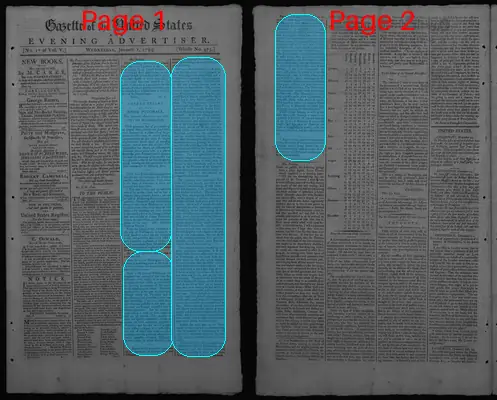
Gazette Of The United States & Evening Advertiser
Philadelphia, Philadelphia County, Pennsylvania
What is this article about?
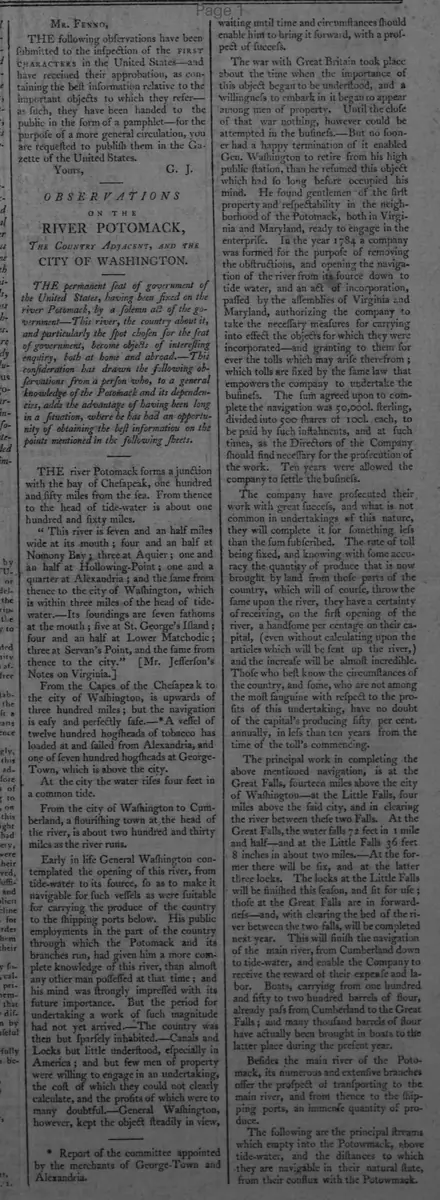
Detailed observations on the Potomac River's geography, navigation from Chesapeake Bay to Cumberland, and improvements by the Potomack Company formed in 1784 under General Washington's initiative, highlighting its importance for the U.S. capital at Washington City.
Merged-components note: This is a continuation of the article 'OBSERVATIONS ON THE RIVER POTOMACK' across pages 1 and 2, ending with '[TO BE CONTINUED.]'.
Clippings
1 of 2
OCR Quality
Full Text
submitted to the inspection of the FIRST
CHARACTERS in the United States—and
have received their approbation, as con-
taining the best information relative to the
important objects to which they refer—
as such, they have been handed to the
public in the form of a pamphlet—for the
purpose of a more general circulation, you
are requested to publish them in the Ga-
zette of the United States.
Yours,
G. J.
OBSERVATIONS
ON THE
RIVER POTOMACK.
THE COUNTRY ADJACENT, AND THE
CITY OF WASHINGTON.
THE permanent seat of government of
the United States, having been fixed on the
river Potomack, by a solemn act of the go-
vernment—This river, the country about it,
and particularly the spot chosen for the seat
of government, become objects of interesting
enquiry, both at home and abroad.—This
consideration has drawn the following ob-
servations from a person who, to a general
knowledge of the Potomack and its dependen-
cies, adds the advantage of having been long
in a situation, where he has had an opportu-
nity of obtaining the best information on the
points mentioned in the following sheets.
THE river Potomack forms a junction
with the bay of Chesapeake, one hundred
and fifty miles from the sea. From thence
to the head of tide-water is about one
hundred and sixty miles.
This river is one and an half miles
wide at its mouth ; four and an half at
Nomony Bay: three at Aquia; one and
an half at Hollowing-Point; one and a
quarter at Alexandria ; and the same from
thence to the city of Washington, which
is within three miles of the head of tide-
water.—Its soundings are seven fathoms
at the mouth ; five at St. George's Island;
four and an half at Lower Matchodic;
three at Sheridan's Point, and the same from
thence to the city. [Mr. Jefferson's
Notes on Virginia.]
From the Capes of the Chesapeake to
the city of Washington, is upwards of
three hundred miles; but the navigation
is easy and perfectly safe.—A vessel of
twelve hundred hogsheads of tobacco has
loaded at and sailed from Alexandria, and
one of seven hundred hogsheads at George-
Town, which is above the city.
At the city the water rises four feet in
a common tide.
From the city of Washington to Cum-
berland, a flourishing town at the head of
the river, is about two hundred and thirty
miles as the river runs.
Early in life General Washington con-
templated the opening of this river, from
tide-water to its source, so as to make it
navigable for such vessels as were suitable
for carrying the produce of the country
to the shipping ports below. His public
employments in the part of the country
through which the Potomack and its
branches run, had given him a more com-
plete knowledge of this river, than almost
any other man possessed at that time; and
his mind was strongly impressed with its
future importance. But the period for
undertaking a work of such magnitude
had not yet arrived.—The country was
then but sparingly inhabited. Canals and
Locks but little understood, especially in
America : and but few men of property
were willing to engage in an undertaking,
the cost of which they could not clearly
calculate, and the profits of which were to
many doubtful. General Washington,
however, kept the object steadily in view,
waiting until time and circumstances should
enable him to bring it forward, with a pro-
spect of success.
The war with Great Britain took place
about the time when the importance of
this object began to be understood, and a
willingness to embark in it began to appear
among men of property. Until the close
of that war nothing, however could be
attempted in the business.—But no soon-
er had a happy termination of it enabled
Gen. Washington to retire from his high
public station, than he resumed this object
which had so long before occupied his
mind. He found gentlemen of the first
property and respectability in the neigh-
borhood of the Potomack, both in Virgi-
nia and Maryland, ready to engage in the
enterprise. In the year 1784 a company
was formed for the purpose of removing
the obstructions, and opening the naviga-
tion of the river from its source down to
tide water, and an act of incorporation,
passed by the assemblies of Virginia and
Maryland, authorizing the company to
take the necessary measures for carrying
into effect the objects for which they were
incorporated—and granting to them for
ever the tolls which may arise therefrom ;
which tolls are fixed by the same law that
empowers the company to undertake the
business. The sum agreed upon to com-
plete the navigation was 50,000l. sterling,
divided into 500 shares of 100l. each, to
be paid by such instalments, and at such
times, as the Directors of the Company
should find necessary for the prosecution of
the work. Ten years were allowed the
company to settle the business.
The company have prosecuted their
work with great success, and what is not
common in undertakings of this nature,
they will complete it for something less
than the sum subscribed. The rate of toll
being fixed, and knowing with some accu-
racy the quantity of produce that is now
brought by land from those parts of the
country, which will of course, throw the
same upon the river, they have a certainty
of receiving, on the first opening of the
river, a handsome percentage on their ca-
pital, (even without calculating upon the
articles which will be sent up the river,)
and the increase will be almost incredible.
Those who best know the circumstances of
the country, and some, who are not among
the most sanguine with respect to the pro-
fits of this undertaking, have no doubt
of the capital's producing fifty per cent.
annually, in less than ten years from the
time of the toll's commencing.
The principal work in completing the
above mentioned navigation, is at the
Great Falls, fourteen miles above the city
of Washington—at the Little Falls, four
miles above the said city, and in clearing
the river between these two Falls. At the
Great Falls, the water falls 72 feet in 1 1/2 mile
and at the Little Falls 36 feet 8 inches in about two miles.—At the for-
mer there will be six, and at the latter
three locks. The locks at the Little Falls
will be finished this season, and fit for use:
those at the Great Falls are in forward-
ness and, with clearing the bed of the ri-
ver between the two falls, will be completed
next year. This will finish the navigation
of the main river, from Cumberland down
to tide-water, and enable the Company to
receive the reward of their expense and la-
bor. Boats, carrying from one hundred
and fifty to two hundred barrels of flour,
have actually been brought in boats to the
already pass from Cumberland to the Great
Falls; and many thousand barrels of flour
at the latter place during the present year.
offer the prospect of transporting to the
Besides the main river of the Poto-
mack, its numerous and extensive branches
main river, and from thence to the ship-
ping ports, an immense quantity of pro-
v, duce.
The following are the principal streams
which empty into the Potomack, above
d tide-water, and the distances to which
d they are navigable in their natural state,
from their confluence with the Potowmack.
Patterson's Creek, which falls into the river ten miles below Cumberland, is navigable twenty miles above its mouth:-
The South Branch, seventeen miles below Cumberland, is navigable one hundred miles;-Connogocheque, ninety miles below, is navigable twenty-four miles; O.
pecan, one hundred and twenty-five miles below, is navigable twenty-five miles from its mouth, and within a few miles of Win-
chester, which, after Lancaster, is the larg-
est inland town in the United States;-
The Shanandoah, one hundred and thir-
ty miles below, runs into the country at
right angles from the Potowmack, nearly
two hundred miles, and the navigation of
it, for one hundred and fifty miles of that
distance, is but little interrupted; the
chief obstruction is, where it enters the
Potowmack; and, so trifling is that, com-
pared with the great advantages of this
noble branch, that its removal and clearing
other parts, will not cost more than twen-
ty-five thousand dollars. The Potowmack
Company have already made a beginning
on this work.—The Monocacy, one hun-
dred and fifty miles below Cumberland, is
navigable thirty miles above its mouth.
This branch is within two miles of Frede-
rick-Town, in Maryland, one of the larg-
est inland towns in the United States. *
These several streams, as well as the
main river, pass through a country not
exceeded in fertility of soil and salubrity
of air, by any in America, if any in the
world; and few parts of America can
boast of being equally healthy with the
banks of this river, and the adjacent coun-
try.
* Report of the committee appointed
by the Merchants of Georgetown and Al-
exandria, which, being founded on the
actual observations made by order of the
Directors of the Potomack company, may
be deemed authentic.
[TO BE CONTINUED.]
What sub-type of article is it?
What themes does it cover?
What keywords are associated?
What entities or persons were involved?
Where did it happen?
Story Details
Key Persons
Location
River Potomack, City Of Washington, Virginia, Maryland, Chesapeake Bay
Event Date
1784
Story Details
General Washington initiated efforts to navigate the Potomac River from tidewater to its source; in 1784, the Potomack Company was formed with Virginia and Maryland support to remove obstructions, build locks at Great and Little Falls, enabling transport of produce like flour and tobacco to ports near the new U.S. capital.