Thank you for visiting SNEWPapers!
Sign up free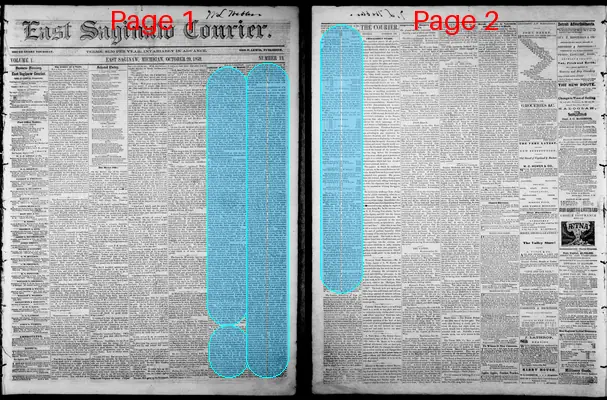
East Saginaw Courier
East Saginaw, Saginaw, Saginaw County, Michigan
What is this article about?
Mr. Shoemaker, Collector of Customs in Detroit, defends against press attacks accusing him of mismanagement. He details reforms to the disorganized office since 1857, including better oversight of goods and finances, and provides statistics showing increased exports and tonnage under his administration compared to predecessors.
Merged-components note: Continuation of the article on the Detroit Customs Collector Shoemaker's defense and statistics across pages 1 and 2; relabeled from 'letter_to_editor' to 'domestic_news' as it is a news feature, not a reader letter.
Clippings
1 of 2
OCR Quality
Full Text
For some months past a bitter crusade has been waged against Mr. Shoemaker, Collector of Customs, of Detroit, through the columns of a vindictive, and "insignificant" Black Republican sheet of that city. It is said that the attack is instigated by a former Collector of that port—a person whom we have heretofore highly estimated as a prominent Democrat, and the last person whom we should suspect of traducing a partisan in the opposition prints. These agitators, and their correspondents, have induced some of the country Press to re-echo the charges against Mr. S.; and an agent from Washington has visited Detroit for the purpose of investigating affairs.—The charge that "Mr. Shoemaker was from the country, and had no business to accept the office," as urged by a correspondent in the Grand Rapids paper,—that Detroit is entitled to all the Federal offices, every Democrat outside of Detroit is ready to refute. But if the charges are well founded, and the Collector has unadvisedly over-stepped the bounds of duty, he will be removed; but the Democracy of the State, among whom he has a host of friends, will expect a thorough an impartial hearing at the Department, and that all the local prejudices bargains, and intrigues of the Detroit clique will be ignored. Mr. Shoemaker has long been a prominent citizen of Jackson, whose honesty and integrity has never been questioned, and whose business qualifications are of the highest character.
Mr. S. has furnished us with the following statement of Custom House affairs during his administration:
"When I entered upon the discharge of the duties of the office of Collector of the Port of Detroit, I found it in a state of almost entire disorganization, and much of the most important business neglected and not done at all. I will state a few facts from which the rest may be judged. The freights landed by the steamers of the Great Western Railway Company at the Depot of the Michigan Central and Detroit and Milwaukee Railroads, were not checked or examined at all, by the officers of the Customs, to ascertain whether they were Canada, or from the United States in transit, and these goods frequently amounted to from thirty to one hundred car loads per day; the goods known to be from Canada, and landed at the wharfs of the agents of the Great Western Rail Company, were not checked or examined at all by the officers of the Customs, but the agent received them, at such times as they were called for, or were sent to their owners, and the officers of the customs could not tell whether they were all entered, or but a part of them. Many of the vessels clearing were not required to deliver a manifest of their cargo, but were given a blank clearance and manifest, to be filled up and the latter returned to the office, if not neglected or forgotten. The business of the office was done through a bank, and demands and vouchers paid by checks thereon. Bank notes were taken for fees, hospital dues, inspection papers and duties, unless of a large amount, and the bank notes paid out again or deposited.
Not only was all the Railroad Iron in bond belonging to the Detroit and Toledo Railroad, and the Detroit and Milwaukee Railroad, delivered without payment of duties, but bonded goods of all kinds, and all in bond, were delivered to the owners with but one or two exceptions, and in some cases had, I found, been entirely disposed of. Bonds were taken in blanks, and still remain so, for the licensing of steamers and vessels. Receipts in blank were taken from subordinate officers. There was no account kept of the goods coming from Canada by express, whether through or way, and these goods were entered without the officers of the customs knowing whether those from Canada were or not all entered.—I might further particularize, but from these facts the condition of the business of this District will be understood, and some idea may be formed of the difficulties under which I labored when I state that when I was appointed I never had held an appointment under the General Government, and could only judge of the manner in which it held its officers accountable, by what was the rule in this office. I did not however, continue these practices, but without prompting from any quarter, amended them, and brought the office up to the standard of the regulations as fast and as soon as it was possible for me to do so, under the circumstances, and more rapidly, I have no hesitation in saying, than would most other men in the State with my want of experience.
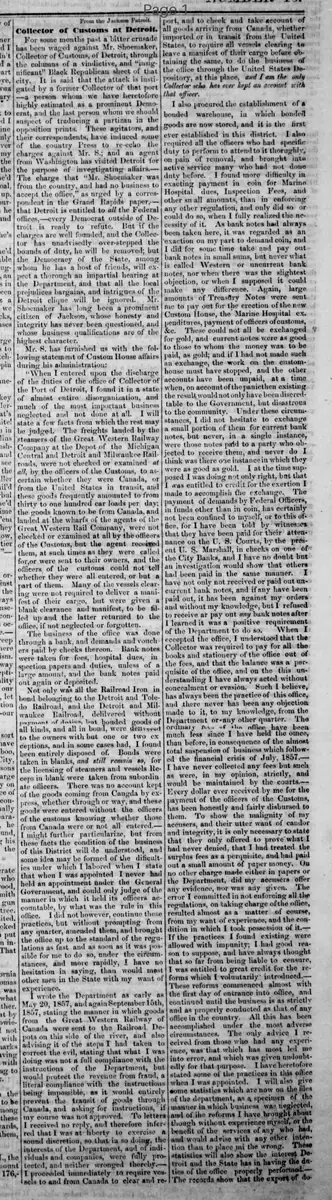
I wrote the Department as early as May 20, 1857, and again September 15th, 1857, stating the manner in which goods from the Great-Western Railway of Canada were sent to the Railroad Depots on this side of the river, and also advising it of the steps I had taken to correct the evil, stating that what I was doing was not a full compliance with the instructions of the Department, but would protect the revenue from fraud, a literal compliance with the instructions being impossible, as it would entirely prevent the transit of goods through Canada, and asking for instructions, if my course was not approved. To letters I received no reply, and therefore inferred that I was at liberty to exercise a sound discretion, so that in so doing, the interests of the Department, and of individuals and companies, were fully protected, and neither wronged thereby.—I proceeded immediately to require vessels to and from Canada to clear and report, and to check and take account of all goods arriving from Canada, whether imported or in transit from the United States, to require all vessels clearing to leave a manifest of their cargo before obtaining the same, to do the business of the office through the United States Depository, at this place, and I am the only Collector who has ever kept an account with that officer.
I also procured the establishment of a bonded warehouse, in which bonded goods are now stored, and it is the first ever established in this district. I also required all the officers who had specific duty to perform to attend to it thoroughly, on pain of removal, and brought into active service many who had not done duty before. I found more difficulty in exacting payment in coin for Marine Hospital dues, Inspection Fees, and other small amounts, than in enforcing any other regulation, and only did so or could do so, when I fully realized the necessity of it. As bank notes had always been taken here, it was regarded as an exaction on my part to demand coin, and I did for some time take and pay out—bank notes in small sums, but never what is called Western or uncurrent bank notes, nor when there was the slightest objection, or when I supposed it could make any difference. Again, large amounts of Treasury Notes were sent me to pay out for the erection of the new Custom House, the Marine Hospital expenditures, payment of officers of customs, &c. These could not all be exchanged for gold, and current notes were as good to those to whom the money was to be paid, as gold; and if I had not made such an exchange, the work on the custom-house must have stopped, and the other accounts have been unpaid, at a time when, on account of the panic then existing the result would not only have been discreditable to the Government, but disastrous to the community. Under these circumstances, I did not hesitate to exchange a small portion of them for current bank notes, but never, in a single instance, were those notes paid to a party who objected to receive them, and never do I think was there one instance in which they were as good as gold. I at the time supposed I was doing not only right, but that I was entitled to credit for the exertion I made to accomplish the exchange. The payment of demands by Federal Officers, in funds other than in coin, has certainly not been confined to myself, or to this office, for I have been told by witnesses. that they have been paid for their attendance on the U. S. Courts, by the present U. S. Marshall, in checks on one of the City Banks, and I have no doubt but an investigation would show that others had been paid in the same manner. I have not only not received or paid out uncurrent bank notes, and if any have been paid out, it has been against my orders and without my knowledge, but I refused to receive or pay out any bank notes after I learned it was a positive requirement of the Department to do so. When I accepted the office, I understood that the Collector was required to pay for all the books and stationery of the office out of the fees, and that the balance was a perquisite of the office, and on this understanding I have always acted without concealment or evasion. Such I believe, has always been the practice of this office, and there never has been any objection made to it, to my knowledge, from the Department or any other quarter. The ordinary fees of the office have been much less since I have held the office, than before, in consequence of the almost total suspension of business which followed the financial crisis of July, 1857.—I have never collected any fees but such as were, in my opinion, strictly, and would be maintained by the courts.—Every dollar ever received by me for the payment of the officers of the Customs, has been honestly and fairly disbursed to them. To show the malignity of my accusers, and their utter want of candor and integrity, it is only necessary to state that they only offered to prove what I had never denied, that I had treated the surplus fees as a perquisite, and had paid out a small amount of paper money. On no other charge made either in papers or the Department, did my accusers offer any evidence, nor was any given. The error I committed in not enforcing all the regulations, on taking charge of the office, resulted almost as a matter of course from my want of experience, and the condition in which I took possession of it.—If the practices I found existing were allowed with impunity; I had good reason to suppose, and have always thought that so far from being liable to censure, I was entitled to great credit for the reforms which I voluntarily introduced.—These reforms commenced almost with the first day of entrance into office, and continued until the business is as strictly and as properly conducted as that of any office in the country. All this has been accomplished under the most adverse circumstances. The only advice I received from those who had any experience, was that which has most led me into error, and which was given undoubtedly for that purpose. I have heretofore stated some of the practices in this office when I was appointed. I will also give some statistics which are now on the files of the department, as a specimen of the manner in which business was neglected, and of the reforms I have brought about though without experience myself, or the benefit of the services of any who had, and would advise with any other intention than to place me in the wrong. These statistics will also show the interest Detroit and the State has in having the duties of the office properly performed.
The records show that the export of do- Customs produce from the District of Detroit was for the year ending June 30th, 1854, under J. H. Harmon, $125,404.00
Year ending June 30th, 1855, $18,250.00
1856, $36,615.00
1857, except the last quarter, $102,606.00
For the year ending June 30th, 1858, under M. Shoemaker, $1,435,301.00
For the year ending June 30th, 1859, under M. Shoemaker, $963,640.00
Showing an exportation fifty times greater than the lowest of my two years, than the lowest of the four preceding years, and an average exportation nearly twenty times greater during the two years I have been in office, than for the four previous years; and yet it is an undeniable fact that on account of the change in the times, the exportations must have been greater during any one of the first four, than the last two years, and these remarks apply equally well to all the other tables. The exports of domestic produce in foreign vessels, was for the year ending June 30th, 1854, under J. H. Harmon, $179,726.00
1855, $199,697.00
1856, $863,019.00
1857, except last quarter, $1,765,530.00
30th, 1858, under M. Shoemaker, $3,737,095.00
1859, $2,742,284.00
These records show an exportation fifteen times greater than the lowest of the last two than of the first four years, and that the average for the four years preceding my appointment was not one-fourth as much as during the last two years, and of the returns of 1857, $982,942 was in the first quarter of my term of office.
The tonnage of American vessels entered from Foreign Ports, was, for the year ending June 30, 1854, under J. H. Harmon, 5,531
1855, 4,736
1856, 13,999
1857, 40,060
1858, M. Shoemaker, 77,697
1859, 157,478
By these statistics it would appear that the tonnage was over fifteen times greater the lowest of the last two than the lowest of the first four years, and that the average for the last two years has been seven times greater than for the four years preceding, though there can be no doubt but it was actually greater during the former period; and of the returns of 1857, 18,523 was in the first quarter after my term commenced.
The tonnage of Foreign vessels entered from Foreign ports was, for the year ending June 30, 1854, under J. H. Harmon, 61,481
Year ending June 30, 1855, J. H. Harmon, 38,208
1856, 55,945
1857 except last quarter, 128,642
Year ending June 30, 1858, M. Shoemaker, 142,092
1859, 171,222
The average amount of tonnage being seven times greater the last two than the first four years.
The tonnage of American vessels cleared to Foreign ports was for the year ending June 30, 1854, under J. H. Harmon, 9,403
Year ending June 30, 1855, J. H. Harmon, 2,966
1856, 17,368
1857 except the last quarter, 50,061
Year ending June 30, 1858, M. Shoemaker, 113,655
1859, 192,029
Showing an increase from less than 3,000, in 1855, to near 200,000 in 1859, and showing the last two years an average amount of tonnage near eight times greater than the preceding years.
The amount of duties, except those withdrawn from Bonded Warehouse during the last two years of Mr. Harmon's term, was $8,980.01, while for the two years from my appointment, the receipts from the same kind of duties amounted to $22,213.57. These are the duties collected on importations made direct to Detroit: these goods in bond being mostly forwarded from New York and other ports, and when the change in times is taken into consideration, as the years during Mr. Harmon's term were of unexampled prosperity, and those of mine of great depression and embarrassment, it is, to say the least of it, very remarkable that the importations should be nearly three times as large during years when business was almost entirely suspended as during years when the country was in the state of highest prosperity.
The errors I have committed have been such as were almost inevitable from the practices in force when I came into office, but there is not one of them which with any man can in the least degree affect upon my character as a man of integrity. My enemies did not charge me at the Department with one tenth of what they in the papers accused me of, and did not attempt to prove most of the charges they made.
I ought not to be held responsible for the continuance of practices which had existed ever since the office was established, and which I corrected as soon as I knew it was required of me to do so; but if I am, I only ask to be judged by every man by what he knows of me and of my actions, and not by what my enemies say of me.
M. SHOEMAKER.
What sub-type of article is it?
What keywords are associated?
What entities or persons were involved?
Where did it happen?
Domestic News Details
Primary Location
Detroit
Event Date
1857 1859
Key Persons
Outcome
investigation by agent from washington; shoemaker defends reforms and provides statistics showing improved performance; no removal mentioned, expects fair hearing.
Event Details
Bitter press crusade against Mr. Shoemaker, Collector of Customs in Detroit, instigated by former collector; charges of mismanagement in disorganized office; Shoemaker details initial disorganization, reforms implemented since appointment, correspondence with Department in 1857, establishment of bonded warehouse, and statistics on exports, tonnage, and duties under his and predecessor Harmon's administrations demonstrating increases despite economic panic.