Thank you for visiting SNEWPapers!
Sign up free
Fowle's New Hampshire Gazette And General Advertiser
Portsmouth, Rockingham County, New Hampshire
What is this article about?
In Roxbury on April 4, 1786, the Committee on Agriculture, appointed by the American Academy of Arts and Sciences, recommends Major John J. Spooner's method of field-cultivating carrots for cattle feed, based on his experiment yielding nearly 40 bushels from a quarter acre despite neglect and drought.
Clipping
OCR Quality
Full Text
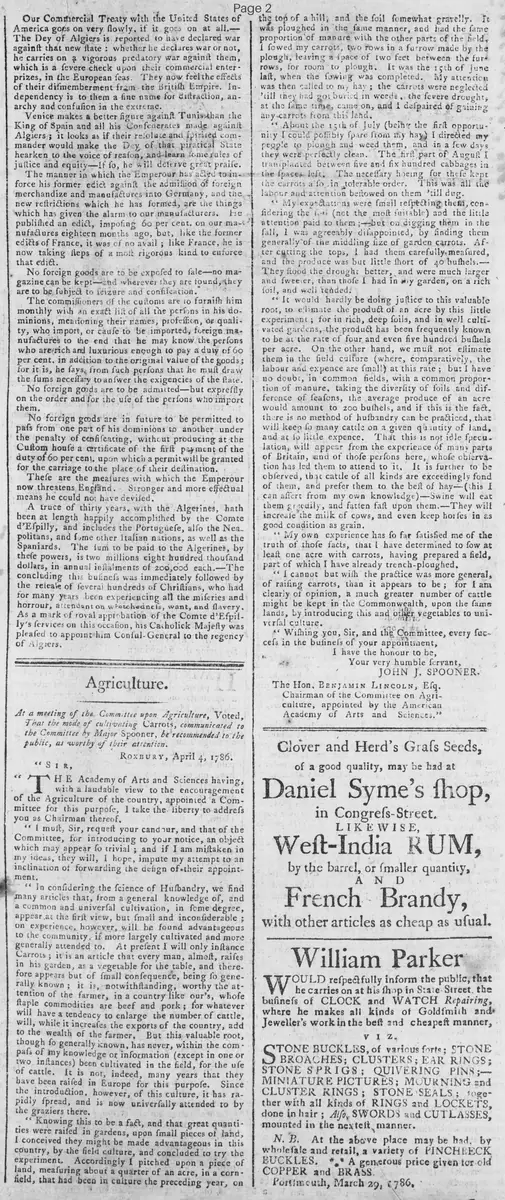
At a meeting of the Committee upon Agriculture, Voted, That the mode of cultivating Carrots, communicated to the Committee by Major Spooner, be recommended to the public, as worthy of their attention.
Roxbury, April 4, 1786.
"SIR,
The Academy of Arts and Sciences having, with a laudable view to the encouragement of the Agriculture of the country, appointed a Committee for this purpose, I take the liberty to address you as Chairman thereof,
"I must, Sir, request your candour, and that of the Committee, for introducing to your notice, an object which may appear so trivial ; and if I am mistaken in my ideas, they will, I hope, impute my attempt to an inclination of forwarding the design of -their appointment.
"In considering the science of Husbandry, we find many articles that, from a general knowledge of, and a common and universal cultivation, in some degree, appear at the first view, but small and inconsiderable ; on experience, however. will be found advantageous to the community. if more largely cultivated and more generally attended to. At present I will only instance Carrots ; it is an article that every man, almost, raises in his garden, as a vegetable for the table, and therefore appears but of small consequence, being so generally known ; it is, notwithstanding, worthy the attention of the farmer, in a country like our's, whose staple commodities are beef and pork; for whatever will have a tendency to enlarge the number of cattle, will, while it increases the exports of the country, add to the wealth of the farmer. But this valuable root, though so generally known, has never, within the compass of my knowledge or information (except in one or two instances) been cultivated in the field, for the use of cattle. It is not, indeed, many years that they have been raised in Europe for this purpose. Since the introduction, however, of this culture, it has rapidly spread, and is now universally attended to by the graziers there.
"Knowing this to be a fact, and that great quantities were raised in gardens, upon small pieces of land, I conceived they might be made advantageous in this country, by the field culture, and concluded to try the experiment. Accordingly I pitched upon a piece of land, measuring about a quarter of an acre, in a corn-field, that had been in culture the preceding year, on the top of a hill; and the soil somewhat gravelly. It was ploughed in the same manner. and had the same proportion of manure with the other parts of the field. I sowed my carrots, two rows in a furrow made by the plough, leaving a space of two feet between the furrows, for room to plough. It was the 15th of June last, when the sowing was completed. My attention was then called to my hay ; the carrots were neglected 'till they had got buried in weeds , the severe drought; at the same time, came on, and I despaired of gaining any carrots from this land.
"About the 12th of July (being the first opportunity I could possibly spare from my hay) I directed my people to plough and weed them, and in a few days they were perfectly clean. The first part of August I transplanted between five and six hundred cabbages in the spaces left. The necessary hoeing for these kept the carrots also .in tolerable order. This was all the labour and attention bestowed on them 'till dug.
"My expectations were small respecting them, considering the soil (not the most suitable) and the little attention paid to them ;-but on digging them in the fall, I was agreeably disappointed, by finding them generally of the middling size of garden carrots. After cutting the tops, I had them carefully measured, and the produce was but little short of 40 bushels.--They stood the drought better, and were much larger and sweeter, than those I had in my garden, on a rich soil, and well tended!
"It would hardly be doing justice to this valuable root, to estimate the product of an acre by this little experiment ; for in rich, deep soils, and in well cultivated gardens,-the product has been frequently known to be at the rate of four and even five hundred bushels per acre. On the other hand, we must not estimate them in the field culture (where, comparatively, the labour and expence are small) at this rate; but I have no doubt, in common fields, with a common proportion of manure, taking the diversity of soils and difference of seasons, the average produce of an acre would amount to 200 bushels, and if this is the fact. there is no method of husbandry can be practiced, that will keep so many cattle on a given quantity of land, and at so little expence. That this is not idle peculation, will appear from the experience of many parts of Britain, and of those persons here, whose observation has led them to attend to it, "It is further to be observed, that cattle of all kinds are exceedingly fond of them, and prefer them to the best of hay- (this I can assert from my own knowledge)--Swine will eat them greedily, and fatten fast upon them.--They will increase the milk of cows, and even keep horses in as good condition as grain.
"My own experience has so far satisfied me of the truth of those facts, that l have determined to sow at least one acre with carrots, having prepared a field, part of which I have already trench-ploughed.
"I cannot but wish the practice was more general, of raising carrots, than it appears to be; for I am clearly of opinion, a much greater number of cattle might be kept in the Commonwealth, upon the same lands, by introducing this and other vegetables to universal culture.
"Wishing you, Sir, and the Committee, every success in the business of your appointment,
I have the honour to be,
Your very humble servant,
JOHN J. SPOONER.
The Hon. Benjamin Lincoln, Esq.
Chairman of the Committee on Agriculture, appointed by the American Academy of Arts and Sciences."
What sub-type of article is it?
What keywords are associated?
What entities or persons were involved?
Where did it happen?
Domestic News Details
Primary Location
Roxbury
Event Date
1786 04 04
Key Persons
Outcome
the experiment yielded nearly 40 bushels of carrots from a quarter acre, despite neglect and drought; committee votes to recommend the method to the public.
Event Details
The Committee upon Agriculture votes to recommend Major Spooner's mode of cultivating carrots, detailed in his letter describing a field experiment on a quarter acre sown June 15, 1785, weeded July 12, with cabbages transplanted in August, dug in fall, producing middling-sized carrots preferred by cattle over hay.