Thank you for visiting SNEWPapers!
Sign up free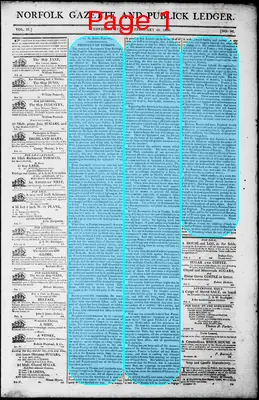
Norfolk Gazette And Publick Ledger
Norfolk, Virginia
What is this article about?
Analysis of Napoleon's rapid march from Boulogne to Vienna, defeating Austrian forces under Mack, and prospects for continued resistance by Austria with Russian aid, potential Prussian involvement, and the broader threat to European independence.
Clipping
OCR Quality
Full Text
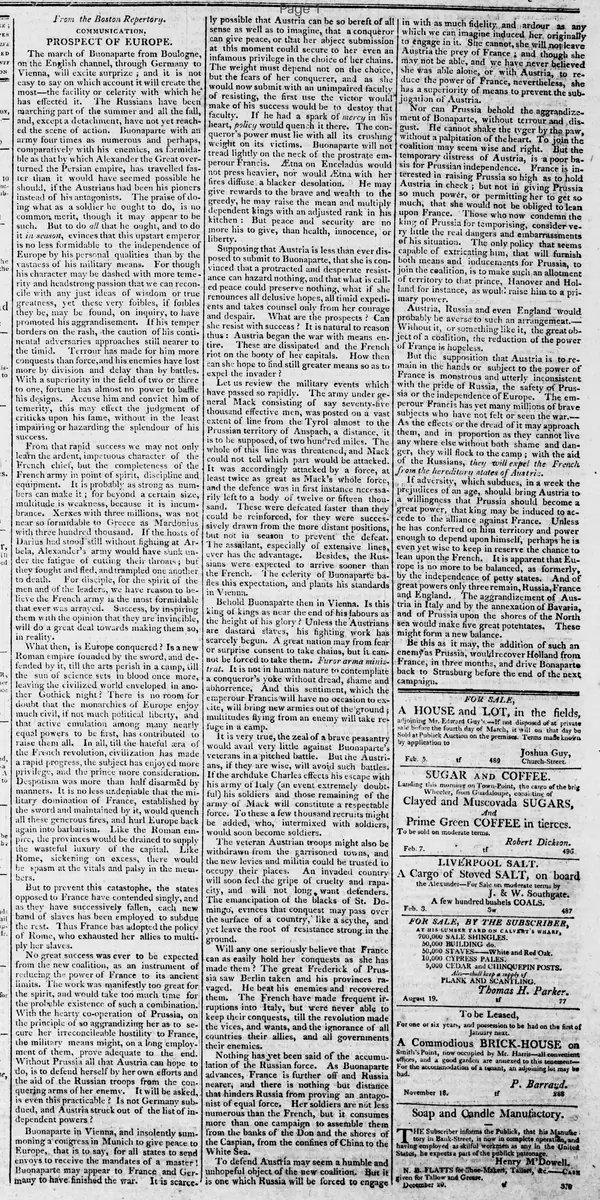
COMMUNICATION.
PROSPECT OF EUROPE.
The march of Buonaparte from Boulogne, on the English channel, through Germany to Vienna, will excite surprize; and it is not easy to say on which account it will create the most—the facility or celerity with which he has effected it. The Russians have been marching part of the summer and all the fall, and, except a detachment, have not yet reached the scene of action. Buonaparte with an army four times as numerous and perhaps, comparatively with his enemies, as formidable as that by which Alexander the Great overturned the Persian empire, has travelled faster than it would have seemed possible he should, if the Austrians had been his pioners instead of his antagonists. The praise of doing what as a soldier he ought to do, is no common merit, though it may appear to be such. But to do all that he ought, and to do it in season, evinces that this upstart emperor is no less formidable to the independence of Europe by his personal qualities than by the vastness of his military means. For though his character may be dashed with more temerity and headstrong passion that we can reconcile with any just ideas of wisdom or true greatness, yet these very foibles, if foibles they be, may be found, on inquiry, to have promoted his aggrandisement. If his temper borders on the rash, the caution of his continental adversaries approaches still nearer to the timid. Terrour has made for him more conquests than force, and his enemies have lost more by division and delay than by battles. With a superiority in the field of two or three to one, fortune has almost no power to baffle his designs. Accuse him and convict him of temerity, this may effect the judgment of criticks upon his fame, without in the least impairing or hazarding the splendour of his success.
From that rapid success we may not only learn the ardent, impetuous character of the French chief, but the completeness of the French army in point of spirit, discipline and equipment. It is probably as strong as numbers can make it; for beyond a certain size, multitude is weakness, because it is incumbrance. Xerxes with three millions, was not near so formidable to Greece as Mardonius with three hundred thousand. If the hosts of Darius had stood still without fighting at Arbela, Alexander's army would have sunk under the fatigue of cutting their throats; but they fought and fled, and trampled one another to death. For discipline, for the spirit of the men and of the leaders, we have reason to believe the French army is the most formidable that ever was arrayed. Success, by inspiring them with the opinion that they are invincible, will do a great deal towards making them so, in reality.
What then, is Europe conquered? Is a new Roman empire founded by the sword, and defended by it, till the arts perish in a camp, till the sun of science sets in blood once more, leaving the civilized world enveloped in another Gothick night? There is no room for doubt that the monarchies of Europe enjoy much civil, if not much political liberty, and that active emulation among many nearly equal powers to be first, has contributed to raise them all. In all, till the hateful æra of the French revolution, civilization has made a rapid progress, the subject has enjoyed more privilege, and the prince more consideration. Despotism was more than half disarmed by manners. It is no less undeniable that the military domination of France, established by the sword and maintained by it, would quench all these generous fires, and hurl Europe back again into barbarism. Like the Roman empire, the provinces would be drained to supply the wasteful luxury of the capital. Like Rome, sickening on excess, there would be spasm at the vitals and palsy in the members.
But to prevent this catastrophe, the states opposed to France have contended singly, and as they have successively fallen, each new band of slaves has been employed to subdue the rest. Thus France has adopted the policy of Rome, who exhausted her allies to multiply her slaves.
No great success was ever to be expected from the new coalition, as an instrument of reducing the power of France to its ancient limits. The work was manifestly too great for the spirit, and would take too much time for the probable existence of such a combination. With the hearty co-operation of Prussia, on the principle of so aggrandizing her as to secure her irreconcileable hostility to France, the military means might, on a long employment of them, prove adequate to the end. Without Prussia all that Austria can hope to do, is to defend herself by her own efforts and the aid of the Russian troops from the conquering arms of her enemy. It will be asked, is even this practicable? Is not Germany subdued, and Austria struck out of the list of independent powers?
Buonaparte in Vienna, and insolently summoning a congress in Munich to give peace to Europe, that is to say, for all states to send envoys to receive the mandates of a master! Buonaparte may appear to France and Germany possible that Austria can be so bereft of all sense as well as to imagine, that a conqueror can give peace, or that her abject submission at this moment could secure to her even an infamous privilege in the choice of her chains. The weight must depend not on the choice. but the fears of her conquerer, and as she would now submit with an unimpaired faculty of resisting, the first use the victor would make of his success would be to destroy that faculty. If he had a spark of mercy in his heart, policy would quench it there. The conqueror's power must lie with all its crushing weight on its victims. Buonaparte will not tread lightly on the neck of the prostrate emperour Francis. Etna on Enceladus would not press heavier, nor would Etna with her fires diffuse a blacker desolation. He may give rewards to the brave and wealth to the greedy, he may raise the mean and multiply dependent kings with an adjusted rank in his kitchen: But peace and security are no more his to give, than health, innocence, or liberty.
Supposing that Austria is less than ever disposed to submit to Buonaparte, that she is convinced that a protracted and desperate resistance can hazard nothing, and that what is called peace could preserve nothing, what if she renounces all delusive hopes, all timid expedients and takes counsel only from her courage and despair. What are the prospects? Can she resist with success? It is natural to reason thus: Austria began the war with means entire. These are dissipated and the French riot on the booty of her capitals. How then can she hope to find still greater means so as to expel the invader?
Let us review the military events which have passed so rapidly. The army under general Mack consisting of say seventy-five thousand effective men, was posted on a vast extent of line from the Tyrol almost to the Prussian territory of Anspach, a distance, it is to be supposed, of two hundred miles. The whole of this line was threatened, and Mack could not tell which part would be attacked. It was accordingly attacked by a force, at least twice as great as Mack's whole force, and the defence was in first instance necessarily left to a body of twelve or fifteen thousand. These were defeated faster than they could be reinforced, for they were successively drawn from the more distant positions, but not in season to prevent the defeat. The assailant, especially of extensive lines, ever has the advantage. Besides, the Russians were expected to arrive sooner than the French. The celerity of Buonaparte baffles this expectation, and plants his standards in Vienna.
Behold Buonaparte then in Vienna. Is this king of kings as near the end of his labours as the height of his glory? Unless the Austrians are dastard slaves, his fighting work has scarcely begun. A great nation may from fear or surprise consent to take chains, but it cannot be forced to take them. Furor arma ministrat. It is not in human nature to contemplate a conqueror's yoke without dread, shame and abhorrence. And this sentiment, which the emperour Francis will have no occasion to excite, will bring new armies out of the ground multitudes flying from an enemy will take refuge in a camp.
It is very true, the zeal of a brave peasantry would avail very little against Buonaparte's veterans in a pitched battle. But the Austrians, if they are wise, will avoid such battles. If the archduke Charles effects his escape with his army of Italy (an event extremely doubtful) his soldiers and those remaining of the army of Mack will constitute a respectable force. To these a few thousand recruits might be added, who, intermixed with soldiers, would soon become soldiers.
The veteran Austrian troops might also be withdrawn from the garrisoned towns, and the new levies and militia could be trusted to occupy their places. An invaded country will soon feel the gripe of cruelty and rapacity, and will not long want defenders. The emancipation of the blacks of St. Domingo, evinces that conquest may pass over the surface of a country, like a scythe, and yet leave the root of resistance strong in the ground.
Will any one seriously believe that France can as easily hold her conquests as she has made them? The great Frederick of Prussia saw Berlin taken and his provinces ravaged. He beat his enemies and recovered them. The French have made frequent irruptions into Italy, but were never able to keep their conquests, till the revolution made the vices, and wants, and the ignorance of all countries their allies, and all governments their enemies.
Nothing has yet been said of the accumulation of the Russian force. As Buonaparte advances, France is further off and Russia nearer, and there is nothing but distance that hinders Russia from proving an antagonist of equal force. Her soldiers are not less numerous than the French, but it consumes more than one campaign to assemble them from the banks of the Don and the shores of the Caspian, from the confines of China to the White Sea.
To defend Austria may seem a humble and unhopeful object of the new coalition. But it is one which Russia will be forced to engage in with as much fidelity and ardour as any which we can imagine induced her originally to engage in it. She cannot, she will not leave Austria the prey of France: and though she may not be able, and we have never believed she was able alone, or with Austria, to reduce the power of France, nevertheless, she has a superiority of means to prevent the subjugation of Austria.
Nor can Prussia behold the aggrandizement of Bonaparte, without terrour and disgust. He cannot shake the tiger by the paw, without a palpitation of the heart. To join the coalition may seem wise and right. But the temporary distress of Austria, is a poor basis for Prussian independence. France is interested in raising Prussia so high as to hold Austria in check; but not in giving Prussia so much power, or permitting her to get so much, that she would not be obliged to lean upon France. Those who now condemn the king of Prussia for temporising, consider very little the real dangers and embarrassments of his situation. The only policy that seems capable of extricating him, that will furnish both means and inducements for Prussia, to join the coalition, is to make such an allotment of territory to that prince, Hanover and Holland for instance, as would raise him to a primary power.
Austria, Russia and even England would probably be averse to such an arrangement.— Without it, or something like it, the great object of a coalition, the reduction of the power of France is hopeless.
But the supposition that Austria is to remain in the hands or subject to the power of France is monstrous and utterly inconsistent with the pride of Russia, the safety of Prussia or the independence of Europe. The emperour Francis has yet many millions of brave subjects who have not felt or seen the war.— As the effects or the dread of it may approach them, and in proportion as they cannot live any where else without both shame and danger, they will flock to the camp; with the aid of the Russians, they will expel the French from the hereditary states of Austria.
If adversity, which subdues, in a week the prejudices of an age, should bring Austria to a willingness that Prussia should become a great power, that king may be induced to accede to the alliance against France. Unless he has conferred on him territory and power enough to depend upon himself, perhaps he is even yet wise to keep in reserve the chance to lean upon the French. It is apparent that Europe is no more to be balanced, as formerly. by the independence of petty states. And of great powers only three remain, Russia, France and England. The aggrandizement of Austria in Italy and by the annexation of Bavaria, and of Prussia upon the shores of the North sea would make five great potentates. These might form a new balance.
Be this as it may, the addition of such an enemy as Prussia, would recover Holland from France, in three months, and drive Bonaparte back to Strasburg before the end of the next campaign.
What sub-type of article is it?
What keywords are associated?
What entities or persons were involved?
Where did it happen?
Foreign News Details
Primary Location
Vienna
Key Persons
Outcome
austrian army under mack defeated; french advance to vienna; potential for continued austrian resistance with russian aid and possible prussian alliance.
Event Details
Napoleon's rapid march through Germany to Vienna defeats Austrian forces led by General Mack, capturing the city. Analysis suggests Austria can resist with Russian support, peasant levies, and potential Prussian entry into coalition, preventing full French domination of Europe.