Thank you for visiting SNEWPapers!
Sign up free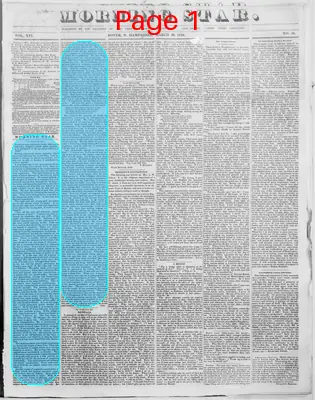
Letter to Editor
March 30, 1842
Morning Star
Limerick, York County, Maine
What is this article about?
A letter responding to a question in the Morning Star argues that human woes, sicknesses, death, and calamities like shipwrecks are not special providences of God but natural consequences of infringing the laws of nature through folly, intemperance, and idleness. It emphasizes living in accordance with these laws for health and happiness.
Clipping
OCR Quality
95%
Excellent
Full Text
MORNING STAR.
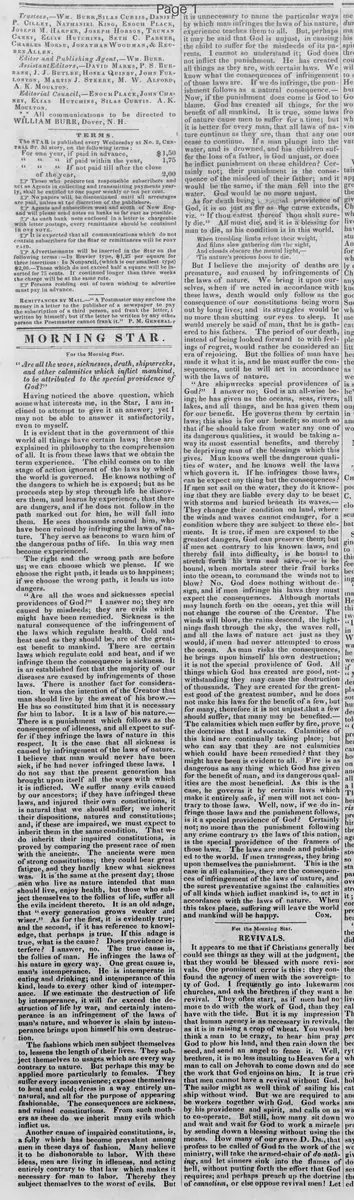
For the Morning Star.
"Are all the woes, sicknesses, death, shipwrecks, and other calamities which inflict mankind, to be attributed to the special providence of God?"
Having noticed the above question, which somewhat interests me, in the 'Star,' I am inclined to attempt to give it an answer; yet I may not be able to answer it satisfactorily, even to myself.
It is evident that in the government of this world all things have certain laws; these are explained in philosophy to the comprehension of all. It is from these laws that we obtain the term experience. The child comes on to the stage of action ignorant of the laws by which the world is governed. He knows nothing of the dangers to which he is exposed; but as he proceeds step by step through life he discovers them, and learns by experience, that there are dangers, and if he does not follow in the path marked out for him, he will fall into them. He sees thousands around him, who have been ruined by infringing the laws of nature. They serve as beacons to warn him of the dangerous paths of life. In this way men become experienced.
The right and the wrong path are before us; we can choose which we please. If we choose the right path, it leads us to happiness; if we choose the wrong path, it leads us into dangers.
"Are all the woes and sicknesses special providences of God?" I answer no; they are caused by misdeeds; they are evils which might have been remedied. Sickness is the natural consequence of the infringement of the laws which regulate health. Cold and heat used as they should be, are of the greatest benefit to mankind. There are certain laws which regulate cold and heat, and if we infringe them the consequence is sickness. It is an established fact that the majority of our diseases are caused by infringements of those laws. There is another fact for consideration. It was the intention of the Creator that man should live by the sweat of his brow.—He has so constituted him that it is necessary for him to labor. It is a law of his nature.—There is a punishment which follows as the consequence of idleness, and all expect to suffer if they infringe the laws of nature in this respect. It is the case that all sickness is caused by infringement of the laws of nature.
I believe that man would never have been sick, if he had never infringed these laws. I do not say that the present generation has brought upon itself all the woes with which it is inflicted. We suffer many evils caused by our ancestors; if they have infringed these laws, and injured their own constitutions, it is natural that we should suffer; we inherit their dispositions, natures and constitutions; and, if these are impaired, we must expect to inherit them in the same condition. That we do inherit their impaired constitutions, is proved by comparing the present race of men with the ancients. The ancients were men of strong constitutions; they could bear great fatigue, and they hardly knew what sickness was. It is the same at the present day; those men who live as nature intended that man should live, enjoy health, but those who subject themselves to the follies of life, suffer all the evils incident thereto. It is an old adage, that "every generation grows weaker and wiser." As for the first, it is evidently true; and the second, if it has reference to knowledge, that perhaps is true. If this adage is true, what is the cause? Does providence interfere? I answer, no. The true cause is, the follies of man. He infringes the laws of his nature in every way. One great cause is, man's intemperance. He is intemperate in eating and drinking; and intemperance of this kind, leads to every other kind of intemperance. If we estimate the destruction of life by intemperance, it will far exceed the destruction of life by war, and certainly intemperance is an infringement of the laws of man's nature, and whoever is slain by intemperance brings upon himself his own destruction.
The fashions which men subject themselves to, lessens the length of their lives. They subject themselves to usages which are every way contrary to nature. But perhaps this may be applied more particularly to females. They suffer every inconvenience; expose themselves to heat and cold; dress in a way entirely unnatural, and all for the purpose of appearing fashionable. The consequences are sickness, and ruined constitutions. From such mothers as these do we inherit many evils which inflict us.
Another cause of impaired constitutions, is a folly which has become prevalent among men in these days of fashion. Many believe it to be dishonorable to labor. With these ideas, men are living in idleness, and acting entirely contrary to that law which makes it necessary for man to labor. Thereby they subject themselves to the worst of evils. But it is unnecessary to name the particular ways by which man infringes the laws of his nature, experience teaches them to all. But, perhaps it may be said that God is unjust, in causing the child to suffer for the misdeeds of its parents. I cannot so understand it; God does not inflict the punishment. He has created all things as they are, with certain laws. We know what the consequences of infringement of those laws are. If we do infringe, the punishment follows as a natural consequence.—Now, if the punishment does come is God to blame. God has created all things, for the benefit of all mankind. It is true, some laws of nature cause men to suffer for a time; but it is better for every man, that all laws of nature continue as they are, than that any one cease to continue. If a man plunge into the water, and is drowned, and his children suffer the loss of a father, is God unjust, or does he inflict punishment on these children? Certainly not; their punishment is the consequence of the misdeed of their father; and it would be the same, if the man fell into the water. God would be no more unjust.
As for death being a special providence of God, it is so just as far as the curse extends, viz. "If thou eatest thereof thou shalt surely die." All must die, and it is a blessing for man to die, as his condition is in this world.
When trembling limbs refuse their weight
And films slow gathering dim the sight,
And clouds obscure the mental light,—
'Tis nature's precious boon to die.
But I believe the majority of deaths are premature, and caused by infringements of the laws of nature. We bring it upon ourselves, when if we acted in accordance with these laws, death would only follow as the consequence of our constitutions being worn out by long lives; and its struggles would be no more than shutting our eyes to sleep. It would merely be said of man, that he is gathered to his fathers. The period of our death, instead of being looked forward to with feelings of regret, would rather be considered an era of rejoicing. But the follies of man have made it what it is, and he must suffer the consequences, until he will act in accordance with the laws of nature.
"Are shipwrecks special providences of God?" I answer no; God is an all-wise being; he has given us the oceans, seas, rivers, lakes, and all things, and he has given them for our benefit. He governs them by certain laws: this also is for our benefit; so much so that if he should take from water any one of its dangerous qualities, it would be taking away its most essential benefits, and thereby be depriving man of the blessings which this gives. Man knows well the dangerous qualities of water, and he knows well the laws which govern it. If he infringes those laws, can he expect any thing but the consequences? If men set sail on the water, they do it knowing that they are liable every day to be beset with storms and buried beneath its waves.—They change their condition on land, where the winds and waves cannot endanger, for a condition where they are subject to these elements. It is true, if men are exposed to the greatest dangers, God can preserve them; but if men act contrary to his known laws, and thereby fall into difficulty, is he bound to stretch forth his arm and save,—or is he bound, when mortals steer their frail barks into the ocean, to command the winds not to blow? No. God does nothing without design, and if men infringe his laws they must expect the consequences. Although mortals may launch forth on the ocean, yet this will not change the course of the Creator. The winds will blow, the rains descend, the lightnings flash through the sky, the waves roll, and all the laws of nature act just as they would, if men had never attempted to cross the ocean. As man risks the consequences, he brings upon himself his own destruction; it is not the special providence of God. All things which God has created are good, notwithstanding they may cause the destruction of thousands. They are created for the greatest good of the greatest number, and he does not make his laws for the benefit of a few, but for many. Therefore it is not unjust, that a few should suffer, that many may be benefited.—The calamities which men suffer by fire, prove the doctrine that I advocate. Calamities of this kind are continually taking place; but who can say that they are not calamities which could have been remedied? that they might have been is evident to all. Fire is as dangerous as any thing which God has given for the benefit of man, and its dangerous qualities are the most beneficial. As this is the case, he governs it by certain laws which make it entirely safe, if men will not act contrary to those laws. Well, now, if we do infringe those laws and the punishment follows, is it a special providence of God? Certainly not; no more than the punishment following any crime contrary to the laws of this nation, is the special providence of the framers of those laws. The laws are made and published to the world. If men transgress, they bring upon themselves the punishment. This is the case in all calamities, they are the consequences of infringement of the laws of nature, and the surest preventative against the calamities of all kinds which inflict mankind is, to act in accordance with the laws of nature. When this takes place, suffering will leave the world and mankind will be happy.
Com.
For the Morning Star.
"Are all the woes, sicknesses, death, shipwrecks, and other calamities which inflict mankind, to be attributed to the special providence of God?"
Having noticed the above question, which somewhat interests me, in the 'Star,' I am inclined to attempt to give it an answer; yet I may not be able to answer it satisfactorily, even to myself.
It is evident that in the government of this world all things have certain laws; these are explained in philosophy to the comprehension of all. It is from these laws that we obtain the term experience. The child comes on to the stage of action ignorant of the laws by which the world is governed. He knows nothing of the dangers to which he is exposed; but as he proceeds step by step through life he discovers them, and learns by experience, that there are dangers, and if he does not follow in the path marked out for him, he will fall into them. He sees thousands around him, who have been ruined by infringing the laws of nature. They serve as beacons to warn him of the dangerous paths of life. In this way men become experienced.
The right and the wrong path are before us; we can choose which we please. If we choose the right path, it leads us to happiness; if we choose the wrong path, it leads us into dangers.
"Are all the woes and sicknesses special providences of God?" I answer no; they are caused by misdeeds; they are evils which might have been remedied. Sickness is the natural consequence of the infringement of the laws which regulate health. Cold and heat used as they should be, are of the greatest benefit to mankind. There are certain laws which regulate cold and heat, and if we infringe them the consequence is sickness. It is an established fact that the majority of our diseases are caused by infringements of those laws. There is another fact for consideration. It was the intention of the Creator that man should live by the sweat of his brow.—He has so constituted him that it is necessary for him to labor. It is a law of his nature.—There is a punishment which follows as the consequence of idleness, and all expect to suffer if they infringe the laws of nature in this respect. It is the case that all sickness is caused by infringement of the laws of nature.
I believe that man would never have been sick, if he had never infringed these laws. I do not say that the present generation has brought upon itself all the woes with which it is inflicted. We suffer many evils caused by our ancestors; if they have infringed these laws, and injured their own constitutions, it is natural that we should suffer; we inherit their dispositions, natures and constitutions; and, if these are impaired, we must expect to inherit them in the same condition. That we do inherit their impaired constitutions, is proved by comparing the present race of men with the ancients. The ancients were men of strong constitutions; they could bear great fatigue, and they hardly knew what sickness was. It is the same at the present day; those men who live as nature intended that man should live, enjoy health, but those who subject themselves to the follies of life, suffer all the evils incident thereto. It is an old adage, that "every generation grows weaker and wiser." As for the first, it is evidently true; and the second, if it has reference to knowledge, that perhaps is true. If this adage is true, what is the cause? Does providence interfere? I answer, no. The true cause is, the follies of man. He infringes the laws of his nature in every way. One great cause is, man's intemperance. He is intemperate in eating and drinking; and intemperance of this kind, leads to every other kind of intemperance. If we estimate the destruction of life by intemperance, it will far exceed the destruction of life by war, and certainly intemperance is an infringement of the laws of man's nature, and whoever is slain by intemperance brings upon himself his own destruction.
The fashions which men subject themselves to, lessens the length of their lives. They subject themselves to usages which are every way contrary to nature. But perhaps this may be applied more particularly to females. They suffer every inconvenience; expose themselves to heat and cold; dress in a way entirely unnatural, and all for the purpose of appearing fashionable. The consequences are sickness, and ruined constitutions. From such mothers as these do we inherit many evils which inflict us.
Another cause of impaired constitutions, is a folly which has become prevalent among men in these days of fashion. Many believe it to be dishonorable to labor. With these ideas, men are living in idleness, and acting entirely contrary to that law which makes it necessary for man to labor. Thereby they subject themselves to the worst of evils. But it is unnecessary to name the particular ways by which man infringes the laws of his nature, experience teaches them to all. But, perhaps it may be said that God is unjust, in causing the child to suffer for the misdeeds of its parents. I cannot so understand it; God does not inflict the punishment. He has created all things as they are, with certain laws. We know what the consequences of infringement of those laws are. If we do infringe, the punishment follows as a natural consequence.—Now, if the punishment does come is God to blame. God has created all things, for the benefit of all mankind. It is true, some laws of nature cause men to suffer for a time; but it is better for every man, that all laws of nature continue as they are, than that any one cease to continue. If a man plunge into the water, and is drowned, and his children suffer the loss of a father, is God unjust, or does he inflict punishment on these children? Certainly not; their punishment is the consequence of the misdeed of their father; and it would be the same, if the man fell into the water. God would be no more unjust.
As for death being a special providence of God, it is so just as far as the curse extends, viz. "If thou eatest thereof thou shalt surely die." All must die, and it is a blessing for man to die, as his condition is in this world.
When trembling limbs refuse their weight
And films slow gathering dim the sight,
And clouds obscure the mental light,—
'Tis nature's precious boon to die.
But I believe the majority of deaths are premature, and caused by infringements of the laws of nature. We bring it upon ourselves, when if we acted in accordance with these laws, death would only follow as the consequence of our constitutions being worn out by long lives; and its struggles would be no more than shutting our eyes to sleep. It would merely be said of man, that he is gathered to his fathers. The period of our death, instead of being looked forward to with feelings of regret, would rather be considered an era of rejoicing. But the follies of man have made it what it is, and he must suffer the consequences, until he will act in accordance with the laws of nature.
"Are shipwrecks special providences of God?" I answer no; God is an all-wise being; he has given us the oceans, seas, rivers, lakes, and all things, and he has given them for our benefit. He governs them by certain laws: this also is for our benefit; so much so that if he should take from water any one of its dangerous qualities, it would be taking away its most essential benefits, and thereby be depriving man of the blessings which this gives. Man knows well the dangerous qualities of water, and he knows well the laws which govern it. If he infringes those laws, can he expect any thing but the consequences? If men set sail on the water, they do it knowing that they are liable every day to be beset with storms and buried beneath its waves.—They change their condition on land, where the winds and waves cannot endanger, for a condition where they are subject to these elements. It is true, if men are exposed to the greatest dangers, God can preserve them; but if men act contrary to his known laws, and thereby fall into difficulty, is he bound to stretch forth his arm and save,—or is he bound, when mortals steer their frail barks into the ocean, to command the winds not to blow? No. God does nothing without design, and if men infringe his laws they must expect the consequences. Although mortals may launch forth on the ocean, yet this will not change the course of the Creator. The winds will blow, the rains descend, the lightnings flash through the sky, the waves roll, and all the laws of nature act just as they would, if men had never attempted to cross the ocean. As man risks the consequences, he brings upon himself his own destruction; it is not the special providence of God. All things which God has created are good, notwithstanding they may cause the destruction of thousands. They are created for the greatest good of the greatest number, and he does not make his laws for the benefit of a few, but for many. Therefore it is not unjust, that a few should suffer, that many may be benefited.—The calamities which men suffer by fire, prove the doctrine that I advocate. Calamities of this kind are continually taking place; but who can say that they are not calamities which could have been remedied? that they might have been is evident to all. Fire is as dangerous as any thing which God has given for the benefit of man, and its dangerous qualities are the most beneficial. As this is the case, he governs it by certain laws which make it entirely safe, if men will not act contrary to those laws. Well, now, if we do infringe those laws and the punishment follows, is it a special providence of God? Certainly not; no more than the punishment following any crime contrary to the laws of this nation, is the special providence of the framers of those laws. The laws are made and published to the world. If men transgress, they bring upon themselves the punishment. This is the case in all calamities, they are the consequences of infringement of the laws of nature, and the surest preventative against the calamities of all kinds which inflict mankind is, to act in accordance with the laws of nature. When this takes place, suffering will leave the world and mankind will be happy.
Com.
What sub-type of article is it?
Philosophical
Religious
Ethical Moral
What themes does it cover?
Religion
Morality
Health Medicine
What keywords are associated?
Natural Laws
Special Providence
Sickness Causes
Intemperance
Human Folly
Shipwrecks
Death Consequences
What entities or persons were involved?
Com.
Morning Star
Letter to Editor Details
Author
Com.
Recipient
Morning Star
Main Argument
woes, sicknesses, death, shipwrecks, and calamities are not special providences of god but consequences of humans infringing the laws of nature through misdeeds, intemperance, idleness, and folly; adhering to these laws would prevent most suffering.
Notable Details
References Biblical 'Sweat Of His Brow' And 'Thou Shalt Surely Die'
Quotes Poem On Death As Nature's Boon
Cites Adage 'Every Generation Grows Weaker And Wiser'
Compares Modern Men To Ancients For Constitutional Strength