Thank you for visiting SNEWPapers!
Sign up free
Lincoln Telegraph
Bath, Sagadahoc County, Maine
What is this article about?
John Wood, a Kentucky farmer captured during the War of 1812, suffers imprisonment in Quebec and England, impressment into the British navy aboard the Sea Horse, multiple failed escape attempts, and 21 years of forced service in the East Indies before returning home after 26 years, anxious about his wife and children.
Clipping
OCR Quality
Full Text
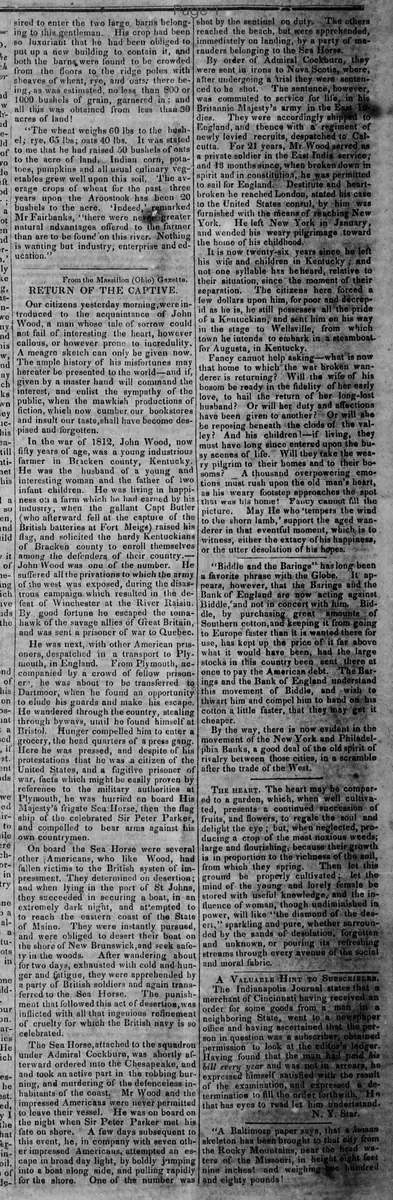
RETURN OF THE CAPTIVE.
Our citizens yesterday morning, were introduced to the acquaintance of John Wood, a man whose tale of sorrow could not fail of interesting the heart, however callous, or however prone to incredulity. A meagre sketch can only be given now. The ample history of his misfortunes may hereafter be presented to the world--and if given by a master hand will command the interest, and enlist the sympathy of the public, when the mawkish productions of fiction, which now cumber our bookstores and insult our taste, shall have become despised and forgotten.
In the war of 1812, John Wood, now fifty years of age, was a young industrious farmer in Bracken county, Kentucky. He was the husband of a young and interesting woman and the father of two infant children. He was living in happiness on a farm which he had earned by his industry, when the gallant Capt Butler (who afterward fell at the capture of the British batteries at Fort Meigs) raised his flag, and solicited the hardy Kentuckians of Bracken county to enroll themselves among the defenders of their country.-- John Wood was one of the number. He suffered all the privations to which the army of the west was exposed, during the disastrous campaign which resulted in the defeat of Winchester at the River Raisin. By good fortune he escaped the tomahawk of the savage allies of Great Britain, and was sent a prisoner of war to Quebec. He was next, with other American prisoners, despatched in a transport to Plymouth, in England. From Plymouth, accompanied by a crowd of fellow prisoners, he was about to be transferred to Dartmoor, when he found an opportunity to elude his guards and make his escape. He wandered through the country, stealing through byways, until he found himself at Bristol. Hunger compelled him to enter a grocery, the head quarters of a press gang. Here he was pressed, and despite of his protestations that he was a citizen of the United States, and a fugitive prisoner of war, acts which might be easily proven by reference to the military authorities at Plymouth, he was hurried on board His Majesty's frigate Sea Horse, then the flag ship of the celebrated Sir Peter Parker, and compelled to bear arms against his own countrymen.
On board the Sea Horse were several other Americans. who like Wood, had fallen victims to the British system of impressment. They determined on desertion; and when lying in the port of St Johns, they succeeded in securing a boat, in an extremely dark night, and attempted to reach the eastern coast of the State of Maine. They were instantly pursued, and were obliged to desert their boat on the shore of New Brunswick, and seek safety in the woods. After wandering about for two days, exhausted with cold and hunger and fatigue, they were apprehended by a party of British soldiers and again transferred to the Sea Horse. The punishment that followed this act of desertion, was inflicted with all that ingenious refinement of cruelty of which the British navy is so celebrated.
The Sea Horse, attached to the squadron under Admiral Cockburn, was shortly afterward ordered into the Chesapeake, and took an active part in the robbing burning, and murdering of the defenceless inhabitants of the coast. Mr Wood and the impressed Americans were never permitted to leave their vessel. He was on board on the night when Sir Peter Parker met his fate on shore. A few days subsequent to this event, he, in company with seven other impressed Americans, attempted an escape in broad day light, by boldly jumping into a boat along side, and pulling rapidly for the shore. One of the number was shot by the sentinel on duty. The others reached the beach, but were apprehended. immediately on landing, by a party of marauders belonging to the Sea Horse. By order of Admiral Cockburn, they were sent in irons to Nova Scotia, where, after undergoing a trial they were sentenced to be shot. The sentence, however, was commuted to service for life in his Britannic Majesty's army in the East Indies. They were accordingly shipped to England, and thence with a regiment of newly levied recruits, despatched to Calcutta. For 21 years, Mr Wood served as a private soldier in the East India service; and 18 months since, when broken down in spirit and in constitution, he was permitted to sail for England. Destitute and heart-broken he reached London, stated his case to the United States consul by him was furnished with the means of reaching New York. He left New York in January, and wended his weary pilgrimage toward the home of his childhood.
It is now twenty-six years since he left his wife and children in Kentucky ; and not one syllable has he heard, relative to their situation, since the moment of their separation. The citizens here forced a few dollars upon him, for poor and decrepid as he is, he still possesses all the pride of a Kentuckian, and sent him on his way in the stage to Wellsville. From which town he intends to embark in a steamboat. for Augusta, in Kentucky.
Fancy cannot help asking --what is now that home to which the war broken wanderer is returning? Will the wife of his bosom be ready in the fidelity of her early love, to hail the return of her long-lost husband? Or will her duty and affections have been given to another? Or will she be reposing beneath the clods of the valley? And his children!--if living, they must have long since entered upon the busy scenes of life. " Will they take the weary pilgrim to their homes and to their bosoms?
A thousand overpowering emotions must rush upon the old man's heart, as his weary footstep approaches the spot that was his home! Fancy cannot fill the picture. May He who 'tempers the wind to the shorn lamb,' support the aged wanderer in that eventful moment, which is to witness. either the extacy of his happiness or the utter desolation of his hopes.
What sub-type of article is it?
What themes does it cover?
What keywords are associated?
What entities or persons were involved?
Where did it happen?
Story Details
Key Persons
Location
Bracken County, Kentucky; Quebec; Plymouth, England; Bristol; Sea Horse Frigate; St Johns; New Brunswick; Chesapeake; Nova Scotia; East Indies; Calcutta; London; New York; Massillon, Ohio; Augusta, Kentucky
Event Date
War Of 1812; Twenty Six Years Ago; 21 Years Service; 18 Months Since
Story Details
John Wood, a Kentucky farmer, enlists in the War of 1812, is captured at River Raisin, imprisoned in Quebec and England, escapes but is impressed into British navy on Sea Horse, attempts desertion to Maine but recaptured, serves in Chesapeake raids, attempts another escape leading to sentence of life service in East Indies army, serves 21 years in Calcutta, returns via London and New York to Kentucky after 26 years, uncertain of family.