Thank you for visiting SNEWPapers!
Sign up free
The Tribune
Roanoke, Virginia
What is this article about?
Speech by Sidney J. Phillips at the July 4, 1953, dedication of the Booker T. Washington Memorial Highway in Virginia, honoring Washington's legacy of racial friendship, self-reliance, economic progress, and defending segregation's benefits for Negro development.
Clipping
OCR Quality
Full Text
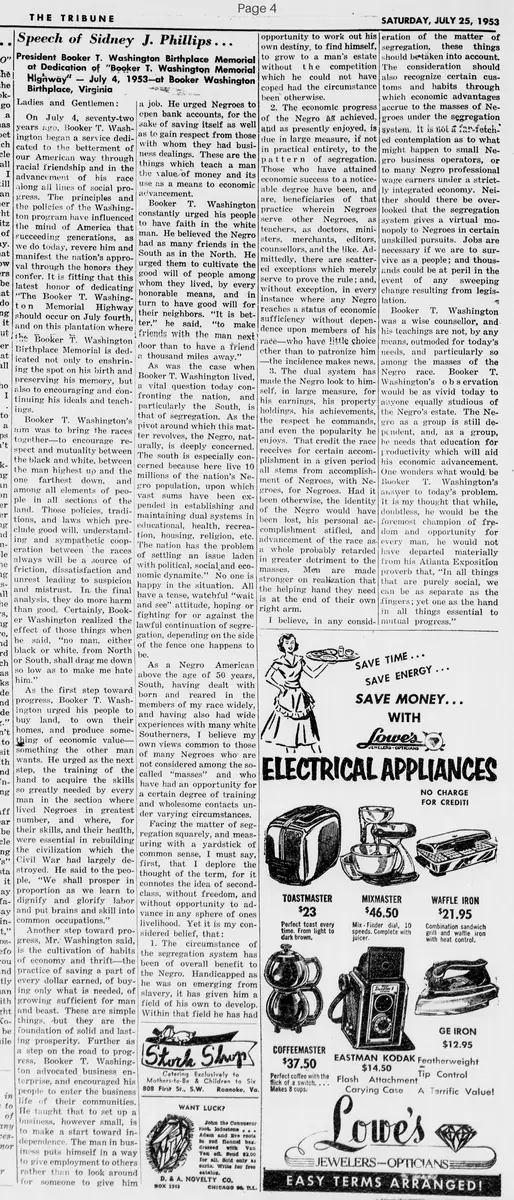
Speech of Sidney J. Phillips, President Booker T. Washington Birthplace Memorial at Dedication of "Booker T. Washington Memorial Highway" July 4, 1953—at Booker Washington Birthplace, Virginia
Ladies and Gentlemen:
On July 4, seventy-two years ago, Booker T. Washington began a service dedicated to the betterment of our American way through racial friendship and in the advancement of his race along all lines of social progress.
The principles and the policies of the Washington program have influenced the mind of America that succeeding generations, as we do today, revere him and manifest the nation's approval through the honors they confer. It is fitting that this latest honor of dedicating "The Booker T. Washington Memorial Highway" should occur on July fourth, and on this plantation where the Booker T. Washington Birthplace Memorial is dedicated not only to enshrining the spot on his birth and preserving his memory, but also to encouraging and continuing his ideals and teachings.
Booker T. Washington's aim was to bring the races together—to encourage respect and mutuality between the black and white, between the man highest up and the one farthest down, and among all elements of people in all sections of the land. Those policies, traditions, and laws which preclude good will, understanding and sympathetic cooperation between the races always will be a source of friction, dissatisfaction and unrest leading to suspicion and mistrust. In the final analysis, they do more harm than good. Certainly, Booker Washington realized the effect of those things when he said, "no man, either black or white, from North or South, shall drag me down so low as to make me hate him."
As the first step toward progress, Booker T. Washington urged his people to buy land, to own their homes, and produce something of economic value—something the other man wants. He urged as the next step, the training of the hand to acquire the skills so greatly needed by every man in the section where lived Negroes in greatest number, and where, for their skills, and their health, were essential in rebuilding the civilization which the Civil War had largely destroyed. He said to the people, "We shall prosper in proportion as we learn to dignify and glorify labor and put brains and skill into common occupations."
Another step toward progress, Mr. Washington said, is the cultivation of habits of economy and thrift—the practice of saving a part of every dollar earned, of buying only what is needed, of growing sufficient for man and beast. These are simple things, but they are the foundation of solid and lasting prosperity.
Further as a step on the road to progress, Booker T. Washington advocated business enterprise, and encouraged his people to enter the business life of their communities. He taught that to set up a business, however small, is to make a start toward independence. The man in business puts himself in a way to give employment to others rather than to look around for someone to give him a job. He urged Negroes to open bank accounts, for the sake of saving itself as well as to gain respect from those with whom they had business dealings. These are the things which teach a man the value of money and its use as a means to economic advancement.
Booker T. Washington constantly urged his people to have faith in the white man. He believed the Negro had as many friends in the South as in the North. He urged them to cultivate the good will of people among whom they lived, by every honorable means, and in turn to have good will for their neighbors. "It is better," he said, "to make friends with the man next door than to have a friend a thousand miles away."
As was the case when Booker T. Washington lived, a vital question today confronting the nation, and particularly the South, is that of segregation. As the pivot around which this matter revolves, the Negro, naturally, is deeply concerned. The south is especially concerned because here live 10 millions of the nation's Negro population, upon which vast sums have been expended in establishing and maintaining dual systems in educational, health, recreation, housing, religion, etc. The nation has the problem of settling an issue laden with political, social and economic dynamite. No one is happy in the situation. All have a tense, watchful "wait and see" attitude, hoping or fighting for or against the lawful continuation of segregation, depending on the side of the fence one happens to be.
As a Negro American above the age of 50 years, born and reared in the South, having dealt with members of my race widely, and having also had wide experiences with many white Southerners, I believe my own views common to those of many Negroes who are not considered among the so-called "masses" and who have had an opportunity for a certain degree of training and wholesome contacts under varying circumstances.
Facing the matter of segregation squarely, and measuring with a yardstick of common sense, I must say, first, that I deplore the thought of the term, for it connotes the idea of second-class, without freedom, and without opportunity to advance in any sphere of ones livelihood. Yet it is my considered belief, that:
1. The circumstance of the segregation system has been of overall benefit to the Negro. Handicapped as he was on emerging from slavery, it has given him a field of his own to develop. Within that field he has had opportunity to work out his own destiny, to find himself, to grow to a man's estate without the competition which he could not have coped had the circumstance been otherwise.
2. The economic progress of the Negro as achieved, and as presently enjoyed, is due in large measure, if not in practical entirety, to the pattern of segregation. Those who have attained economic success to a noticeable degree have been, and are, beneficiaries of that practice wherein Negroes serve other Negroes, as teachers, as doctors, ministers, merchants, editors, counsellors, and the like. Admittedly, there are scattered exceptions which merely serve to prove the rule; and, without exception, in every instance where any Negro reaches a status of economic sufficiency without dependence upon members of his race—who have little choice other than to patronize him—the incidence makes news.
3. The dual system has made the Negro look to himself, in large measure, for his earnings, his property holdings, his achievements, the respect he commands, and even the popularity he enjoys. That credit the race receives for certain accomplishment in a given period all stems from accomplishment of Negroes, with Negroes, for Negroes. Had it been otherwise, the identity of the Negro would have been lost, his personal accomplishment stifled, and advancement of the race as a whole probably retarded in greater detriment to the masses.
Men are made stronger on realization that the helping hand they need is at the end of their own right arm.
I believe, in any consideration of the matter of segregation, these things should be taken into account. The consideration should also recognize certain customs and habits through which economic advantages accrue to the masses of Negroes under the segregation system. It is not a far-fetched contemplation as to what might happen to small Negro business operators, or to many Negro professional wage earners under a strictly integrated economy. Neither should there be overlooked that the segregation system gives a virtual monopoly to Negroes in certain unskilled pursuits. Jobs are necessary if we are to survive as a people; and thousands could be at peril in the event of any sweeping change resulting from legislation.
Booker T. Washington was a wise counsellor, and his teachings are not, by any means, outmoded for today's needs, and particularly so among the masses of the Negro race. Booker T. Washington's observation would be as vivid today to anyone equally studious of the Negro's estate. The Negro as a group is still dependent, and, as a group, he needs that education for productivity which will aid his economic advancement. One wonders what would be Booker T. Washington's answer to today's problem.
It is my thought that while, doubtless, he would be the foremost champion of freedom and opportunity for every man, he would not have departed materially from his Atlanta Exposition proverb that, "In all things that are purely social, we can be as separate as the fingers, yet one as the hand in all things essential to mutual progress."
What sub-type of article is it?
What themes does it cover?
What keywords are associated?
What entities or persons were involved?
Where did it happen?
Story Details
Key Persons
Location
Booker Washington Birthplace, Virginia
Event Date
July 4, 1953
Story Details
Sidney J. Phillips delivers a speech honoring Booker T. Washington's principles of racial harmony, self-reliance, economic progress through land ownership, skill training, thrift, business enterprise, and faith in neighbors, while arguing that segregation has benefited Negro economic and social development by fostering self-sufficiency and intra-racial support.