Thank you for visiting SNEWPapers!
Sign up free
The Daily Bulletin
Honolulu, Honolulu County, Hawaii
What is this article about?
Quarterly meeting of the Hawaiian Humane Society in Y.M.C.A. hall, discussing animal welfare issues like mule conditions, horse beating case, slaughter-house, pound abuses, stray dogs, and plans for water troughs, membership, and law changes. Attendees include President J.S. Walker, Agent Mehrtens, and others.
Clipping
OCR Quality
Full Text
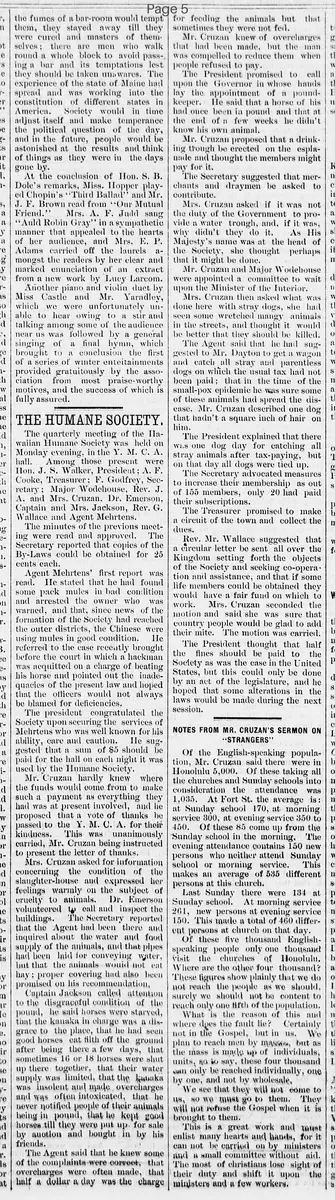
The quarterly meeting of the Hawaiian Humane Society was held on Monday evening in the Y. M. C. A. hall. Among those present were Hon. J. S. Walker, President; A. F. Cooke, Treasurer; F. Godfrey, Secretary; Major Woodhouse, Rev. J. A. and Mrs. Cruzan, Dr. Emerson, Captain and Mrs. Jackson, Rev. G. Wallace and Agent Mehrtens.
The minutes of the previous meeting were read and approved. The Secretary reported that copies of the By-Laws could be obtained for 25 cents each.
Agent Mehrtens' first report was read. He stated that he had found some pack mules in bad condition and arrested the owner who was warned, and that, since news of the formation of the Society had reached the outer districts, the Chinese were using mules in good condition. He referred to the case recently brought before the court in which a hackman was acquitted on a charge of beating his horse and pointed out the inadequacies of the present law and hoped that the officers would not always be blamed for deficiencies.
The president congratulated the Society upon securing the services of Mehrtens who was well known for his ability, care and caution. He suggested that a sum of $5 should be paid for the hall on each night it was used by the Humane Society.
Mr. Cruzan hardly knew where the funds would come from to make such a payment as everything they had was at present involved, and he proposed that a vote of thanks be passed to the Y. M. C. A. for their kindness. This was unanimously carried, Mr. Cruzan being instructed to present the letter of thanks.
Mrs. Cruzan asked for information concerning the condition of the slaughter-house and expressed her feelings warmly on the subject of cruelty to animals. Dr. Emerson volunteered to call and inspect the buildings. The Secretary reported that the Agent had been there and inquired about the water and food supply of the animals, and that pipes had been laid for conveying water, but that the animals would not eat hay; proper covering had also been promised on his recommendation.
Captain Jackson called attention to the disgraceful condition of the pound, he said horses were starved, that the kanaka in charge was a disgrace to the place, that he had seen good horses eat filth off the ground after being there a few days, that sometimes 16 or 18 horses were shut up there together, that their water supply was limited, that the kanaka was insolent and made overcharges and was often intoxicated, that he never notified people of their animals being in pound, that he kept good horses till they were put up for sale by auction and bought in by his friends.
The Agent said that he knew some of the complaints were correct, that overcharges were often made, that half a dollar a day was the charge for feeding the animals but that sometimes they were not fed.
Mr. Cruzan knew of overcharges that had been made, but the man was compelled to reduce them when people refused to pay.
The President promised to call upon the Governor in whose hands lay the appointment of a pound-keeper. He said that a horse of his had once been in pound and that at the end of a few weeks he didn't know his own animal.
Mr. Cruzan proposed that a drinking trough be erected on the esplanade and thought the members might pay for it.
The Secretary suggested that merchants and draymen be asked to contribute.
Mrs. Cruzan asked if it was not the duty of the Government to provide a water trough, and, if it was, why didn't they do it. As His Majesty's name was at the head of the Society, she thought perhaps that it might be done.
Mr. Cruzan and Major Wodehouse were appointed a committee to wait upon the Minister of the Interior.
Mrs. Cruzan then asked what was done here with stray dogs, she had seen some wretched mangy animals in the streets, and thought it would be better that they should be killed.
The Agent said that he had suggested to Mr. Dayton to get a wagon and catch all stray and parentless dogs on which the usual tax had not been paid: that in the time of the small-pox epidemic he was sure some of these animals had spread the disease. Mr. Cruzan described one dog that hadn't a square inch of hair on him.
The President explained that there was one dog day for catching all stray animals after tax-paying, but on that day all dogs were tied up.
The Secretary advocated measures to increase their membership as out of 155 members, only 20 had paid their subscriptions.
The Treasurer promised to make a circuit of the town and collect the dues.
Rev. Mr. Wallace suggested that a circular letter be sent all over the Kingdom setting forth the objects of the Society and seeking co-operation and assistance, and that if some life members could be obtained they would have a fair fund on which to work. Mrs. Cruzan seconded the motion and said she was sure that country people would be glad to add their mite. The motion was carried.
The President thought that half the fines should be paid to the Society as was the case in the United States, but this could only be done by an act of the legislature, and he hoped that some alterations in the laws would be made during the next session.
What sub-type of article is it?
What themes does it cover?
What keywords are associated?
What entities or persons were involved?
Where did it happen?
Story Details
Key Persons
Location
Y. M. C. A. Hall, Hawaii
Event Date
Monday Evening
Story Details
The Hawaiian Humane Society held its quarterly meeting, reporting on animal welfare issues including poor mule conditions, a horse beating acquittal, slaughter-house improvements, pound abuses like starvation and overcharges, stray dogs, and proposals for a drinking trough, membership drive, circular letter, and law changes for fines and protections.