Thank you for visiting SNEWPapers!
Sign up free
Letter to Editor
February 24, 1841
Southern Argus
Columbus, Lowndes County, Mississippi
What is this article about?
R. M. Johnson writes in favor of a federal uniform bankrupt law, citing constitutional authority and arguing it provides just relief to unfortunate debtors, prevents undue punishment, and supports national commerce and enterprise without benefiting from abuses.
Clipping
OCR Quality
95%
Excellent
Full Text
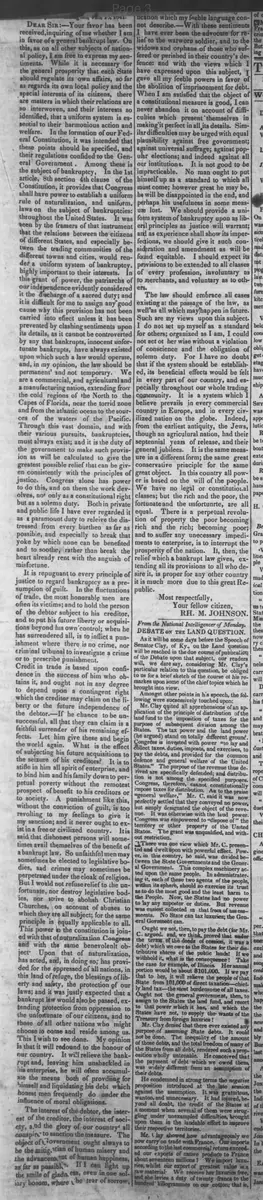
Dear Sir: Your favor has been received, inquiring of me whether I am in favor of a general bankrupt law. On this, as on all other subjects of national policy, I am free to express my sentiments.
While it is necessary or the general prosperity that each State should regulate its own affairs, so far as regards its own local policy and the special interests of its citizens, there are matters in which their relations are so interwoven, and their interests so identified, that a uniform system is essential to their harmonious action and welfare. In the formation of our Federal Constitution, it was intended that these points should be specified, and their regulations confided to the General Government. Among these is the subject of bankruptcy. In the 1st article, 8th section 4th clause of the Constitution, it provides that Congress shall have power to establish a uniform rule of naturalization, and uniform laws on the subject of bankruptcies throughout the United States.
It was seen by the framers of that instrument that the relations between the citizens of different States, and especially between the trading communities of the different towns and cities, would render a uniform system of bankruptcy highly important to their interests. In this grant of power, the patriarchs of our independence evidently considered it the discharge of a sacred duty; and it is difficult for me to assign any good cause why this provision has not been carried into effect unless it has been prevented by clashing sentiments upon its details, as it cannot be controverted by any that bankrupts, innocent unfortunate bankrupts, have always existed upon which such a law would operate, and, in my opinion, the law should be permanent and not temporary.
We are a commercial, and agricultural and a manufacturing nation, extending from the cold regions of the North to the Capes of Florida, near the torrid zone and from the Atlantic ocean to the sources of the waters of the Pacific. Through this vast domain, and with their various pursuits, bankruptcies must always exist; and it is the duty of the government to make such provision as will be calculated to give the greatest possible relief that can be given consistently with the principles of justice. Congress alone has power to do this, and on them the work devolves, not only as a constitutional right but as a solemn duty.
Both in private and public life I have ever regarded it as a paramount duty to relieve the distressed from every burden as far as possible, and especially to break that yoke by which none can be benefited and to soothe, rather than break the heart already rent with the anguish of misfortune. It is repugnant to every principle of justice to regard bankruptcy as a presumption of guilt. In the fluctuations of trade, the most honorable men are often its victims; and to hold the person of the debtor subject to his creditor, and to put his future liberty or acquisitions beyond his own control; when he has surrendered all, is to inflict a punishment where there is no crime, nor criminal tribunal to investigate a crime or to prescribe punishment.
Credit in trade is based upon confidence in the success of him who obtains it, and ought not in any degree to depend upon a contingent right which the creditor may claim on the liberty or the future independence of the debtor. If he chance to be unsuccessful, all that they can claim is a faithful surrender of his remaining effects. Let him give these and begin the world again. What is the effect of subjecting his future acquisitions to the seizure of his creditors? It is to stifle in him all spirit of enterprise, and to bind him and his family down to perpetual poverty without the remotest prospect of benefit to his creditors or to society.
A punishment like this, without the conviction of guilt, is too revolting to my feelings to give it my sanction; and it never ought to exist in a free or civilized country. It is said that dishonest persons will sometimes avail themselves of the benefit of a bankrupt law. So unfaithful men may sometimes be elected to legislative bodies, and crimes may sometimes be perpetrated under the cloak of religion. But I would not refuse relief to the unfortunate, nor destroy legislative bodies, nor strive to abolish Christian Churches, on account of abuses to which they are all subject; for the same principle is equally applicable to all.
This power in the constitution is joined with that of naturalization Congress and with the same benevolent object. Upon that of naturalization, has acted, and, in doing so; has provided for the oppressed of all nations, in this land of refuge, the blessings of liberty and safety, the protection of our laws; and it was justly expected that a bankrupt law would also be passed, extending protection from oppression to the unfortunate of our citizens, and to those of all other nations who might choose to come and reside among us. This I wish to see done. My opinion is that it will redound to the honour of our country. It will relieve the bankrupt and, leaving him unshackled in his enterprise, he will often accumulate the means both of providing for himself and liquidating his debt which honest men frequently do under the influence of moral obligations.
The interest of the debtor, the interest of the creditor, the interest of society, and the glory of our country all conspire to sanction the measure. The object of Government ought always to be the mitigation of human misery and the advancement of human happiness, as far as possible. If I can light up the smile of gladness, even in one solitary bosom, where the tear of sorrow, ncauon which my feeble language cannot describe.
With these sentiments I have ever been the advocate for relief to the warworn soldier, and to the widows and orphans of those who suffered or perished in their country's defence: and with the views which I have expressed upon this subject, I gave all my feeble powers in favor of the abolition of imprisonment for debt.
When I am satisfied that the object of a constitutional measure is good, I can never abandon it on account of difficulties which present themselves in making it perfect in all its details. Similar difficulties may be urged with equal plausibility against free government; against universal suffrage; against popular elections; and indeed against all our institutions. It is not good to be impracticable. No man ought to put himself up as a standard to which all must come; however great he may be, he will be disappointed in the end, and perhaps his usefulness in some measure lost.
We should provide a uniform system of bankruptcy upon as liberal principles as justice will warrant; and as experience shall show its imperfections, we should give it such consideration and amendment as will be found equitable. I should expect its provisions to be extended to all classes of every profession, involuntary as to merchants, and voluntary as to others. The law should embrace all cases existing at the passage of the law, as well as all which may happen in future.
Such are my views upon this subject. I do not set up myself as a standard for others; organized as I am, I could not act otherwise without a violation of conscience and the obligation of solemn duty. For I have no doubt that if the system should be established, its beneficial effects would be felt in every part of our country, and especially throughout our whole trading community. It is a system which I believe prevails in every commercial country in Europe, and in every civilized nation on the globe. Indeed, from the earliest antiquity, the Jews, though an agricultural nation, had their septennial years of release, and their general jubilees. It is the same measure in a different form; the same great conservative principle for the same great object.
In this country all power is based on the will of the people. We have no legal or constitutional classes; but the rich and the poor, the fortunate and the unfortunate, are all equal. There is a perpetual revolution of property the poor becoming rich and the rich becoming poor; and to suffer any unnecessary impediments to enterprise, is to interrupt the prosperity of the nation. If, then, the relief which a bankrupt law gives, extending all its provisions to all who desire it, is proper for any other country it is much more due to this great Republic.
Most respectfully,
Your fellow citizen,
R. M. JOHNSON.
While it is necessary or the general prosperity that each State should regulate its own affairs, so far as regards its own local policy and the special interests of its citizens, there are matters in which their relations are so interwoven, and their interests so identified, that a uniform system is essential to their harmonious action and welfare. In the formation of our Federal Constitution, it was intended that these points should be specified, and their regulations confided to the General Government. Among these is the subject of bankruptcy. In the 1st article, 8th section 4th clause of the Constitution, it provides that Congress shall have power to establish a uniform rule of naturalization, and uniform laws on the subject of bankruptcies throughout the United States.
It was seen by the framers of that instrument that the relations between the citizens of different States, and especially between the trading communities of the different towns and cities, would render a uniform system of bankruptcy highly important to their interests. In this grant of power, the patriarchs of our independence evidently considered it the discharge of a sacred duty; and it is difficult for me to assign any good cause why this provision has not been carried into effect unless it has been prevented by clashing sentiments upon its details, as it cannot be controverted by any that bankrupts, innocent unfortunate bankrupts, have always existed upon which such a law would operate, and, in my opinion, the law should be permanent and not temporary.
We are a commercial, and agricultural and a manufacturing nation, extending from the cold regions of the North to the Capes of Florida, near the torrid zone and from the Atlantic ocean to the sources of the waters of the Pacific. Through this vast domain, and with their various pursuits, bankruptcies must always exist; and it is the duty of the government to make such provision as will be calculated to give the greatest possible relief that can be given consistently with the principles of justice. Congress alone has power to do this, and on them the work devolves, not only as a constitutional right but as a solemn duty.
Both in private and public life I have ever regarded it as a paramount duty to relieve the distressed from every burden as far as possible, and especially to break that yoke by which none can be benefited and to soothe, rather than break the heart already rent with the anguish of misfortune. It is repugnant to every principle of justice to regard bankruptcy as a presumption of guilt. In the fluctuations of trade, the most honorable men are often its victims; and to hold the person of the debtor subject to his creditor, and to put his future liberty or acquisitions beyond his own control; when he has surrendered all, is to inflict a punishment where there is no crime, nor criminal tribunal to investigate a crime or to prescribe punishment.
Credit in trade is based upon confidence in the success of him who obtains it, and ought not in any degree to depend upon a contingent right which the creditor may claim on the liberty or the future independence of the debtor. If he chance to be unsuccessful, all that they can claim is a faithful surrender of his remaining effects. Let him give these and begin the world again. What is the effect of subjecting his future acquisitions to the seizure of his creditors? It is to stifle in him all spirit of enterprise, and to bind him and his family down to perpetual poverty without the remotest prospect of benefit to his creditors or to society.
A punishment like this, without the conviction of guilt, is too revolting to my feelings to give it my sanction; and it never ought to exist in a free or civilized country. It is said that dishonest persons will sometimes avail themselves of the benefit of a bankrupt law. So unfaithful men may sometimes be elected to legislative bodies, and crimes may sometimes be perpetrated under the cloak of religion. But I would not refuse relief to the unfortunate, nor destroy legislative bodies, nor strive to abolish Christian Churches, on account of abuses to which they are all subject; for the same principle is equally applicable to all.
This power in the constitution is joined with that of naturalization Congress and with the same benevolent object. Upon that of naturalization, has acted, and, in doing so; has provided for the oppressed of all nations, in this land of refuge, the blessings of liberty and safety, the protection of our laws; and it was justly expected that a bankrupt law would also be passed, extending protection from oppression to the unfortunate of our citizens, and to those of all other nations who might choose to come and reside among us. This I wish to see done. My opinion is that it will redound to the honour of our country. It will relieve the bankrupt and, leaving him unshackled in his enterprise, he will often accumulate the means both of providing for himself and liquidating his debt which honest men frequently do under the influence of moral obligations.
The interest of the debtor, the interest of the creditor, the interest of society, and the glory of our country all conspire to sanction the measure. The object of Government ought always to be the mitigation of human misery and the advancement of human happiness, as far as possible. If I can light up the smile of gladness, even in one solitary bosom, where the tear of sorrow, ncauon which my feeble language cannot describe.
With these sentiments I have ever been the advocate for relief to the warworn soldier, and to the widows and orphans of those who suffered or perished in their country's defence: and with the views which I have expressed upon this subject, I gave all my feeble powers in favor of the abolition of imprisonment for debt.
When I am satisfied that the object of a constitutional measure is good, I can never abandon it on account of difficulties which present themselves in making it perfect in all its details. Similar difficulties may be urged with equal plausibility against free government; against universal suffrage; against popular elections; and indeed against all our institutions. It is not good to be impracticable. No man ought to put himself up as a standard to which all must come; however great he may be, he will be disappointed in the end, and perhaps his usefulness in some measure lost.
We should provide a uniform system of bankruptcy upon as liberal principles as justice will warrant; and as experience shall show its imperfections, we should give it such consideration and amendment as will be found equitable. I should expect its provisions to be extended to all classes of every profession, involuntary as to merchants, and voluntary as to others. The law should embrace all cases existing at the passage of the law, as well as all which may happen in future.
Such are my views upon this subject. I do not set up myself as a standard for others; organized as I am, I could not act otherwise without a violation of conscience and the obligation of solemn duty. For I have no doubt that if the system should be established, its beneficial effects would be felt in every part of our country, and especially throughout our whole trading community. It is a system which I believe prevails in every commercial country in Europe, and in every civilized nation on the globe. Indeed, from the earliest antiquity, the Jews, though an agricultural nation, had their septennial years of release, and their general jubilees. It is the same measure in a different form; the same great conservative principle for the same great object.
In this country all power is based on the will of the people. We have no legal or constitutional classes; but the rich and the poor, the fortunate and the unfortunate, are all equal. There is a perpetual revolution of property the poor becoming rich and the rich becoming poor; and to suffer any unnecessary impediments to enterprise, is to interrupt the prosperity of the nation. If, then, the relief which a bankrupt law gives, extending all its provisions to all who desire it, is proper for any other country it is much more due to this great Republic.
Most respectfully,
Your fellow citizen,
R. M. JOHNSON.
What sub-type of article is it?
Persuasive
Political
Ethical Moral
What themes does it cover?
Economic Policy
Commerce Trade
Constitutional Rights
What keywords are associated?
Bankrupt Law
Uniform Bankruptcy
Constitutional Authority
Debt Relief
Imprisonment Abolition
Commercial Prosperity
What entities or persons were involved?
R. M. Johnson
Dear Sir
Letter to Editor Details
Author
R. M. Johnson
Recipient
Dear Sir
Main Argument
advocates for a uniform national bankrupt law as authorized by the u.s. constitution to provide relief to honest, unfortunate bankrupts, allowing them to surrender assets and start anew without imprisonment or loss of future earnings, emphasizing justice, economic prosperity, and moral duty.
Notable Details
References Article 1, Section 8, Clause 4 Of The Constitution Granting Congress Power Over Bankruptcies
Compares To Naturalization Power And Historical Jewish Jubilees
Supports Abolition Of Imprisonment For Debt
Argues Against Punishing Bankruptcy As Guilt, Promotes Enterprise And Societal Benefit