Thank you for visiting SNEWPapers!
Sign up free
Daily National Republican
Washington, District Of Columbia
What is this article about?
Meeting of the National Equal Suffrage Association at the Unitarian church in the District, where Gov. Hahn of Louisiana advocated for universal suffrage, highlighting ongoing slavery-like practices in the South and the need for protective laws and equal rights for African Americans.
Clipping
OCR Quality
Full Text
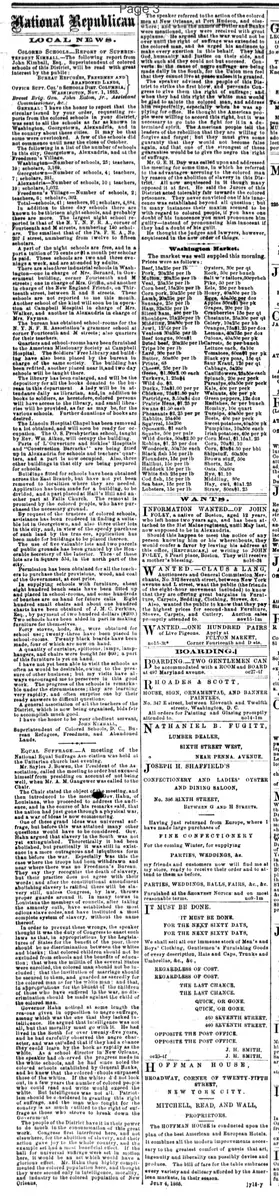
Mr. Sayles J. Bowen, the President of the Association, called the meeting to order but excused himself from presiding on account of not being well, when Mr. A. M. Gangewer was called to the Chair.
The Chair stated the object of the meeting, and then introduced to the meeting Gov. Hahn, of Louisiana, who proceeded to address the audience, and in the course of his remarks said, that the nation had just gone through a physical war, and a war of ideas is now commencing.
One of these grand ideas was universal suffrage, but before this was attained many other questions would have to be considered. Gov. Hahn argued that slavery in the South was not yet extinguished. Theoretically it had been abolished, but practically it was still in existence in a more outrageous and iniquitous form than before the war. Especially was this the case where the troops had been withdrawn and near where there was no Freedmen's Bureau.
They say they recognize the death of slavery, but their practice does not agree with their words: and after the constitutional amendment abolishing slavery is ratified there will be slavery still, unless Congress, by law, throws proper guards around it. In many towns in Louisiana the members of councils, after taking the amnesty oath, have established the most odious slave codes, and have instituted a most complete system of slavery, without the name thereof.
In order to prevent these wrongs, the speaker thought it was the duty of Congress to enact such laws as that, in appropriations by the Legislatures of States for the benefit of the poor, there should be no discrimination between the whites and blacks; that colored children should not be excluded from schools and the benefits of education; that when the militia of the several States were enrolled, the colored man should not be included; that the institution of marriage should be secured to them, and, guarded as sacredly for the colored man as for the white man; and that, in appropriations for the benefit of the children of those who have suffered in the war, no discrimination should be made against the child of the colored man.
Governor Hahn noticed at some length the reasons given in opposition to negro suffrage, among which was the one that they lacked intelligence. He argued that intelligence was not all, but that morality must go with it. He had lived in the South for over twenty-five years, and he had carefully observed the negro character, and was satisfied that if they had a chance they could learn by the book as rapidly as the white. As a school director in New Orleans, the speaker had observed the progress made in the white schools, and he had since noted the colored schools established by General Banks, and he knew that the colored schools surpassed those of the whites. If the whites did not look out, in a few years the number of colored people who could read and write would exceed the white. But intelligence was not all. Patriotism should be considered in granting this right of suffrage, and the man who fought for the country is as much entitled to the right of suffrage as those who strove to break down the Government.
The people of the District have it in their power to do much in the consummation of this great work. Congress first interfered here, and not elsewhere, for the abolition of slavery, and their action gave joy to the whole country, and the example set had a most beneficial effect. If the ball for universal suffrage were set in motion here, it would be an act which would have a glorious effect. Mr. Hahn then highly complimented the colored population here, and thought they were second only in intelligence, morality, and industry to the colored population of New Orleans.
The speaker referred to the action of the colored men at New Orleans, at Port Hudson, and elsewhere; and when the names of Butler and Banks were mentioned, they were received with great applause. He argued that the war would not be over until the right of suffrage was extended to the colored man, and he urged his audience to make every exertion in this behalf. They had God, humanity and justice on their side, and with such aid they could not but succeed. Converts to the cause of negro suffrage are being made daily in the South, for the Union men feel that they cannot live at peace unless it is granted.
The speaker advised the people of this District to strike the first blow, and "persuade Congress to give them the right of suffrage; and when they had this right the white man would be glad to salute the colored man, and address him respectfully, especially when he was applying for office. He thought the American people were willing to accord this right, but it was necessary to go into the fight for it in a determined spirit. The American people tell the leaders of the rebellion that they are willing to forgive and forget; but they must give some guaranty that they would not become false again, and that one of the strongest of these guaranties would be to give the negro the right of suffrage.
Mr. G. E. H. Day was called upon and addressed the meeting for some time, in which he referred to the advantages accruing to the colored man by reason of the abolition of slavery in this District. All now acquiesced in it though many opposed it at first. He said the jurors of this District acted tolerably fair towards the colored prisoners. They never convicted one if his innocence was established beyond all question; but in many instances their maxim seemed to be with regard to colored people, if you have one doubt of his innocence you must pronounce him guilty—instead of pronouncing him innocent if they had a doubt of his guilt.
He thought the judges and lawyers, however, acquiesced in the new order of things.
What sub-type of article is it?
What themes does it cover?
What keywords are associated?
What entities or persons were involved?
Where did it happen?
Story Details
Key Persons
Location
Unitarian Church In The District
Event Date
Last Evening
Story Details
A meeting of the National Equal Suffrage Association where President Sayles J. Bowen opened but A. M. Gangewer chaired; Gov. Hahn spoke on universal suffrage, lingering slavery in the South, need for protective laws, education equality, and patriotism of African Americans; G. E. H. Day discussed benefits of abolition in the District and fair treatment in courts.