Thank you for visiting SNEWPapers!
Sign up free
The Portland Daily Press
Portland, Cumberland County, Maine
What is this article about?
On February 23 in Washington, the U.S. Senate passes a bill on life-saving station pay, debates and postpones a commission on alcoholic liquor traffic, and discusses without action a bill against food and drug adulteration, highlighting concerns over costs and federal overreach.
Clipping
OCR Quality
Full Text
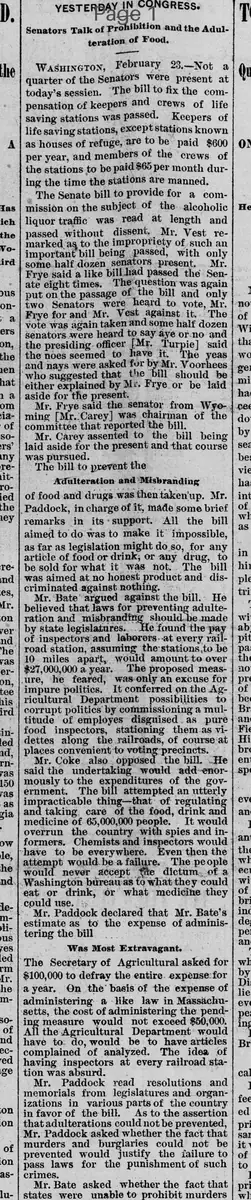
WASHINGTON, February 23.—Not a quarter of the Senators were present at today's session. The bill to fix the compensation of keepers and crews of life saving stations was passed. Keepers of life saving stations, except stations known as houses of refuge, are to be paid $600 per year, and members of the crews of the stations to be paid $65 per month during the time the stations are manned.
The Senate bill to provide for a commission on the subject of the alcoholic liquor traffic was read at length and passed without dissent. Mr. Vest remarked as to the impropriety of such an important bill being passed, with only some half dozen senators present, Mr. Frye said a like bill had passed the Senate eight times. The question was again put on the passage of the bill and only two Senators were heard to vote, Mr. Frye for and Mr. Vest against it. The vote was again taken and some half dozen senators were heard to say aye or no and the presiding officer [Mr. Turpie] said the noes seemed to have it. The yeas and nays were asked for by Mr. Voorhees who suggested that the bill should be either explained by Mr. Frye or be laid aside for the present.
Mr. Frye said the senator from Wyoming [Mr. Carey] was chairman of the committee that reported the bill.
Mr. Carey assented to the bill being laid aside for the present and that course was pursued.
The bill to prevent the Adulteration and Misbranding of food and drugs was then taken up. Mr. Paddock, in charge of it, made some brief remarks in its support. All the bill aimed to do was to make it impossible, as far as legislation might do so, for any article of food or drink; or any drug, to be sold for what it was not. The bill was aimed at no honest product and discriminated against nothing.
Mr. Bate argued against the bill. He believed that laws for preventing adulteration and misbranding should be made by state legislatures. He found the pay of inspectors and laborers, at every railroad station, assuming the stations to be 10 miles apart, would amount to over $27,000,000 a year. The proposed measure, he feared, was only an excuse for impure politics. It conferred on the Agricultural Department possibilities to corrupt politics by commissioning a multitude of employes disguised as pure food inspectors, stationing them as vendettas along the railroads, of course at places convenient to voting precincts.
Mr. Coke also opposed the bill. He said the undertaking would add enormously to the expenditures of the government. The bill attempted an utterly impracticable thing—that of regulating and taking care of the food, drink and medicine of 65,000,000 people. It would overrun the country with spies and informers. Chemists and inspectors would have to be everywhere. Even then the attempt would be a failure. The people would never accept the dictum of a Washington bureau as to what they could eat or drink, or what medicine they could use.
Mr. Paddock declared that Mr. Bate's estimate as to the expense of administering the bill Was Most Extravagant. The Secretary of Agriculture asked for $100,000 to defray the entire expense for a year. On the basis of the expense of administering a like law in Massachusetts, the cost of administering the pending measure would not exceed $50,000. All the Agricultural Department would have to do, would be to have articles complained of analyzed. The idea of having inspectors at every railroad station was absurd.
Mr. Paddock read resolutions and memorials from legislatures and organizations in various parts of the country in favor of the bill. As to the assertion that adulterations could not be prevented, Mr. Paddock asked whether the fact that murders and burglaries could not be prevented would justify the failure to pass laws for the punishment of such crimes.
Mr. Bate asked whether the fact that states were unable to prohibit murders and burglaries would justify the general government in trying to do so in the state.
Without action on the bill the Senate adjourned.
What sub-type of article is it?
What themes does it cover?
What keywords are associated?
What entities or persons were involved?
Where did it happen?
Story Details
Key Persons
Location
Washington
Event Date
February 23
Story Details
The Senate passes a bill on compensation for life-saving station keepers and crews. A bill for a commission on alcoholic liquor traffic is debated and laid aside. Debate on a bill to prevent adulteration and misbranding of food and drugs focuses on federal vs. state authority, costs, and practicality, with no action taken before adjournment.