Thank you for visiting SNEWPapers!
Sign up free
The National Republican
Washington, District Of Columbia
What is this article about?
In the Criminal Court, Benjamin F. Hough is tried for murdering Samuel E. Gaskins in Georgetown. After arguments, Judge Fisher charges the jury on homicide laws, emphasizing reasonable doubt and self-defense. The jury deliberates 15 minutes and finds Hough guilty of manslaughter.
Merged-components note: Sequential reading order; the second component provides the verdict concluding the trial narrative started in the first.
Clipping
OCR Quality
Full Text
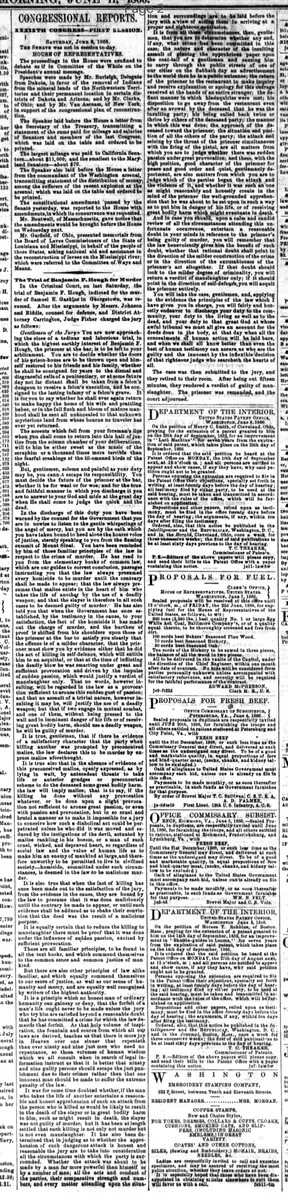
In the Criminal Court, on last Saturday, the trial of Benjamin F. Hough, indicted for the murder of Samuel E. Gaskins in Georgetown, was resumed. After the arguments by Messrs. Johnson and Riddle, counsel for defence, and District Attorney Carrington, Judge Fisher charged the jury as follows:
Gentlemen of the Jury: You are now approaching the close of a tedious and laborious trial, in which the highest earthly interest of Benjamin F. Hough, the prisoner at the bar, is to be left to your arbitrament. You are to decide whether the doors of his prison-house are to be thrown open and himself restored to his friends and his family, whether he shall be consigned for years to the dismal and disgraceful cells of a penitentiary, or at some future day not far distant shall be taken from a felon's dungeon to receive a felon's execution, and be consigned to the lasting infamy of a felon's grave. It is for you to say whether he shall ever again return to make happy the home of his wife and prattling babes, or in the full flush and bloom of mature manhood shall be sent all unprepared to that unknown mysterious land from whose bourne no traveler has ever yet returned.
The accents which fall from your foreman's lips when you shall come to return into this hall of justice from the solemn chamber of your deliberations, will to him be either sweet as the music of the seraphim or a thousand times more terrible than the fearful creakings of the ill-omened birds of the night.
But, gentlemen, solemn and painful as your duty may be, you cannot escape its responsibility. You must decide the future of the prisoner at the bar whether it be for weal or for woe; and for the true and faithful manner in which you discharge it you are to answer to your God and mine at the great day when He shall come to judge the quick and the dead.
In the discharge of this duty you have been warned by the counsel for the Government that you are in nowise to listen to the gentle whisperings of the angel of mercy, but you are by the oath which you have taken bound to heed alone the hoarse voice of justice, sternly speaking to you from the flaming summit of Mount Sinai. You have been reminded by him of those familiar principles of the law in respect to the crime of murder. He has read to you from the elementary books of common law, which are our guides to correct conclusion, passages instructing you that the law always presumed every homicide to be murder until the contrary shall be made to appear; that the law always presumes that malice exists in the heart of him who takes the life of another by the use of a deadly weapon; and that the slayer is therefore in all such cases to be deemed guilty of murder." He has also told you that when the Government has once established, by the testimony in the cause, to your satisfaction, the fact of the homicide it has made out the charge of murder, and the burden of proof is shifted from his shoulders upon those of the prisoner at the bar to satisfy you clearly that the offence is of a milder character, that the prisoner must show you by evidence either that he did the act of killing in self-defence, which will entitle him to an acquittal, or that at the time of inflicting the deadly blow he was smarting under great and sufficient provocation and driven by the impulse of sudden passion, which would justify a verdict of manslaughter only.
That no words, however insulting, will be regarded in the law as a provocation sufficient to arouse this sudden gust of passion; and that no assault of a trivial nature, however insulting it may be, will justify the use of a deadly weapon; but that if two engage in mutual combat, and one of them, without being pressed to the wall and in imminent danger of his life or of receiving great bodily harm, should use a deadly weapon, he will be guilty of murder.
It is true, gentlemen, that if there be evidence of a satisfactory character that the party when killing another was prompted by preconceived malice, the law declares this to be murder by express malice aforethought.
It is true also that in the absence of evidence of this preconceived malice, openly expressed, as by lying in wait, by antecedent threats to take life or anterior grudges or preconcerted scheme to do the deceased some great bodily harm, the law will imply malice; that is to say, if the killing be done without any provocation whatever, or be done upon a slight provocation not sufficient to arouse great passion, or even with passion and provocation, but in so cruel and brutal a manner as to make it impossible for a jury to conceive how such a diabolical act could be perpetrated unless he who did it was moved and seduced by the instigations of the devil, actuated by malice rankling in his bosom, or a man of such cruel, wicked, and depraved heart, so regardless of social law and the value of human life as to make him an enemy of mankind at large, and therefore unworthy to be permitted to live in civilized society—homicide, committed under such circumstances, is deemed in the law to be malicious murder.
It is also true that when the fact of killing has once been made out to the satisfaction of the jury, from the evidence in the cause, they are bound by the law to presume that it was done maliciously until the contrary be made to appear, or until such evidence shall be adduced as to shake their conviction that the deed was the result of a malicious purpose.
It is equally certain that to reduce the killing to manslaughter there must be proof that it was done under the influence of sudden passion, excited by sufficient provocation.
These are all familiar principles, to be found in all the text books, and which commend themselves to the common sense and common justice of mankind.
But there are also other principles of law alike familiar, and which equally commend themselves to our sense of justice, as well as our sense of humanity and mercy, and are equally well recognized by writers of the highest authority.
It is a principle which no honest man of ordinary humanity can gainsay or deny, that the forfeit of a man's life ought never to be made unless the jury who try him are satisfied beyond a reasonable doubt that he has committed a crime for which the law demands that forfeit. As that holy volume of inspiration, the fountain and source from which all our laws are derived, teaches us that there is more joy in Heaven over one sinner that repenteth than over ninety and nine just men who need no repentance, so those volumes of human wisdom which we all consult when in search of legal information instruct us that it is better that ninety and nine guilty persons should escape the just punishment due to their crimes rather than that one innocent man should be made to suffer the extreme penalty of the law.
It was for some time doubted whether, if the man who takes the life of another entertains a reasonable and honest apprehension of such an attack from the person who is killed as would be likely to result in the death of the slayer or in great bodily harm to him, such as might result in death, the slayer was not guilty of murder; but it has been at length settled that such killing is not only not murder but is not even manslaughter. It has also been determined that in judging as to whether the apprehension of such dangerous attack is honest and reasonable the jury are to take into consideration all the circumstances with which the party is surrounded. Whether the attack was about to be made by a man far more powerful than himself or by a number of men; all the acts and conduct of the parties, their comparative strength and numbers, and every matter attending upon the situation and surroundings are to be laid before the jury with a view of aiding them in arriving at a proper and righteous conclusion.
It is from all these circumstances, then, gentlemen, that you are to determine whether any and, if any, what crime has been committed in this case; the nature and character of the insulting assault of pinning the opprobrious paper upon the coat-tail of a gentleman and causing him to carry through the public streets of one of our cities on the Sabbath day an advertisement to the world that he is a public nuisance; the return of the prisoner to the restaurant to make inquiry and receive explanation or apology for this outrage received at the hands of an entire stranger; the defiant manner in which his inquiries were met; his disposition to go away from the restaurant even after an avowal by the deceased that he was the insulting party; his being called back twice or thrice by others of the deceased party; the manner in which this was done; the approach of the deceased toward the prisoner; the situation and position of all the others of the party; the attack and seizing by the throat of the prisoner simultaneous with the firing of the pistol, are all matters from which you are to judge whether there was sudden passion under great provocation; and these, with the high position, good character of the prisoner for peace and good order and quiet, gentlemanly deportment, are also matters from which you are to judge which of the parties began the attack and the violence of it, and whether it was such an one as might reasonably and honestly create in the mind of the prisoner the well-grounded apprehension that he was about to be set upon in such a way as to put him in danger of his life, or of receiving great bodily harm which might eventuate in death.
And in case you should, upon a calm and candid review of all the circumstances attending this unfortunate occurrence, entertain a reasonable doubt in your minds in reference to the prisoner's being guilty of murder, you will remember that the law benevolently gives him the benefit of such doubt, whether that rational doubt shall point in the direction of the milder construction of the crime or in the direction of the excusableness of the prisoner's act altogether. If that doubt should look to the milder degree of criminality, you will return a verdict of manslaughter only; if it should point in the direction of self-defence, you will acquit the prisoner entirely.
You will take the case, gentlemen, and, applying to the evidence the principles of the law which I have given you in charge, you will fairly and honestly endeavor to discharge your duty to the community, your duty to the living as well as to the dead, and your duty to that great God at whose awful tribunal we must all give an account for the deeds done in the body, at that day when all the concealments of human action will be laid bare, and when we shall all know better than even the best of human testimony can assure us who are the guilty and the innocent by the inflexible decision of that righteous judge who searcheth the hearts of all.
The case was then submitted to the jury, and they retired to their room. After being out fifteen minutes, they rendered a verdict of guilty of manslaughter. The prisoner was remanded, and the court adjourned.
What sub-type of article is it?
What themes does it cover?
What keywords are associated?
What entities or persons were involved?
Where did it happen?
Story Details
Key Persons
Location
Georgetown, Criminal Court
Event Date
Last Saturday
Story Details
Benjamin F. Hough is tried for murdering Samuel E. Gaskins after an insulting incident involving a paper pinned to his coat. Judge Fisher instructs the jury on murder, manslaughter, and self-defense principles. The jury finds Hough guilty of manslaughter after brief deliberation.