Thank you for visiting SNEWPapers!
Sign up free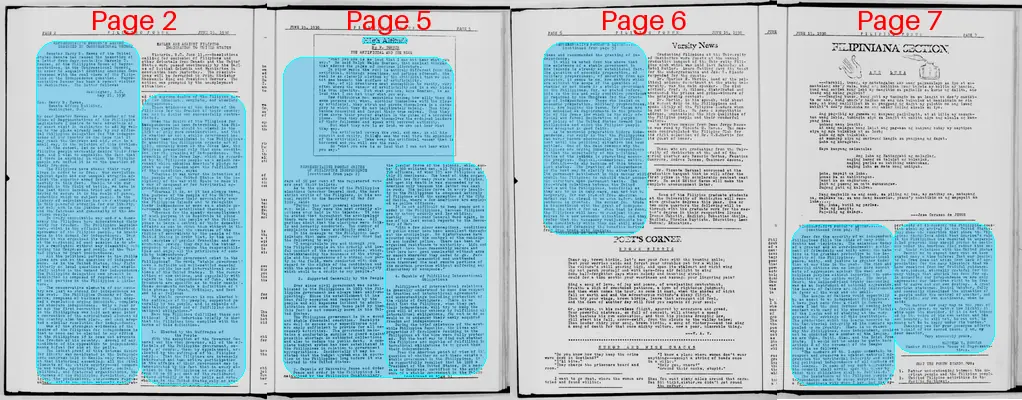
Filipino Forum
Seattle, King County, Washington
What is this article about?
Senator Harry B. Hawes inserts a letter from Philippine Representative Marcelo T. Boncan into the Congressional Record. Boncan argues that Filipinos unanimously seek independence, a stable government exists per the Jones Law, and the U.S. should grant immediate freedom, addressing economic and security concerns.
Merged-components note: Merged continuations of Representative Boncan's letter across pages 2, 5, 6, and 7 into a single component. Note: The page 5 component includes preceding editorial text 'High Altitude', which may require further text separation in downstream processing.
Clippings
1 of 4
OCR Quality
Full Text
INSERTED IN CONGRESSIONAL RECORD
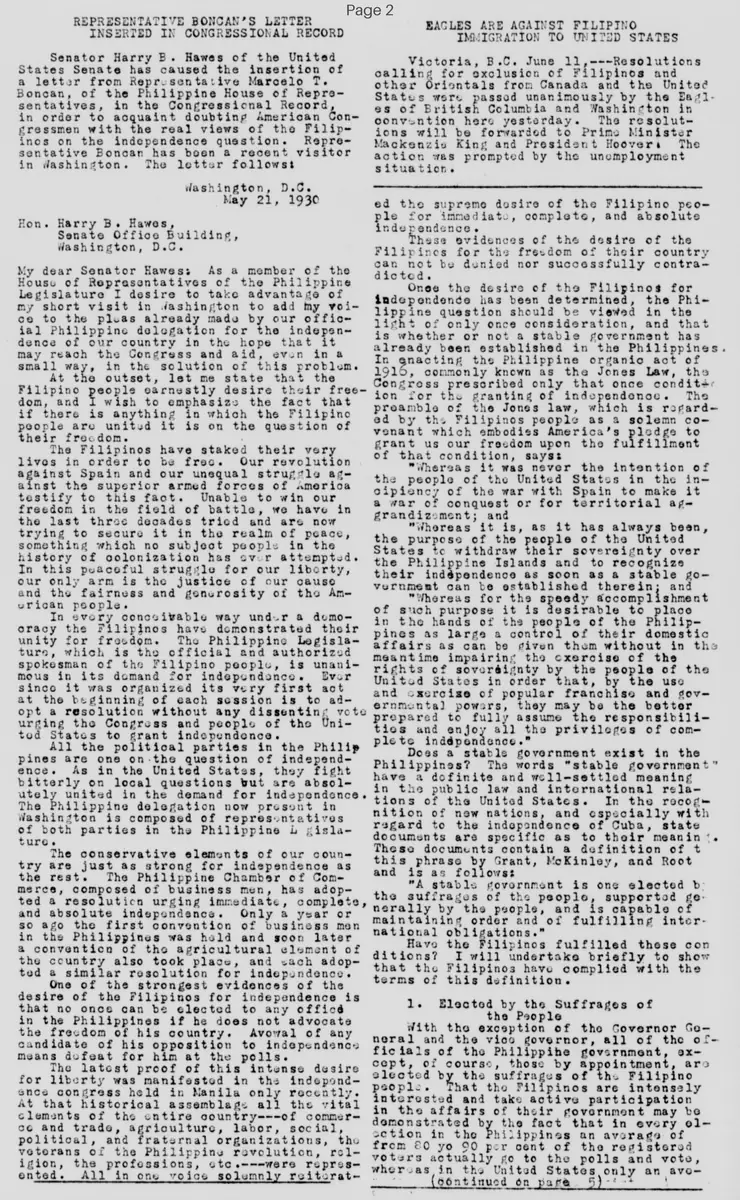
Senator Harry B. Hawes of the United States Senate has caused the insertion of a letter from Representative Marcelo T. Boncan, of the Philippine House of Representatives, in the Congressional Record in order to acquaint doubting American Congressmen with the real views of the Filipinos on the independence question. Representative Boncan has been a recent visitor in Washington. The letter follows:
Washington, D.C.
May 21, 1930
Hon. Harry B. Hawes
Senate Office Building,
Washington, D.C.
My dear Senator Hawes: As a member of the House of Representatives of the Philippine Legislature I desire to take advantage of my short visit in Washington to add my voice to the pleas already made by our official Philippine delegation for the independence of our country in the hope that it may reach the Congress and aid, even in a small way, in the solution of this problem.
At the outset, let me state that the Filipino people earnestly desire their freedom, and I wish to emphasize the fact that if there is anything in which the Filipino people are united it is on the question of their freedom.
The Filipinos have staked their very lives in order to be free. Our revolution against Spain and our unequal struggle against the superior armed forces of America testify to this fact. Unable to win our freedom in the field of battle, we have in the last three decades tried and are now trying to secure it in the realm of peace, something which no subject people in the history of colonization has ever attempted.
In this peaceful struggle for our liberty, our only arm is the justice of our cause and the fairness and generosity of the American people.
In every conceivable way under a democracy the Filipinos have demonstrated their unity for freedom. The Philippine Legislature, which is the official and authorized spokesman of the Filipino people, is unanimous in its demand for independence. Ever since it was organized its very first act at the beginning of each session is to adopt a resolution without any dissenting vote urging the Congress and people of the United States to grant independence.
All the political parties in the Philippines are one on the question of independence. As in the United States, they fight bitterly on local questions but are absolutely united in the demand for independence.
The Philippine delegation now present in Washington is composed of representatives of both parties in the Philippine Legislature.
The conservative elements of our country are just as strong for independence as the rest. The Philippine Chamber of Commerce, composed of business men, has adopted a resolution urging immediate, complete, and absolute independence. Only a year or so ago the first convention of business men in the Philippines was held and soon later a convention of the agricultural element of the country also took place, and each adopted a similar resolution for independence.
One of the strongest evidences of the desire of the Filipinos for independence is that no one can be elected to any office in the Philippines if he does not advocate the freedom of his country. Avowal of any candidate of his opposition to independence means defeat for him at the polls.
The latest proof of this intense desire for liberty was manifested in the independence congress held in Manila only recently. At that historical assemblage all the vital elements of the entire country---of commerce and trade, agriculture, labor, social, political, and fraternal organizations, the veterans of the Philippine revolution, religion, the professions, etc.---were represented. All in one voice solemnly reiterated the supreme desire of the Filipino people for immediate, complete, and absolute independence.
These evidences of the desire of the Filipinos for the freedom of their country can not be denied nor successfully contradicted.
Once the desire of the Filipinos for independence has been determined, the Philippine question should be viewed in the light of only one consideration, and that is whether or not a stable government has already been established in the Philippines.
In enacting the Philippine organic act of 1916, commonly known as the Jones Law, the Congress prescribed only that one condition for the granting of independence. The preamble of the Jones Law, which is regarded by the Filipino people as a solemn covenant which embodies America's pledge to grant us our freedom upon the fulfillment of that condition, says:
"Whereas it was never the intention of the people of the United States in the incipiency of the war with Spain to make it a war of conquest or for territorial aggrandizement: and
"Whereas it is, as it has always been, the purpose of the people of the United States to withdraw their sovereignty over the Philippine Islands and to recognize their independence as soon as a stable government can be established therein: and
"Whereas for the speedy accomplishment of such purpose it is desirable to place in the hands of the people of the Philippines as large a control of their domestic affairs as can be given them without in the meantime impairing the exercise of the rights of sovereignty by the people of the United States in order that, by the use and exercise of popular franchise and governmental powers, they may be the better prepared to fully assume the responsibilities and enjoy all the privileges of complete independence."
Does a stable government exist in the Philippines? The words "stable government" have a definite and well-settled meaning in the public law and international relations of the United States. In the recognition of new nations, and especially with regard to the independence of Cuba, state documents are specific as to their meaning. These documents contain a definition of this phrase by Grant, McKinley, and Root and is as follows:
"A stable government is one elected by the suffrages of the people, supported generally by the people, and is capable of maintaining order and of fulfilling international obligations."
Have the Filipinos fulfilled these conditions? I will undertake briefly to show that the Filipinos have complied with the terms of this definition.
1. Elected by the Suffrages of the People
With the exception of the Governor General and the vice governor, all of the officials of the Philippine government, except, of course, those by appointment, are elected by the suffrages of the Filipino people. That the Filipinos are intensely interested and take active participation in the affairs of their government may be demonstrated by the fact that in every election in the Philippines an average of from 80 to 90 per cent of the registered voters actually go to the polls and vote, whereas in the United States, only an average of 50 per cent of the registered voters cast their ballots.
As to the character of the Philippine elections Governor General Wood, the most strict critic of the Filipinos, in his annual report to the Secretary of War for 1922, said:
"During the year general elections were held. They were the most orderly elections ever held in the islands. It can be stated that throughout the archipelago there were no serious disturbances. All parties admit that the elections were fairly and honestly conducted. The number of complaints have been strikingly small."
In his message to the Philippine Legislature that same year, Governor Wood had the following to say:
"I congratulate you and through you the Filipino people on the orderly and lawful conduct of the recent elections, which, notwithstanding the keenness of the struggle and the appearance of a strong new party in the field, were conducted with due regard to the rights of the candidates and with the absence of fraud and irregularity which would be a credit to any people."
2. Supported Generally by the People
Ever since civil government was established in the Philippines in 1903 the Philippine government has always been self-supporting. Since its establishment it has been fully accepted and respected by the people and all expenses incident to administration have come from taxes paid by them.
This fact is not commonly known in the United States.
The Philippine government is in a sound and stable financial condition. Receipts are well in excess over expenditures and are amply sufficient to provide for all necessary activities.
The government maintains a comfortable surplus to guard against possible shortage in estimated collections and also to reduce the public debt. A complete budget system has been established in the Philippines in relation to government appropriations. Incidentally it may be stated that the budget system was in operation in the Philippines long before it was adopted in the United States.
3. Capable of Maintaining Peace and Order
Peace and order in the Philippines is maintained by the Philippine Constabulary, the insular force of the islands, which number 6,300 enlisted men, all Filipinos, and 398 officers, of whom 375 are Filipinos and only 23 Americans. The head of this organization has for many years been a Filipino, and upon his death he was succeeded by an American only because the latter was next in rank.
The police force in every locality in the Philippines is composed entirely of Filipinos with the exception of the City of Manila, where a few Americans are employed as police officers.
It is not difficult to keep peace and order in the Philippines, because Filipinos are by nature orderly and law abiding.
Quoting Governor General Wood again, in one of his last annual reports to the Secretary of War:
"With a few minor exceptions, conditions of public order have been excellent throughout the archipelago. No disturbances have occurred beyond the control of the municipal and insular police. There has been no organized resistance to authority. Life and property have been reasonably secure and travelers have gone unmolested without arms or escort wherever they cared to go. Parties of women unescorted and unattended have traversed the most remote portions of the mountain province without suffering any discourtesy or annoyance."
4. Capable of Fulfilling International Obligations
Fulfillment of international relations is generally understood to mean due respect to treaties and international agreements and understandings including protection of the rights of foreigners.
There is no doubt that the Filipinos, when they get their independence, will try to keep the good will of other nations by fulfilling all international obligations, for not to do so would be to endanger their newly acquired freedom and independence.
During the brief existence of the erstwhile Philippine Republic, the lives and properties of foreigners residing in the Philippines at the time were fully protected. But the best way to find out whether the Filipinos are capable of fulfilling international obligations is to grant them their independence.
From the American point of view of this question of whether or not there exists a stable government in the Philippines, it is respectfully recalled that in 1920 a President of the United States, in a message to Congress, certified to the existence of a stable government in the Philippines and recommended the granting of independence.
It will be noted from the above that the existence of a stable government in the islands is already an established fact.
The question of economic preparation, of military preparedness, of security from aggression, it seems to me, are matters which are without the scope of the question of whether or not there is a stable government in the Philippines, for, as stated before, this is the one and only condition previously required by the Congress for the granting of independence. Those who insist on economic preparation, military preparedness, etc., are begging the issue, for these are not embodied as requirements in the preamble of the Jones law which is the only official and formal declaration of purpose and policy of the United States toward the Philippines and which the Filipino people have accepted in good faith.
As to economic preparation before independence, our reply is that the Philippines can never become economically self-sufficient until the political situation has been settled. One of the main reasons why the Filipinos are urging immediate independence is that the uncertainty of the political status of the islands is preventing economic progress. Capital,—American, native, or foreign—is shy because of this uncertain status. The granting of independence is the best way to clarify the situation. Its permanent settlement in this manner will enable the Filipinos to rebuild their economic structure upon permanent basis. The free-trade relations between the United States and the Philippines, beneficial as they are to us in many ways, can not but be temporary, for our present free American market can be closed to us even before independence is granted. The sooner free trade is discontinued with the grant of independence the better for us. When that is done, the Filipinos will have to readjust themselves to a new economic situation, and they prefer that the necessary readjustments be made immediately while they can still stand the shock of foregoing the benefits derived from free trade with America.
Fear for the security of an independent Philippines fills the minds of many with doubts and misgivings. The existence today of a greater and an ever-increasing sentiment of friendship and amity among the nations is the greatest protection to the integrity of the Philippines. International peace, amity, and justice is greater today than at any time in the past.
The rich and powerful nations can no longer dare commit acts of aggression against the weak and helpless peoples without incurring the condemnation of the entire world. The World Court, the Kellogg-Briand treaty denouncing war as an instrument of national aggression, the League of Nations are mighty instruments in favor of the weak and the small.
The League of Nations would especially be an asset to an independent Philippines.
I have just come from a visit in Geneva where I had the good fortune of coming into contact with many of the executive officials of the league and of studying at the very grounds the workings of this institution.
The protection which the league accords to the territorial integrity of its members appealed to me greatly. There is no reason why the Philippines, once independent, could not be admitted as a member of the league, as are Cuba, Haiti, Siam, and the Irish Free State. It would not be amiss to quote here Article X of the covenant of the league which is as follows:
"The members of the league undertake to respect and preserve as against external aggression the territorial integrity and existing political independence of all members of the league. In case of any such aggression, the council shall advise upon the means by which this obligation shall be fulfilled."
The insistence of the Filipino people on independence seems to cause surprise to not a few Americans with whom I have had the opportunity of discussing the Philippine question since my arrival in the United States.
They make the assertion that since the Filipinos themselves admit that America's rule in the Philippines has resulted in unparalleled progress they should prefer to continue under the American flag rather than sever their relations with the United States.
Permit me to repeat here what we have stated many a time before: That our longing to be free does not arise from lack of appreciation for the many blessings that we have received from her fruitful guidance.
We are, indeed, eternally grateful for the many things that America has done for us.
In demanding our independence we are only expressing our God-given right to be free and to carve out our own destiny. A great American statesman, Daniel Webster, fully and correctly visualized the situation of a people under the control of another, and was voicing our own sentiments, when he said:
"No matter how easy may be the yoke of a foreign power, no matter how lightly it sits upon the shoulder, if it is not imposed by the voice of his own nation and his own country, he will not, he can not; he means not to be happy under its burden."
Thanking you for your generous efforts on behalf of our sacred cause, I am, my dear Senator
Very sincerely yours,
MARCELO T. BONCAN
Member Philippine House of Representatives.
High Altitude
"What you are is so loud that I can not hear what you say."
So said Ralph Waldo Emerson, that coolest thinker that adorns the pages of American literature.
In other words the real is entirely different from the artificial, although sometimes, and perhaps oftenest, the real is so cleverly clothed by the artificial that we can not see beneath the surface of artificiality.
Man, of all creatures most susceptible to vanity, very often shows the veneer of artificiality and in a way hides his true identity. But what you are, says Emerson, is so loud that I can not hear what you say.
How ridiculous man sometimes becomes; how silly then do some persons act; when, clothing themselves with the glossy artificial, they strut and parade themselves in a category to which they do not legitimately belong. Thus they become conceited and forget their true selves. Thus they rise above their proper station in the guise of a borrowed plume. Thus they proclaim themselves the ordained leaders of their fellowmen and speak with borrowed authority.
But what they are is so loud, we can not hear what they say.
The artificial covers the real, and man, in all his conceit and vanity, fails to see the real thru the splendor of the artificial. Take away the artificial veneer that is borrowed and you will see the real.
So "what you are is so loud that I can not hear what you say,"
What sub-type of article is it?
What themes does it cover?
What keywords are associated?
What entities or persons were involved?
Letter to Editor Details
Author
Marcelo T. Boncan
Recipient
Hon. Harry B. Hawes
Main Argument
the filipino people are united in their earnest desire for independence, demonstrated through revolutions, legislative resolutions, elections, and conventions; a stable government exists in the philippines as defined and required by the jones law of 1916, fulfilling the sole condition for granting independence; thus, the u.s. congress should provide immediate, complete, and absolute independence, addressing concerns over economics and security through international mechanisms like the league of nations.
Notable Details