Thank you for visiting SNEWPapers!
Sign up free
Eagle River Review
Eagle River, Vilas County, Wisconsin
What is this article about?
Herbert Kaufman's column offers advice on effective advertising, warning against poor copywriting, exaggeration, imitation, amateur management, overuse of sales, fine print, and quitting. It also discusses evaluating newspaper circulation for targeted reach, using metaphors like omelette souffle and big steak to illustrate value over bulk.
Clipping
OCR Quality
Full Text
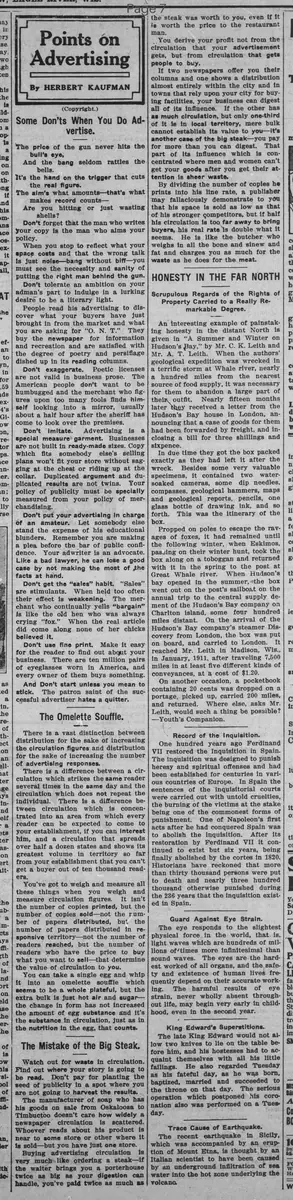
on
Advertising
By HERBERT
KAUFMAN
(Copyright.)
Some Don'ts When You Do Ad-
vertise.
The price of the gun never hits the
bull's eye,
And the bang seldom rattles the
bells.
It's the hand on the trigger that cuts
the real figure.
The aim's what amounts that's what
makes record counts-
Are you hitting or just wasting
shells?
Don't forget that the man who writes
your copy is the man who aims your
policy.
When you stop to reflect what your
space costs and that the wrong talk
is just noisebang without biff-you
must see the necessity and sanity of
putting the right man behind the gun.
Don't tolerate an ambition on your
adman's part to indulge in a lurking
desire to be a literary light
People read his advertising to dis-
cover what your buyers have just
brought in from the market and what
you are asking for "O.N.T." They
buy the newspaper for information
and recreation and are satisfied with
the degree of poetry and persiflage
dished up in its reading columns.
Don't exaggerate. Poetic licenses
are not valid in business prose. The
American people don't want to be
humbugged and the merchant who fig-
ures upon too many fools finds him-
self looking into a mirror, usually
about a half hour after the sheriff has
come to look over the premises.
Don't imitate. Advertising is a
special measure garment. Businesses
are not built in ready-made sizes. Copy
which fits somebody else's selling
plans won't fit your store without sag-
ging at the chest or riding up at the
collar. Duplicated argument and du-
plicated results are not twins. Your
policy of publicity must be specially
measured from your policy of mer-
chandising.
Don't put your advertising in charge
of an amateur. Let somebody else
stand the expense of his educational
blunders. Remember you are making
a plea before the bar of public confi-
dence. Your adwriter is an advocate.
Like a bad lawyer, he can lose a good
case by not making the most of the
facts at hand.
Don't get the "sales" habit. "Sales"
are stimulants. When held too often
their effect is weakening. The mer-
chant who continually yells "bargain"
Is like the old hen who was always
crying "fox." When the real article
did come along none of her chicks
believed it.
Don't use fine print. Make it easy
for the reader to find out about your
business. There are ten million pairs
of eyeglasses worn in America, and
every owner of them buys something.
And Don't start unless you mean to
stick. The patron saint of the suc
cessful advertiser hates a quitter.
The Omelette Souffle.
There is a vast distinction between
distribution for the sake of increasing
the circulation figures and distribution
for the sake of increasing the number
of advertising responses.
There is a difference between a cir-
culation which strikes the same reader
several times in the same day and the
circulation which does not repeat the
individual. There is a difference be-
tween circulation which is concen
trated into an area from which every
reader can be expected to come to
your establishment, if you can interest
him, and a circulation that spreads
over half a dozen states and shows its
greatest volume in territory so far
from your establishment that you can't
get a buyer out of ten thousand read
ers.
You've got to weigh and measure all
these things when you weigh and
measure circulation figures. It isn't
the number of copies printed, but the
number of copies sold-not the rum-
ber of papers distributed, but the
number of papers distributed in re
sponsive territory-not the number of
readers reached, but the number of
readers who have the price to buy
what you want to sell-that determine
the value of circulation to you.
You can take a single egg and whip
it into an omelette souffle which
seems to be a whole plateful, but the
extra bulk is just hot air and sugar-
the change in form has not increased
the amount of egg substance and it's
the substance in circulation, just as in
the nutrition in the egg, that counts.
The Mistake of the Big Steak.
Watch out for waste in circulation.
Find out where your story is going to
be read. Don't pay for planting the
seed of publicity in a spot where you
are not going to harvest the results.
The manufacturer of soap who has
his goods on sale from Oskaloosa to
Timbuctoo doesn't care how widely a
newspaper circulation is scattered.
Whoever reads about his product is
near to some store or other where it
is sold-but you have just one store.
Buying advertising circulation is
very much like ordering a steak-if
the waiter brings you a porterhouse
twice as big as your digestion can
handle, you've paid twice as much as
the steak was worth to you, even if it
is worth the price to the restaurant
man.
You derive your profit not from the
circulation that your advertisement
gets, but from circulation that gets
people to buy.
If two newspapers offer you their
columns and one shows a distribution
almost entirely within the city and in
towns that rely upon your city for buy-
ing facilities, your business can digest
all of its influence. If the other has
as much circulation, but only one-third
of it is in local territory, mere bulk
cannot establish its value to you-it's
another case of the big steak-you pay
for more than you can digest. That
part of its influence which is con-
centrated where men and women can't
get your goods after you get their at-
tention is sheer waste.
By dividing the number of copies he
prints into his line rate, a publisher
may fallaciously demonstrate to you
that his space is sold as low as that
of his stronger competitors, but if half
his circulation is too far away to bring
buyers, his real rate is double what it
seems. He is like the butcher who
weighs in all the bone and sinew and
fat and charges you as much for the
waste as he does for the meat.
What sub-type of article is it?
What themes does it cover?
What keywords are associated?
What entities or persons were involved?
Story Details
Key Persons
Story Details
Article provides practical don'ts for advertisers: hire skilled copywriters, avoid exaggeration and imitation, don't use amateurs, limit sales promotions, avoid fine print, and commit long-term. Uses metaphors of omelette souffle and big steak to explain evaluating circulation for targeted, effective reach over mere bulk.