Thank you for visiting SNEWPapers!
Sign up free
Editorial
January 27, 1928
Union Labor Bulletin
Little Rock, Pulaski County, Arkansas
What is this article about?
The National Council for Prevention of War critiques testimony from Navy officials on a proposed $725M naval construction program, part of a $2.5B 20-year plan to replace obsolete ships. It argues the program aims for real ships to achieve cruiser parity with Britain, potentially igniting a new arms race after the failed Geneva conference.
Clipping
OCR Quality
98%
Excellent
Full Text
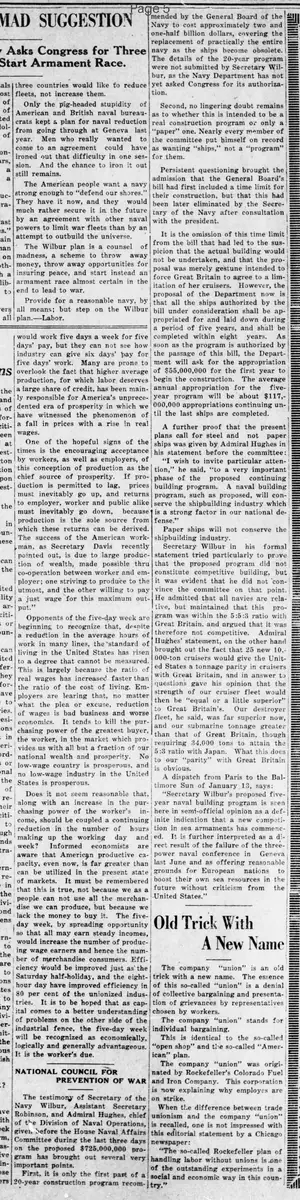
NATIONAL COUNCIL FOR PREVENTION OF WAR
The testimony of Secretary of the Navy Wilbur, Assistant Secretary Robinson, and Admiral Hughes, chief of the Division of Naval Operations, given before the House Naval Affairs Committee during the last three days on the proposed $725,000,000 program has brought out several very important points.
First, it is only the first part of a 20-year construction program recommended by the General Board of the Navy to cost approximately two and one-half billion dollars, covering the replacement of practically the entire navy as the ships become obsolete.
The details of the 20-year program were not submitted by Secretary Wilbur, as the Navy Department has not yet asked Congress for its authorization.
Second, no lingering doubt remains as to whether this is intended to be a real construction program or only a "paper" one. Nearly every member of the committee put himself on record as wanting "ships," not a "program" for them.
Persistent questioning brought the admission that the General Board's bill had first included a time limit for their construction, but that this had been later eliminated by the Secretary of the Navy after consultation with the president.
It is the omission of this time limit from the bill that had led to the suspicion that the actual building would not be undertaken, and that the proposal was merely gesture intended to force Great Britain to agree to a limitation of her cruisers. However, the proposal of the Department now is that all the ships authorized by the bill under consideration shall be appropriated for and laid down during a period of five years, and shall be completed within eight years. As soon as the program is authorized by the passage of this bill, the Department will ask for the appropriation of $55,000,000 for the first year to begin the construction. The average annual appropriation for the five-year program will be about $117,000,000 appropriations continuing until the last ships are completed.
A further proof that the present plans call for steel and not paper ships was given by Admiral Hughes in his statement before the committee:
"I wish to invite particular attention," he said, "to a very important phase of the proposed continuing building program. A naval building program, such as proposed, will conserve the shipbuilding industry which is a strong factor in our national defense."
Paper ships will not conserve the shipbuilding industry.
Secretary Wilbur in his formal statement tried particularly to prove that the proposed program did not constitute competitive building, but it was evident that he did not convince the committee on that point.
He admitted that all navies are relative, but maintained that this program was within the 5:5:3 ratio with Great Britain, and argued that it was therefore not competitive. Admiral Hughes' statement, on the other hand, brought out the fact that 25 new 10,000-ton cruisers would give the United States a tonnage parity in cruisers with Great Britain, and in answer to questions gave his opinion that the strength of our cruiser fleet would then be "equal or a little superior" to Great Britain's. Our destroyer fleet, he said, was far superior now, and our submarine tonnage greater than that of Great Britain, though requiring 34,000 tons to attain the 5:3 ratio with Japan. What this does to our "parity" with Great Britain is obvious.
A dispatch from Paris to the Baltimore Sun of January 13, says:
"Secretary Wilbur's proposed five-year naval building program is seen here in semi-official opinion as a definite indication that a new competition in sea armaments has commenced. It is further interpreted as a direct result of the failure of the three-power naval conference in Geneva last June and as offering reasonable grounds for European nations to boost their own sea resources in the future without criticism from the United States."
The testimony of Secretary of the Navy Wilbur, Assistant Secretary Robinson, and Admiral Hughes, chief of the Division of Naval Operations, given before the House Naval Affairs Committee during the last three days on the proposed $725,000,000 program has brought out several very important points.
First, it is only the first part of a 20-year construction program recommended by the General Board of the Navy to cost approximately two and one-half billion dollars, covering the replacement of practically the entire navy as the ships become obsolete.
The details of the 20-year program were not submitted by Secretary Wilbur, as the Navy Department has not yet asked Congress for its authorization.
Second, no lingering doubt remains as to whether this is intended to be a real construction program or only a "paper" one. Nearly every member of the committee put himself on record as wanting "ships," not a "program" for them.
Persistent questioning brought the admission that the General Board's bill had first included a time limit for their construction, but that this had been later eliminated by the Secretary of the Navy after consultation with the president.
It is the omission of this time limit from the bill that had led to the suspicion that the actual building would not be undertaken, and that the proposal was merely gesture intended to force Great Britain to agree to a limitation of her cruisers. However, the proposal of the Department now is that all the ships authorized by the bill under consideration shall be appropriated for and laid down during a period of five years, and shall be completed within eight years. As soon as the program is authorized by the passage of this bill, the Department will ask for the appropriation of $55,000,000 for the first year to begin the construction. The average annual appropriation for the five-year program will be about $117,000,000 appropriations continuing until the last ships are completed.
A further proof that the present plans call for steel and not paper ships was given by Admiral Hughes in his statement before the committee:
"I wish to invite particular attention," he said, "to a very important phase of the proposed continuing building program. A naval building program, such as proposed, will conserve the shipbuilding industry which is a strong factor in our national defense."
Paper ships will not conserve the shipbuilding industry.
Secretary Wilbur in his formal statement tried particularly to prove that the proposed program did not constitute competitive building, but it was evident that he did not convince the committee on that point.
He admitted that all navies are relative, but maintained that this program was within the 5:5:3 ratio with Great Britain, and argued that it was therefore not competitive. Admiral Hughes' statement, on the other hand, brought out the fact that 25 new 10,000-ton cruisers would give the United States a tonnage parity in cruisers with Great Britain, and in answer to questions gave his opinion that the strength of our cruiser fleet would then be "equal or a little superior" to Great Britain's. Our destroyer fleet, he said, was far superior now, and our submarine tonnage greater than that of Great Britain, though requiring 34,000 tons to attain the 5:3 ratio with Japan. What this does to our "parity" with Great Britain is obvious.
A dispatch from Paris to the Baltimore Sun of January 13, says:
"Secretary Wilbur's proposed five-year naval building program is seen here in semi-official opinion as a definite indication that a new competition in sea armaments has commenced. It is further interpreted as a direct result of the failure of the three-power naval conference in Geneva last June and as offering reasonable grounds for European nations to boost their own sea resources in the future without criticism from the United States."
What sub-type of article is it?
Military Affairs
Foreign Affairs
War Or Peace
What keywords are associated?
Naval Construction
Cruiser Program
Arms Race
Navy Testimony
Geneva Conference
British Parity
Shipbuilding Industry
What entities or persons were involved?
Secretary Of The Navy Wilbur
Assistant Secretary Robinson
Admiral Hughes
House Naval Affairs Committee
General Board Of The Navy
Great Britain
Japan
President
Editorial Details
Primary Topic
Critique Of Proposed Naval Construction Program
Stance / Tone
Opposition To Naval Buildup As Competitive Armaments
Key Figures
Secretary Of The Navy Wilbur
Assistant Secretary Robinson
Admiral Hughes
House Naval Affairs Committee
General Board Of The Navy
Great Britain
Japan
President
Key Arguments
The $725m Program Is The First Part Of A $2.5b 20 Year Plan To Replace The Entire Navy.
It Calls For Real Ship Construction, Not Paper Plans, With Appropriations Over Five Years.
The Program Aims For Cruiser Tonnage Parity Or Superiority Over Great Britain.
It Contradicts Claims Of Non Competitive Building Within 5:5:3 Ratios.
It May Spark A New Sea Armaments Competition Following The Failed Geneva Conference.
Building Preserves The Shipbuilding Industry For National Defense.