Thank you for visiting SNEWPapers!
Sign up free
Editorial
October 9, 1827
Richmond Enquirer
Richmond, Richmond County, Virginia
What is this article about?
An editorial criticizes Henry Clay's secretive stance during the 1824-1825 presidential election, alleging he negotiated a coalition with John Quincy Adams against Andrew Jackson, involving figures like Markley, who was rewarded with a position.
Clipping
OCR Quality
95%
Excellent
Full Text
FOR THE ENQUIRER.
THE COALITION.
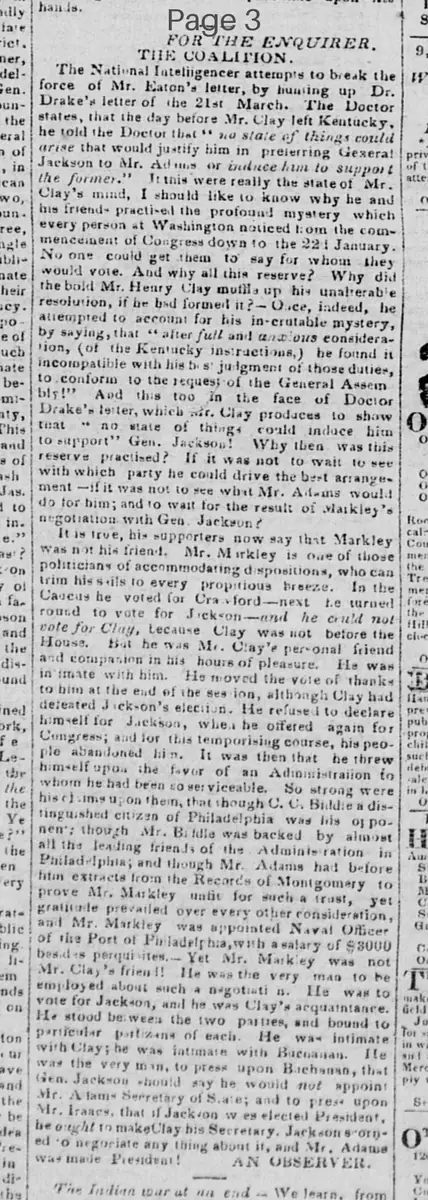
The National Intelligencer attempts to break the force of Mr. Eaton's letter, by hunting up Dr. Drake's letter of the 21st March. The Doctor states, that the day before Mr. Clay left Kentucky, he told the Doctor that "no state of things could arise that would justify him in preferring General Jackson to Mr. Adams or induce him to support the former." If this were really the state of Mr. Clay's mind, I should like to know why he and his friends practiced the profound mystery which every person at Washington noticed from the commencement of Congress down to the 22d January. No one could get them to say for whom they would vote. And why all this reserve? Why did the bold Mr. Henry Clay muffle up his unalterable resolution, if he had formed it?—Once, indeed, he attempted to account for his inscrutable mystery, by saying, that "after full and anxious consideration, of the Kentucky instructions,) he found it incompatible with his best judgment of those duties, to conform to the request of the General Assembly!" And this too in the face of Doctor Drake's letter, which Mr. Clay produces to show that "no state of things could induce him to support" Gen. Jackson! Why then was this reserve practiced? If it was not to wait to see with which party he could drive the best arrangement—if it was not to see what Mr. Adams would do for him; and to wait for the result of Markley's negotiation with Gen. Jackson?
It is true, his supporters now say that Markley was not his friend. Mr. Markley is one of those politicians of accommodating dispositions, who can trim his sails to every propitious breeze. In the Caucus he voted for Crawford—next he turned round to vote for Jackson—and he could not vote for Clay, because Clay was not before the House. But he was Mr. Clay's personal friend and companion in his hours of pleasure. He was intimate with him. He moved the vote of thanks to him at the end of the Session, although Clay had defeated Jackson's election. He refused to declare himself for Jackson, when he offered again for Congress; and for this temporizing course, his people abandoned him. It was then that he threw himself upon the favor of an Administration to whom he had been so serviceable. So strong were his claims upon them, that though C. C. Biddle a distinguished citizen of Philadelphia was his opponent; though Mr. Biddle was backed by almost all the leading friends of the Administration in Philadelphia; and though Mr. Adams had before him extracts from the Records of Montgomery to prove Mr. Markley unfit for such a trust, yet gratitude prevailed over every other consideration, and Mr. Markley was appointed Naval Officer of the Port of Philadelphia, with a salary of $4000 besides perquisites.—Yet Mr. Markley was not Mr. Clay's friend! He was the very man to be employed about such a negotiation. He was to vote for Jackson, and he was Clay's acquaintance. He stood between the two parties, and bound to particular politicians of each. He was intimate with Clay; he was intimate with Buchanan. He was the very man, to press upon Buchanan, that Gen. Jackson should say he would not appoint Mr. Adams Secretary of State; and to press upon Mr. Innes, that if Jackson was elected President, he ought to make Clay his Secretary. Jackson scorned to negotiate any thing about it, and Mr. Adams was made President!
AN OBSERVER.
THE COALITION.
The National Intelligencer attempts to break the force of Mr. Eaton's letter, by hunting up Dr. Drake's letter of the 21st March. The Doctor states, that the day before Mr. Clay left Kentucky, he told the Doctor that "no state of things could arise that would justify him in preferring General Jackson to Mr. Adams or induce him to support the former." If this were really the state of Mr. Clay's mind, I should like to know why he and his friends practiced the profound mystery which every person at Washington noticed from the commencement of Congress down to the 22d January. No one could get them to say for whom they would vote. And why all this reserve? Why did the bold Mr. Henry Clay muffle up his unalterable resolution, if he had formed it?—Once, indeed, he attempted to account for his inscrutable mystery, by saying, that "after full and anxious consideration, of the Kentucky instructions,) he found it incompatible with his best judgment of those duties, to conform to the request of the General Assembly!" And this too in the face of Doctor Drake's letter, which Mr. Clay produces to show that "no state of things could induce him to support" Gen. Jackson! Why then was this reserve practiced? If it was not to wait to see with which party he could drive the best arrangement—if it was not to see what Mr. Adams would do for him; and to wait for the result of Markley's negotiation with Gen. Jackson?
It is true, his supporters now say that Markley was not his friend. Mr. Markley is one of those politicians of accommodating dispositions, who can trim his sails to every propitious breeze. In the Caucus he voted for Crawford—next he turned round to vote for Jackson—and he could not vote for Clay, because Clay was not before the House. But he was Mr. Clay's personal friend and companion in his hours of pleasure. He was intimate with him. He moved the vote of thanks to him at the end of the Session, although Clay had defeated Jackson's election. He refused to declare himself for Jackson, when he offered again for Congress; and for this temporizing course, his people abandoned him. It was then that he threw himself upon the favor of an Administration to whom he had been so serviceable. So strong were his claims upon them, that though C. C. Biddle a distinguished citizen of Philadelphia was his opponent; though Mr. Biddle was backed by almost all the leading friends of the Administration in Philadelphia; and though Mr. Adams had before him extracts from the Records of Montgomery to prove Mr. Markley unfit for such a trust, yet gratitude prevailed over every other consideration, and Mr. Markley was appointed Naval Officer of the Port of Philadelphia, with a salary of $4000 besides perquisites.—Yet Mr. Markley was not Mr. Clay's friend! He was the very man to be employed about such a negotiation. He was to vote for Jackson, and he was Clay's acquaintance. He stood between the two parties, and bound to particular politicians of each. He was intimate with Clay; he was intimate with Buchanan. He was the very man, to press upon Buchanan, that Gen. Jackson should say he would not appoint Mr. Adams Secretary of State; and to press upon Mr. Innes, that if Jackson was elected President, he ought to make Clay his Secretary. Jackson scorned to negotiate any thing about it, and Mr. Adams was made President!
AN OBSERVER.
What sub-type of article is it?
Partisan Politics
What keywords are associated?
Coalition
Clay
Adams
Jackson
Election
Negotiation
Markley
Reserve
Mystery
What entities or persons were involved?
Mr. Clay
General Jackson
Mr. Adams
Dr. Drake
Mr. Eaton
Markley
Crawford
C. C. Biddle
Buchanan
Mr. Innes
Editorial Details
Primary Topic
Alleged Coalition Between Clay And Adams
Stance / Tone
Critical Of Clay's Secrecy And Negotiation
Key Figures
Mr. Clay
General Jackson
Mr. Adams
Dr. Drake
Mr. Eaton
Markley
Crawford
C. C. Biddle
Buchanan
Mr. Innes
Key Arguments
Clay Maintained Profound Mystery About His Vote Until January 22
Clay's Reserve Suggests Waiting For Best Arrangement With Adams Or Jackson
Markley Acted As Negotiator Between Parties Despite Claimed Non Friendship With Clay
Markley Voted For Crawford Then Jackson And Was Rewarded With Philadelphia Post
Jackson Refused To Negotiate, Leading To Adams' Election