Thank you for visiting SNEWPapers!
Sign up free
Literary
May 9, 1799
Gazette Of The United States, & Philadelphia Daily Advertiser
Philadelphia, Philadelphia County, Pennsylvania
What is this article about?
Satirical essay from the Providence Journal titled 'THE ADELPHIAD' discussing plagiarism as a literary crime, introducing a fictional court for literary offenses. It examines cases of alleged theft from authors like James Thompson and Anna Seward, concluding with humorous courtroom antics.
Clipping
OCR Quality
95%
Excellent
Full Text
From the PROVIDENCE JOURNAL.
THE ADELPHIAD.
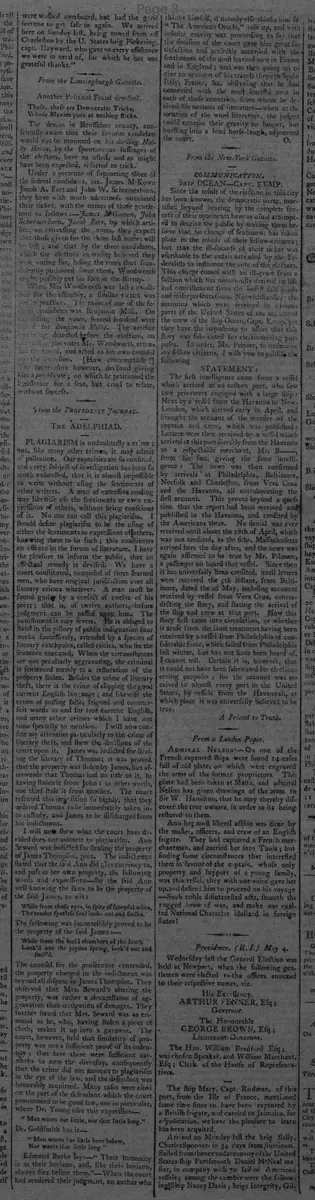
PLAGIARISM is undoubtedly a crime; but, like many other crimes, it may admit of palliation. Our capacities are so confined, and every subject of investigation has been so much exhausted, that it is almost impossible to write without using the sentiments of other writers. A man of extensive reading may likewise use the sentiments or even expressions of others, without being conscious of it. No one can call this plagiarism. I should define plagiarism to be the using of either the sentiments or expressions of others, knowing them to be such; this constitutes an offence in the forum of literature. I have the pleasure to inform the public, that an effectual remedy is devised. We have a court constituted, composed of three learned men, who have original jurisdiction over all literary crimes whatever. A man must be found guilty by a verdict of twelve of his peers; that is, of twelve authors, before judgment can be passed upon him. The punishment is very severe. He is obliged to stand in the pillory of public indignation four weeks successively, attended by a species of literary catchpoles, called critics, who see the sentence executed. When the circumstances are not peculiarly aggravating, the criminal is sentenced merely to a restoration of the property stolen. Besides the crime of literary theft, there is the crime of clipping the good current English language; and likewise the crime of passing false, feigned and counterfeit words as and for true current English, and many other crimes which I have not time specially to mention. I will now confine my attention particularly to the crime of literary theft, and shew the decisions of the court upon it. James was indicted for stealing the literary property of Thomas; it was proved that the property was stolen by James, but afterwards that Thomas had no title to it, he having stolen it from John: in other words, one thief stole it from another. The court resented this imputation so highly, that they ordered Thomas to be immediately taken into custody, and James to be discharged from his indictment.
I will now shew what the court have decided does not amount to plagiarism. Ann Seward was indicted for stealing the property of James Thompson, poet. The indictment stated that the said Ann did give currency to, and pass as her own property, the following words and expressions—she the said Ann well knowing the same to be the property of the said James, to wit:
While from those eyes, in spite of corneal wies.
The tender spotless soul looks out and smiles.
The following was incontestibly proved to be the property of the said James: —
While from the lucid chambers of the south
Look'd out the joyous spring, look'd out and smiled.
The counsel for the prosecutor contended, the property charged in the indictment was beyond all dispute in James Thompson. They observed that Mrs. Seward's altering the property, was rather a circumstance of aggravation than mitigation of damages. They further stated that Mrs. Seward was as criminal as he, who, having stolen a piece of cloth, makes it up into a garment. The court, however, held that similarity of property was not a sufficient proof of its identity; that here there were sufficient ear-marks to note the diversity, consequently that the crime did not amount to plagiarism in the eye of the law, and the defendant was honorably acquitted. Many cases were cited on the part of the defendant which the court pronounced to be good law, one in particular, where Dr. Young uses this expression—
"Man wants but little, nor that little long."
Dr. Goldsmith has it—
"Man wants but little here below,
Nor wants that little long."
Edmund Burke says—"Their humanity is as their horizon, and, like their horizon, always flies before them."
When the court had rendered their judgment, an author who thinks himself, if nobody else thinks him so "The American Oracle," rose up, and with infinite gravity was proceeding to say that the decision of the court gave him great satisfaction and perfectly accorded with the sentiments of the most learned men in France and in England; and was then going on to give an account of his travels through Spain Italy, France, &c. observing that he had conversed with the most learned men in each of those countries, from whom he derived his notions of literature —when at the mention of the word literature, the judges could contain their gravity no longer, but bursting into a loud horse-laugh, adjourned the court.
O.
THE ADELPHIAD.
PLAGIARISM is undoubtedly a crime; but, like many other crimes, it may admit of palliation. Our capacities are so confined, and every subject of investigation has been so much exhausted, that it is almost impossible to write without using the sentiments of other writers. A man of extensive reading may likewise use the sentiments or even expressions of others, without being conscious of it. No one can call this plagiarism. I should define plagiarism to be the using of either the sentiments or expressions of others, knowing them to be such; this constitutes an offence in the forum of literature. I have the pleasure to inform the public, that an effectual remedy is devised. We have a court constituted, composed of three learned men, who have original jurisdiction over all literary crimes whatever. A man must be found guilty by a verdict of twelve of his peers; that is, of twelve authors, before judgment can be passed upon him. The punishment is very severe. He is obliged to stand in the pillory of public indignation four weeks successively, attended by a species of literary catchpoles, called critics, who see the sentence executed. When the circumstances are not peculiarly aggravating, the criminal is sentenced merely to a restoration of the property stolen. Besides the crime of literary theft, there is the crime of clipping the good current English language; and likewise the crime of passing false, feigned and counterfeit words as and for true current English, and many other crimes which I have not time specially to mention. I will now confine my attention particularly to the crime of literary theft, and shew the decisions of the court upon it. James was indicted for stealing the literary property of Thomas; it was proved that the property was stolen by James, but afterwards that Thomas had no title to it, he having stolen it from John: in other words, one thief stole it from another. The court resented this imputation so highly, that they ordered Thomas to be immediately taken into custody, and James to be discharged from his indictment.
I will now shew what the court have decided does not amount to plagiarism. Ann Seward was indicted for stealing the property of James Thompson, poet. The indictment stated that the said Ann did give currency to, and pass as her own property, the following words and expressions—she the said Ann well knowing the same to be the property of the said James, to wit:
While from those eyes, in spite of corneal wies.
The tender spotless soul looks out and smiles.
The following was incontestibly proved to be the property of the said James: —
While from the lucid chambers of the south
Look'd out the joyous spring, look'd out and smiled.
The counsel for the prosecutor contended, the property charged in the indictment was beyond all dispute in James Thompson. They observed that Mrs. Seward's altering the property, was rather a circumstance of aggravation than mitigation of damages. They further stated that Mrs. Seward was as criminal as he, who, having stolen a piece of cloth, makes it up into a garment. The court, however, held that similarity of property was not a sufficient proof of its identity; that here there were sufficient ear-marks to note the diversity, consequently that the crime did not amount to plagiarism in the eye of the law, and the defendant was honorably acquitted. Many cases were cited on the part of the defendant which the court pronounced to be good law, one in particular, where Dr. Young uses this expression—
"Man wants but little, nor that little long."
Dr. Goldsmith has it—
"Man wants but little here below,
Nor wants that little long."
Edmund Burke says—"Their humanity is as their horizon, and, like their horizon, always flies before them."
When the court had rendered their judgment, an author who thinks himself, if nobody else thinks him so "The American Oracle," rose up, and with infinite gravity was proceeding to say that the decision of the court gave him great satisfaction and perfectly accorded with the sentiments of the most learned men in France and in England; and was then going on to give an account of his travels through Spain Italy, France, &c. observing that he had conversed with the most learned men in each of those countries, from whom he derived his notions of literature —when at the mention of the word literature, the judges could contain their gravity no longer, but bursting into a loud horse-laugh, adjourned the court.
O.
What sub-type of article is it?
Satire
Essay
What themes does it cover?
Moral Virtue
What keywords are associated?
Plagiarism
Literary Theft
Satire
Court
Authors
Poets
Thompson
Seward
What entities or persons were involved?
O.
Literary Details
Title
The Adelphiad.
Author
O.
Subject
On Plagiarism In Literature
Form / Style
Satirical Prose Essay
Key Lines
Plagiarism Is Undoubtedly A Crime; But, Like Many Other Crimes, It May Admit Of Palliation.
I Should Define Plagiarism To Be The Using Of Either The Sentiments Or Expressions Of Others, Knowing Them To Be Such; This Constitutes An Offence In The Forum Of Literature.
While From Those Eyes, In Spite Of Corneal Wies.
The Tender Spotless Soul Looks Out And Smiles.
While From The Lucid Chambers Of The South
Look'd Out The Joyous Spring, Look'd Out And Smiled.
"Man Wants But Little, Nor That Little Long."