Thank you for visiting SNEWPapers!
Sign up free
Editorial
July 23, 1952
The Northwest Times
Seattle, King County, Washington
What is this article about?
Reprint of editorial column discussing the McCarran-Walter Immigration and Naturalization Bill passed over presidential veto. Harold R. Gordon highlights positive advances like quotas for Japan and Korea, elimination of racial barriers to naturalization, non-quota status for alien spouses, and easier naturalization for long-term residents, countering objections.
Clipping
OCR Quality
95%
Excellent
Full Text
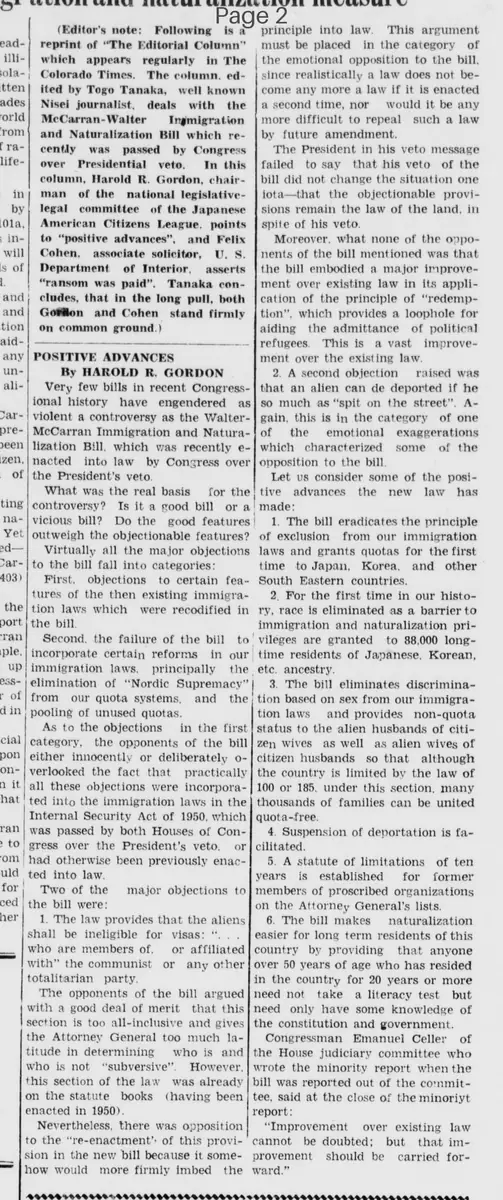
(Editor's note: Following is a reprint of "The Editorial Column" which appears regularly in The Colorado Times. The column, edited by Togo Tanaka, well known Nisei journalist, deals with the McCarran-Walter Immigration and Naturalization Bill which recently was passed by Congress over Presidential veto. In this column, Harold R. Gordon, chairman of the national legislative-legal committee of the Japanese American Citizens League, points to "positive advances", and Felix Cohen, associate solicitor, U. S. Department of Interior, asserts "ransom was paid". Tanaka concludes, that in the long run, both Gordon and Cohen stand firmly on common ground.)
POSITIVE ADVANCES
By HAROLD R. GORDON
Very few bills in recent Congressional history have engendered as violent a controversy as the Walter-McCarran Immigration and Naturalization Bill, which was recently enacted into law by Congress over the President's veto.
What was the real basis for the controversy? Is it a good bill or a vicious bill? Do the good features outweigh the objectionable features?
Virtually all the major objections to the bill fall into categories:
First, objections to certain features of the then existing immigration laws which were recodified in the bill
Second, the failure of the bill to incorporate certain reforms in our immigration laws, principally the elimination of "Nordic Supremacy" from our quota systems, and the pooling of unused quotas.
As to the objections in the first category, the opponents of the bill either innocently or deliberately overlooked the fact that practically all these objections were incorporated into the immigration laws in the Internal Security Act of 1950, which was passed by both Houses of Congress over the President's veto, or had otherwise been previously enacted into law.
Two of the major objections to the bill were:
1. The law provides that the aliens shall be ineligible for visas: ". . . who are members of, or affiliated with" the communist or any other totalitarian party.
The opponents of the bill argued with a good deal of merit that this section is too all-inclusive and gives the Attorney General too much latitude in determining who is and who is not "subversive" However, this section of the law was already on the statute books (having been enacted in 1950).
Nevertheless, there was opposition to the "re-enactment', of this provision in the new bill because it somehow would more firmly imbed the principle into law. This argument must be placed in the category of the emotional opposition to the bill, since realistically a law does not become any more a law if it is enacted a second time, nor would it be any more difficult to repeal such a law by future amendment.
The President in his veto message failed to say that his veto of the bill did not change the situation one iota-that the objectionable provisions remain the law of the land, in spite of his veto.
Moreover, what none of the opponents of the bill mentioned was that the bill embodied a major improvement over existing law in its application of the principle of "redemption", which provides a loophole for aiding the admittance of political refugees. This is a vast improvement over the existing law.
2. A second objection raised was that an alien can be deported if he so much as "spit on the street". Again, this is in the category of one of the emotional exaggerations which characterized some of the opposition to the bill
Let us consider some of the positive advances the new law has made:
1. The bill eradicates the principle of exclusion from our immigration laws and grants quotas for the first time to Japan, Korea, and other Southeastern countries.
2. For the first time in our history, race is eliminated as a barrier to immigration and naturalization privileges are granted to 88,000 long-time residents of Japanese, Korean, etc. ancestry.
3. The bill eliminates discrimination based on sex from our immigration laws and provides non-quota status to the alien husbands of citizen wives as well as alien wives of citizen husbands so that although the country is limited by the law of 100 or 185, under this section, many thousands of families can be united quota-free.
4. Suspension of deportation is facilitated.
5. A statute of limitations of ten years is established for former members of proscribed organizations on the Attorney General's lists.
6. The bill makes naturalization easier for long term residents of this country by providing that anyone over 50 years of age who has resided in the country for 20 years or more need not take a literacy test but need only have some knowledge of the constitution and government.
Congressman Emanuel Celler of the House judiciary committee who wrote the minority report when the bill was reported out of the committee, said at the close of the minority report:
"Improvement over existing law cannot be doubted: but that improvement should be carried forward."
POSITIVE ADVANCES
By HAROLD R. GORDON
Very few bills in recent Congressional history have engendered as violent a controversy as the Walter-McCarran Immigration and Naturalization Bill, which was recently enacted into law by Congress over the President's veto.
What was the real basis for the controversy? Is it a good bill or a vicious bill? Do the good features outweigh the objectionable features?
Virtually all the major objections to the bill fall into categories:
First, objections to certain features of the then existing immigration laws which were recodified in the bill
Second, the failure of the bill to incorporate certain reforms in our immigration laws, principally the elimination of "Nordic Supremacy" from our quota systems, and the pooling of unused quotas.
As to the objections in the first category, the opponents of the bill either innocently or deliberately overlooked the fact that practically all these objections were incorporated into the immigration laws in the Internal Security Act of 1950, which was passed by both Houses of Congress over the President's veto, or had otherwise been previously enacted into law.
Two of the major objections to the bill were:
1. The law provides that the aliens shall be ineligible for visas: ". . . who are members of, or affiliated with" the communist or any other totalitarian party.
The opponents of the bill argued with a good deal of merit that this section is too all-inclusive and gives the Attorney General too much latitude in determining who is and who is not "subversive" However, this section of the law was already on the statute books (having been enacted in 1950).
Nevertheless, there was opposition to the "re-enactment', of this provision in the new bill because it somehow would more firmly imbed the principle into law. This argument must be placed in the category of the emotional opposition to the bill, since realistically a law does not become any more a law if it is enacted a second time, nor would it be any more difficult to repeal such a law by future amendment.
The President in his veto message failed to say that his veto of the bill did not change the situation one iota-that the objectionable provisions remain the law of the land, in spite of his veto.
Moreover, what none of the opponents of the bill mentioned was that the bill embodied a major improvement over existing law in its application of the principle of "redemption", which provides a loophole for aiding the admittance of political refugees. This is a vast improvement over the existing law.
2. A second objection raised was that an alien can be deported if he so much as "spit on the street". Again, this is in the category of one of the emotional exaggerations which characterized some of the opposition to the bill
Let us consider some of the positive advances the new law has made:
1. The bill eradicates the principle of exclusion from our immigration laws and grants quotas for the first time to Japan, Korea, and other Southeastern countries.
2. For the first time in our history, race is eliminated as a barrier to immigration and naturalization privileges are granted to 88,000 long-time residents of Japanese, Korean, etc. ancestry.
3. The bill eliminates discrimination based on sex from our immigration laws and provides non-quota status to the alien husbands of citizen wives as well as alien wives of citizen husbands so that although the country is limited by the law of 100 or 185, under this section, many thousands of families can be united quota-free.
4. Suspension of deportation is facilitated.
5. A statute of limitations of ten years is established for former members of proscribed organizations on the Attorney General's lists.
6. The bill makes naturalization easier for long term residents of this country by providing that anyone over 50 years of age who has resided in the country for 20 years or more need not take a literacy test but need only have some knowledge of the constitution and government.
Congressman Emanuel Celler of the House judiciary committee who wrote the minority report when the bill was reported out of the committee, said at the close of the minority report:
"Improvement over existing law cannot be doubted: but that improvement should be carried forward."
What sub-type of article is it?
Immigration
Legal Reform
What keywords are associated?
Mccarran Walter Bill
Immigration Reform
Naturalization
Racial Exclusion
Quotas
Family Reunification
Japanese Americans
Korean Immigrants
What entities or persons were involved?
Harold R. Gordon
Togo Tanaka
Felix Cohen
Emanuel Celler
Japanese American Citizens League
President
Congress
Editorial Details
Primary Topic
Positive Advances In The Mccarran Walter Immigration And Naturalization Bill
Stance / Tone
Defensive Of The Bill's Improvements Despite Emotional Objections
Key Figures
Harold R. Gordon
Togo Tanaka
Felix Cohen
Emanuel Celler
Japanese American Citizens League
President
Congress
Key Arguments
Objections To Recodified Features From Prior Laws Like Internal Security Act Of 1950 Are Misplaced
Provision Excluding Communist Affiliates Already Existed Since 1950
Bill Improves Refugee Admission Via Redemption Principle
Deportation Objections Are Emotional Exaggerations
Grants Quotas To Japan, Korea, And Southeastern Countries, Eradicating Exclusion
Eliminates Race As Barrier To Immigration And Naturalization For 88,000 Asian Residents
Removes Sex Discrimination, Allows Non Quota Family Reunification
Facilitates Suspension Of Deportation
Establishes 10 Year Statute Of Limitations For Former Proscribed Organization Members
Eases Naturalization For Long Term Elderly Residents Without Literacy Test