Thank you for visiting SNEWPapers!
Sign up free
Danbury Times
Danbury, Fairfield County, Connecticut
What is this article about?
A letter critiquing the Manufacturer's Convention in Middletown, Connecticut, in February for failing to address currency issues and prison labor's impact on mechanics. The writer argues that convict labor in mechanical trades undercuts free workers' wages and degrades the profession, while correcting a misstatement about Judge Niles on tariffs. Signed Franklin.
Merged-components note: Multi-part letter to the editor discussing the Manufacturers' Convention, employment of felons in prisons, and related economic issues.
Clipping
OCR Quality
Full Text
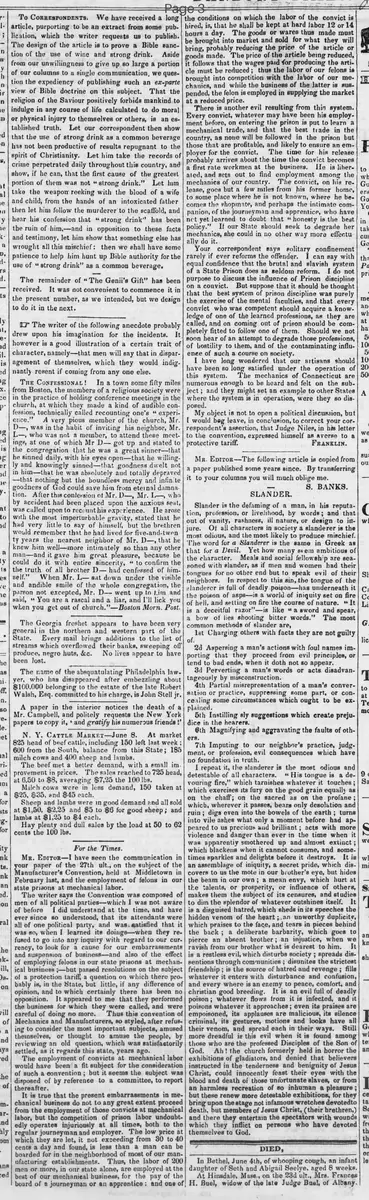
Mr. Editor--I have seen the communication in your paper of the 27th ult., on the subject of the Manufacturer's Convention, held at Middletown in February last, and the employment of felons in our state prisons at mechanical labor.
The writer says the Convention was composed of men of all political parties--which I was not aware of before I did understand at the time, and have ever since so understood, that its attendants were all of one political party, and was satisfied that it was so, when I learned its doings--when they refused to go into any inquiry with regard to our currency, to look for a cause for our embarrassments and suspension of business--and also of the effect of employing felons in our state prisons at mechanical business ;-but passed resolutions on the subject of a protection tariff, a question on which there probably is, in the State, but little, if any difference of opinion, and to which certainly there has been no opposition. It appeared to me that they performed the business for which they were called, and were careful of doing no more. Thus this convention of Mechanics and Manufacturers, so styled, after refusing to consider the most important subjects, amused themselves, or thought to amuse the people, by reviewing an old question, which was satisfactorily settled, as it regards this state, years ago.
The employment of convicts at mechanical labor would have been a fit subject for the consideration of such a convention; but it seems the subject was disposed of by reference to a committee, to report thereafter.
It is true that the present embarrassments in mechanical business do not to any great extent proceed from the employment of those Convicts at mechanical labor, but the competition of prison labor undoubtedly operates injuriously at all times, both to the regular journeyman and employer. The low price at which they are let, it not exceeding from 30 to 40 cents a day and found. is less than a man can be boarded for in the neighborhood of most of our manufacturing establishments. Thus, the labor of 200 men or more, in our state alone, are employed at the best of our mechanical business, for the pay of the board of a journeyman or an apprentice: and one of the conditions on which the labor of the convict is hired, is, that he shall be kept at hard labor 12 or 14 hours a day. The goods or wares thus made must be brought into market and sold for what they will bring, probably reducing the price of the article or goods made. The price of the article being reduced, it follows that the wages paid for producing the article must be reduced; thus the labor of our felons is brought into competition with the labor of our mechanics, and while the business of the latter is suspended, the felon is employed in supplying the market at a reduced price.
There is another evil resulting from this system. Every convict, whatever may have been his employment before, on entering the prison is put to learn a mechanical trade, and that the best trade in the country, as none will be followed in the prison but those that are profitable, and likely to ensure an employer for the convict. The time for his release probably arrives about the time the convict becomes a first rate workman at the business. He is liberated, and sets out to find employment among the mechanics of our country. The convict, on his release, goes but a few miles from his former home, to some place where he is not known, where he becomes the shopmate, and perhaps the intimate companion, of the journeyman and apprentice, who have not yet learned to doubt that "honesty is the best policy." If our State should seek to degrade her mechanics, she could in no other way more effectually do it.
Your correspondent says solitary confinement rarely if ever reforms the offender. I can say with equal confidence that the brutal and slavish system of a State Prison does as seldom reform. I do not purpose to discuss the influence of Prison discipline on a convict. But suppose that it should be thought that the best system of prison discipline was purely the exercise of the mental faculties, and that every convict who was competent should acquire a knowledge of one of the learned professions, as they are called, and on coming out of prison should be completely fitted to follow one of them. Should we not soon hear of an attempt to degrade those professions. of hostility to them, and of the contaminating influence of such a course on society.
I have long wondered that our artisans should have been so long satisfied under the operation of this system. The mechanics of Connecticut are numerous enough to be heard and felt on the subject; and they might set an example to other States where the system is in operation, were they so disposed.
My object is not to open a political discussion, but I would beg leave, in conclusion, to correct your correspondent's assertion, that Judge Niles, in his letter to the convention, expressed himself as averse to a protective tariff.
FRANKLIN.
What sub-type of article is it?
What themes does it cover?
What keywords are associated?
What entities or persons were involved?
Letter to Editor Details
Author
Franklin.
Recipient
Mr. Editor
Main Argument
the manufacturer's convention avoided key issues like currency and prison labor, focusing instead on uncontroversial tariffs; prison employment of convicts in mechanical trades harms free mechanics by competing at low wages, reducing market prices, and degrading the profession upon release.
Notable Details