Thank you for visiting SNEWPapers!
Sign up free
Story
June 12, 1885
The Warner Weekly Sun
Warner, Brown County, South Dakota
What is this article about?
Factual report on the positions, conjunctions, and visibility of major planets (Saturn, Jupiter, Uranus, Mercury, Venus, Neptune, Mars) during June, including times they rise or set.
Clipping
OCR Quality
98%
Excellent
Full Text
The Planets in June.
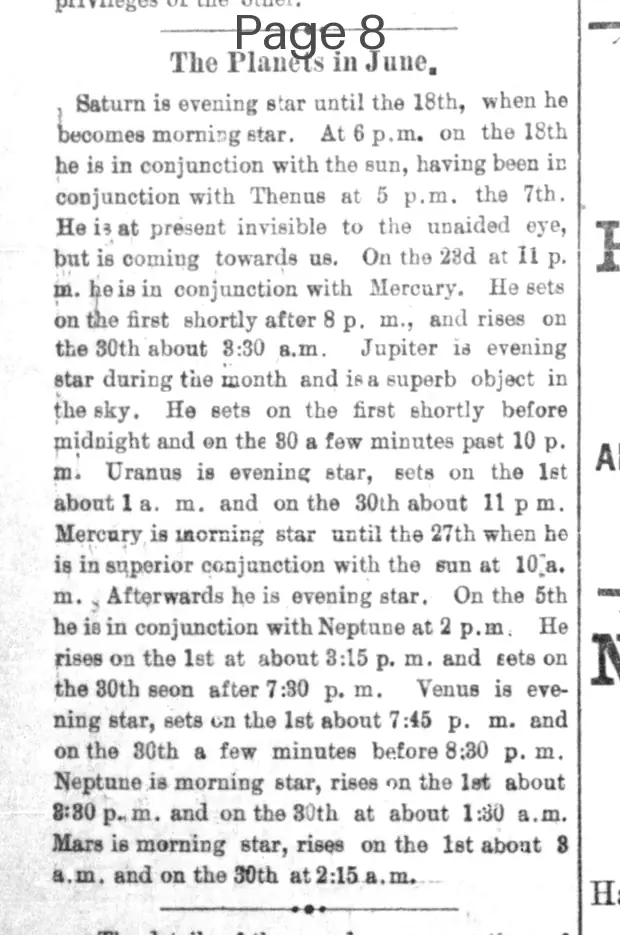
Saturn is evening star until the 18th, when he becomes morning star. At 6 p.m. on the 18th he is in conjunction with the sun, having been in conjunction with The Sun at 5 p.m. the 7th. He is at present invisible to the unaided eye, but is coming towards us. On the 23d at 11 p. m. he is in conjunction with Mercury. He sets on the first shortly after 8 p. m., and rises on the 30th about 3:30 a.m. Jupiter is evening star during the month and is a superb object in the sky. He sets on the first shortly before midnight and on the 30th a few minutes past 10 p. m. Uranus is evening star, sets on the 1st about 1 a. m. and on the 30th about 11 p m. Mercury is morning star until the 27th when he is in superior conjunction with the sun at 10 a. m. Afterwards he is evening star. On the 5th he is in conjunction with Neptune at 2 p.m. He rises on the 1st at about 3:15 p. m. and sets on the 30th soon after 7:30 p. m. Venus is evening star, sets on the 1st about 7:45 p. m. and on the 30th a few minutes before 8:30 p. m. Neptune is morning star, rises on the 1st about 3:30 p.m. and on the 30th at about 1:30 a.m. Mars is morning star, rises on the 1st about 3 a.m. and on the 30th at 2:15 a.m.
Saturn is evening star until the 18th, when he becomes morning star. At 6 p.m. on the 18th he is in conjunction with the sun, having been in conjunction with The Sun at 5 p.m. the 7th. He is at present invisible to the unaided eye, but is coming towards us. On the 23d at 11 p. m. he is in conjunction with Mercury. He sets on the first shortly after 8 p. m., and rises on the 30th about 3:30 a.m. Jupiter is evening star during the month and is a superb object in the sky. He sets on the first shortly before midnight and on the 30th a few minutes past 10 p. m. Uranus is evening star, sets on the 1st about 1 a. m. and on the 30th about 11 p m. Mercury is morning star until the 27th when he is in superior conjunction with the sun at 10 a. m. Afterwards he is evening star. On the 5th he is in conjunction with Neptune at 2 p.m. He rises on the 1st at about 3:15 p. m. and sets on the 30th soon after 7:30 p. m. Venus is evening star, sets on the 1st about 7:45 p. m. and on the 30th a few minutes before 8:30 p. m. Neptune is morning star, rises on the 1st about 3:30 p.m. and on the 30th at about 1:30 a.m. Mars is morning star, rises on the 1st about 3 a.m. and on the 30th at 2:15 a.m.
What sub-type of article is it?
Astronomical Report
What keywords are associated?
Planets
June
Saturn
Jupiter
Mercury
Venus
Neptune
Mars
Conjunctions
Visibility
Story Details
Event Date
June
Story Details
Descriptions of planetary positions, conjunctions, and visibility times for Saturn, Jupiter, Uranus, Mercury, Venus, Neptune, and Mars throughout June.