Thank you for visiting SNEWPapers!
Sign up free
Story
July 25, 1955
Trainman News
Indianapolis, Marion County, Indiana
What is this article about?
Canadian railways urge Royal Commission to eliminate unfair competition from coastal shipping, highlighting wage disparities, regulatory differences, and impending St. Lawrence Seaway impact. They advocate for stricter controls without restricting to Canadian vessels only.
Clipping
OCR Quality
98%
Excellent
Full Text
Railways Take Action
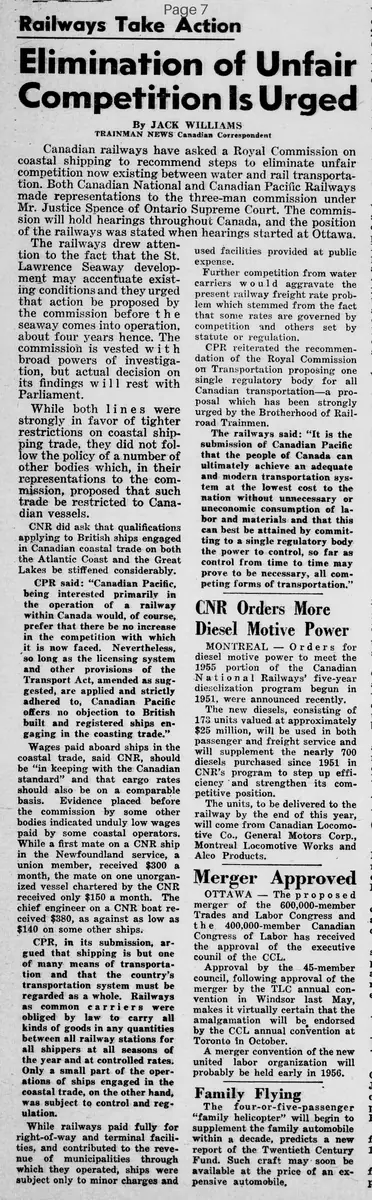
Elimination of Unfair Competition Is Urged
By JACK WILLIAMS
TRAINMAN NEWS Canadian Correspondent
Canadian railways have asked a Royal Commission on coastal shipping to recommend steps to eliminate unfair competition now existing between water and rail transportation. Both Canadian National and Canadian Pacific Railways made representations to the three-man commission under Mr. Justice Spence of Ontario Supreme Court. The commission will hold hearings throughout Canada, and the position of the railways was stated when hearings started at Ottawa.
The railways drew attention to the fact that the St. Lawrence Seaway development may accentuate existing conditions and they urged that action be proposed by the commission before the seaway comes into operation, about four years hence. The commission is vested with broad powers of investigation, but actual decision on its findings will rest with Parliament.
While both lines were strongly in favor of tighter restrictions on coastal shipping trade, they did not follow the policy of a number of other bodies which, in their representations to the commission, proposed that such trade be restricted to Canadian vessels.
CNR did ask that qualifications applying to British ships engaged in Canadian coastal trade on both the Atlantic Coast and the Great Lakes be stiffened considerably.
CPR said: "Canadian Pacific, being interested primarily in the operation of a railway within Canada would, of course, prefer that there be no increase in the competition with which it is now faced. Nevertheless, so long as the licensing system and other provisions of the Transport Act, amended as suggested, are applied and strictly adhered to, Canadian Pacific offers no objection to British built and registered ships engaging in the coasting trade."
Wages paid aboard ships in the coastal trade, said CNR, should be "in keeping with the Canadian standard" and that cargo rates should also be on a comparable basis. Evidence placed before the commission by some other bodies indicated unduly low wages paid by some coastal operators.
While a first mate on a CNR ship in the Newfoundland service, a union member, received $300 a month, the mate on one unorganized vessel chartered by the CNR received only $150 a month. The chief engineer on a CNR boat received $380, as against as low as $140 on some other ships.
CPR, in its submission, argued that shipping is but one of many means of transportation and that the country's transportation system must be regarded as a whole. Railways as common carriers were obliged by law to carry all kinds of goods in any quantities between all railway stations for all shippers at all seasons of the year and at controlled rates.
Only a small part of the operations of ships engaged in the coastal trade, on the other hand, was subject to control and regulation.
While railways paid fully for right-of-way and terminal facilities, and contributed to the revenue of municipalities through which they operated, ships were subject only to minor charges and used facilities provided at public expense.
Further competition from water carriers would aggravate the present railway freight rate problem which stemmed from the fact that some rates are governed by competition and others set by statute or regulation.
CPR reiterated the recommendation of the Royal Commission on Transportation proposing one single regulatory body for all Canadian transportation--a proposal which has been strongly urged by the Brotherhood of Railroad Trainmen.
The railways said: "It is the submission of Canadian Pacific that the people of Canada can ultimately achieve an adequate and modern transportation system at the lowest cost to the nation without unnecessary or uneconomic consumption of labor and materials and that this can best be attained by committing to a single regulatory body the power to control, so far as control from time to time may prove to be necessary, all competing forms of transportation."
Elimination of Unfair Competition Is Urged
By JACK WILLIAMS
TRAINMAN NEWS Canadian Correspondent
Canadian railways have asked a Royal Commission on coastal shipping to recommend steps to eliminate unfair competition now existing between water and rail transportation. Both Canadian National and Canadian Pacific Railways made representations to the three-man commission under Mr. Justice Spence of Ontario Supreme Court. The commission will hold hearings throughout Canada, and the position of the railways was stated when hearings started at Ottawa.
The railways drew attention to the fact that the St. Lawrence Seaway development may accentuate existing conditions and they urged that action be proposed by the commission before the seaway comes into operation, about four years hence. The commission is vested with broad powers of investigation, but actual decision on its findings will rest with Parliament.
While both lines were strongly in favor of tighter restrictions on coastal shipping trade, they did not follow the policy of a number of other bodies which, in their representations to the commission, proposed that such trade be restricted to Canadian vessels.
CNR did ask that qualifications applying to British ships engaged in Canadian coastal trade on both the Atlantic Coast and the Great Lakes be stiffened considerably.
CPR said: "Canadian Pacific, being interested primarily in the operation of a railway within Canada would, of course, prefer that there be no increase in the competition with which it is now faced. Nevertheless, so long as the licensing system and other provisions of the Transport Act, amended as suggested, are applied and strictly adhered to, Canadian Pacific offers no objection to British built and registered ships engaging in the coasting trade."
Wages paid aboard ships in the coastal trade, said CNR, should be "in keeping with the Canadian standard" and that cargo rates should also be on a comparable basis. Evidence placed before the commission by some other bodies indicated unduly low wages paid by some coastal operators.
While a first mate on a CNR ship in the Newfoundland service, a union member, received $300 a month, the mate on one unorganized vessel chartered by the CNR received only $150 a month. The chief engineer on a CNR boat received $380, as against as low as $140 on some other ships.
CPR, in its submission, argued that shipping is but one of many means of transportation and that the country's transportation system must be regarded as a whole. Railways as common carriers were obliged by law to carry all kinds of goods in any quantities between all railway stations for all shippers at all seasons of the year and at controlled rates.
Only a small part of the operations of ships engaged in the coastal trade, on the other hand, was subject to control and regulation.
While railways paid fully for right-of-way and terminal facilities, and contributed to the revenue of municipalities through which they operated, ships were subject only to minor charges and used facilities provided at public expense.
Further competition from water carriers would aggravate the present railway freight rate problem which stemmed from the fact that some rates are governed by competition and others set by statute or regulation.
CPR reiterated the recommendation of the Royal Commission on Transportation proposing one single regulatory body for all Canadian transportation--a proposal which has been strongly urged by the Brotherhood of Railroad Trainmen.
The railways said: "It is the submission of Canadian Pacific that the people of Canada can ultimately achieve an adequate and modern transportation system at the lowest cost to the nation without unnecessary or uneconomic consumption of labor and materials and that this can best be attained by committing to a single regulatory body the power to control, so far as control from time to time may prove to be necessary, all competing forms of transportation."
What sub-type of article is it?
Historical Event
What themes does it cover?
Justice
What keywords are associated?
Railways
Coastal Shipping
Unfair Competition
Royal Commission
St Lawrence Seaway
Transport Regulation
What entities or persons were involved?
Canadian National Railways
Canadian Pacific Railways
Mr. Justice Spence
Jack Williams
Where did it happen?
Canada, Ottawa
Story Details
Key Persons
Canadian National Railways
Canadian Pacific Railways
Mr. Justice Spence
Jack Williams
Location
Canada, Ottawa
Story Details
Canadian railways present to Royal Commission on coastal shipping, urging elimination of unfair competition from water transport through stricter regulations on wages, rates, and licensing, ahead of St. Lawrence Seaway opening.