Thank you for visiting SNEWPapers!
Sign up free
St. Landry Democrat
Opelousas, Saint Landry County, Louisiana
What is this article about?
Critique of Louisiana's state levee policy under Act No. 85 (July 10, 1884), which limited construction to contractors S. L. James and John McGinty. Only 20% of ordered 1,263,000 cubic yards completed, leaving upper river parishes like East Carroll, Madison, and Pointe Coupee vulnerable to flooding despite a temporary cold snap.
Clipping
OCR Quality
Full Text
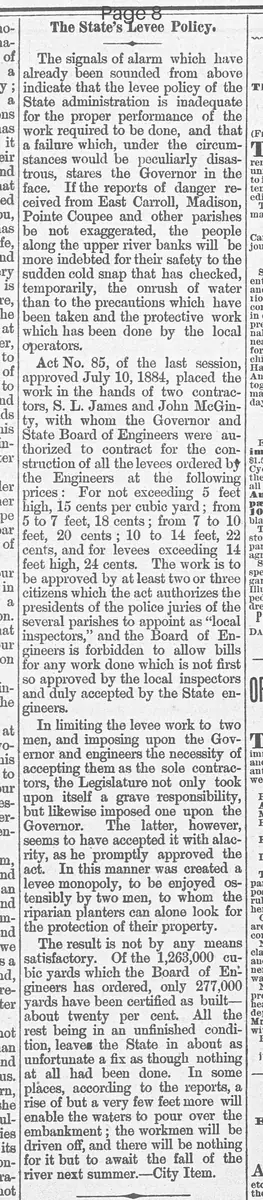
The signals of alarm which have already been sounded from above indicate that the levee policy of the State administration is inadequate for the proper performance of the work required to be done, and that a failure which, under the circumstances would be peculiarly disastrous, stares the Governor in the face. If the reports of danger received from East Carroll, Madison, Pointe Coupee and other parishes be not exaggerated, the people along the upper river banks will be more indebted for their safety to the sudden cold snap that has checked, temporarily, the onrush of water than to the precautions which have been taken and the protective work which has been done by the local operators.
Act No. 85, of the last session, approved July 10, 1884, placed the work in the hands of two contractors, S. L. James and John McGinty, with whom the Governor and State Board of Engineers were authorized to contract for the construction of all the levees ordered by the Engineers at the following prices: For not exceeding 5 feet high, 15 cents per cubic yard; from 5 to 7 feet, 18 cents; from 7 to 10 feet, 20 cents; 10 to 14 feet, 22 cents, and for levees exceeding 14 feet high, 24 cents. The work is to be approved by at least two or three citizens which the act authorizes the presidents of the police juries of the several parishes to appoint as "local inspectors," and the Board of Engineers is forbidden to allow bills for any work done which is not first so approved by the local inspectors and duly accepted by the State engineers.
In limiting the levee work to two men, and imposing upon the Governor and engineers the necessity of accepting them as the sole contractors, the Legislature not only took upon itself a grave responsibility, but likewise imposed one upon the Governor.
The latter, however, seems to have accepted it with alacrity, as he promptly approved the act. In this manner was created a levee monopoly, to be enjoyed ostensibly by two men, to whom the riparian planters can alone look for the protection of their property.
The result is not by any means satisfactory. Of the 1,263,000 cubic yards which the Board of Engineers has ordered, only 277,000 yards have been certified as built—about twenty per cent. All the rest being in an unfinished condition, leaves the State in about as unfortunate a fix as though nothing at all had been done. In some places, according to the reports, a rise of but a very few feet more will enable the waters to pour over the embankment: the workmen will be driven off, and there will be nothing for it but to await the fall of the river next summer.—City Item.
What sub-type of article is it?
What keywords are associated?
What entities or persons were involved?
Where did it happen?
Domestic News Details
Primary Location
Louisiana
Event Date
July 10, 1884
Key Persons
Outcome
only 277,000 of 1,263,000 cubic yards of levee work certified as built (about 20%), leaving embankments vulnerable to overflow and potential flooding in upper river parishes.
Event Details
State levee policy under Act No. 85 limits construction to contractors S. L. James and John McGinty at specified prices per cubic yard based on height. Work requires approval by local inspectors and state engineers. Legislature created a monopoly, approved by Governor. Reports from East Carroll, Madison, Pointe Coupee indicate inadequate protection against rising waters, temporarily checked by cold snap.