Thank you for visiting SNEWPapers!
Sign up free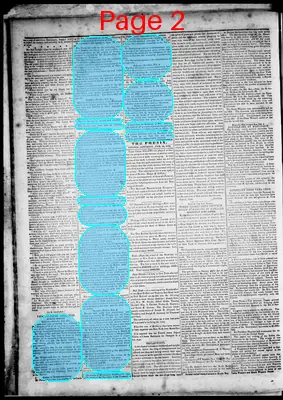
The Phenix
Bristol, Bristol County, Rhode Island
What is this article about?
Summary of U.S. 25th Congress Second Session proceedings from February 4-9, 1838, covering Senate and House debates on small change coinage, slavery petitions and resolutions, appropriation bills for army, diplomacy, lighthouses, public lands, and Indian treaties; multiple bills passed and referred.
Clipping
OCR Quality
Full Text
SENATE--Monday Feb. 4th.
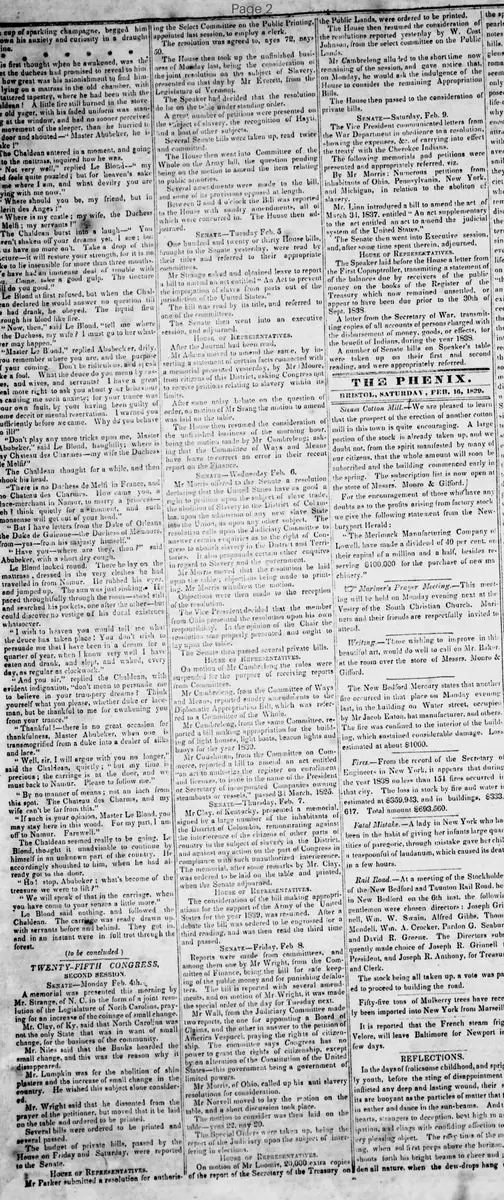
A memorial was presented this morning by Mr. Strange, of N. C. in the form of a joint resolution of the Legislature of North Carolina, praying for an increase of the coinage of small change. Mr. Clay, of Ky. said that North Carolina was not the only State that was in want of small change, for the business of the community. Mr. Niles said that the Banks hoarded the small change, and this was the reason why it disappeared. Mr. Lumpkin was for the abolition of shin plasters and the increase of small change in the country. He wished this subject alone considered. Mr. Wright said that he dissented from the prayer of the petitioner, but moved that it be laid on the table and ordered to be printed. Several bills were ordered to be printed and several passed. The budget of private bills, passed by the House on Friday and Saturday, were reported to the Senate. so the Senate.
HOUSE OF REPRESENTATIVES.
In the Select Committee on the Public Printing, appointed last session, to employ a clerk. The resolution was agreed to, ayes 72, nays 50. The House then took up the unfinished business of Monday last, being the consideration of the joint resolution on the subject of Slavery, presented on that day by Mr Everett, from the Legislature of Vermont. The Speaker had decided that the resolution do lie on the table under standing order. A great number of petitions were presented on the subject of slavery, the recognition of Hayti, and a host of other subjects. Several Senate bills were taken up, read twice and committed. The House then went into Committee of the Whole on the Army bill, the question pending being on the motion to amend the item relating to public armories. Several amendments were made to the bill, and some of its provisions opposed at length. Between 3 and 4 o'clock the Bill was reported to the House with sundry amendments, all of which were concurred in. The House then adjourned.
SENATE--Tuesday Feb. 5
One hundred and twenty or thirty House bills, brought to the Senate yesterday, were read by their titles and referred to their appropriate committees. Mr Strange asked and obtained leave to report a bill to amend an act entitled "An Act to prevent the importation of slaves from ports out of the jurisdiction of the United States." The bill was read by its title, and referred to committees. The Senate then went into an executive session, and adjourned.
HOUSE OF REPRESENTATIVES.
After the Journal had been read, Mr Adams moved to amend the same, by inserting a statement of certain facts connected with a memorial presented yesterday, by Mr Moore, from citizens of this District, asking Congress not to receive petitions relating to slavery within its limits. After some noisy debate on the question of order, on motion of Mr Strange the motion to amend was laid on the table. The House then resumed the consideration of the unfinished business of the morning hour, being the motion made by Mr Cambreleng; asking that the Committee of Ways and Means have leave to correct an error in their recent report on the Finances.
SENATE--Wednesday Feb. 6.
Mr Morris offered to the Senate a resolution declaring that the United States have as good a right to petition upon the subject of slave trade, the abolition of Slavery in the District of Columbia, upon the admission of any new slave State into the Union, as upon any other subject. The resolution calls upon the Judiciary Committee to answer certain enquiries as to the right of Congress to abolish slavery in the District and Territories. It also propounds certain other enquiries in regard to Slavery and the government. Mr Morris moved that the resolution be laid upon the table; objections being made to printing. Mr Morris withdrew the motion. Objections were then made to the reception of the resolution. The Vice President decided that the member from Ohio presented the resolution upon his own responsibility. In the opinion of the Chair the resolution was properly presented and ought to lay upon the table. The Senate then passed several private bills.
HOUSE OF REPRESENTATIVES.
On motion of Mr Cambreleng the rules were suspended for the purpose of receiving reports from Committees. Mr Cambreleng, from the Committee of Ways and Means, reported sundry amendments to the Diplomatic Appropriation Bill, which was referred to a Committee of the Whole. Mr Cambreleng, from the same Committee, reported a bill making appropriation for the building of light houses, light boats, beacon lights and buoys for the year 1839. Mr Cushman, from the Committee on Commerce, reported a bill to amend an act entitled "an act to authorize the register or enrollment and licenses, to issue in the name of the President or Secretary of incorporated Companies owning steamboats or vessels," passed 3d March, 1825. Mr Clay, of Kentucky, presented a memorial, signed by a large number of the inhabitants of the District of Columbia, remonstrating against the interference of the citizens of other parts of the country in the subject of slavery in the District, and against any action on the part of Congress in compliance with such unauthorized interference. The memorial, after some remarks by Mr. Clay, was ordered to be laid on the table and printed when the Senate adjourned.
SENATE--Thursday, Feb. 7.
The consideration of the bill making appropriations for the support of the Army of the United States for the year 1839, was resumed. After a debate the bill was ordered to be engrossed for a third reading, and was then read the third time and passed. Reports were made from committees, among them one by Mr Wright, from the Committee of Finance, being the bill for safe keeping of the public money and for punishing defaulters. The bill is reported with several amendments, and on motion of Mr. Wright, it was made the special order of the day for Tuesday next. Mr Wall, from the Judiciary Committee made two reports, the one for appointing a Board of Claims, and the other in answer to the petition of America Vespucci, praying the rights of citizenship. The committee says Congress has no power to grant the rights of citizenship, except by an alteration of the Constitution of the United States-this government being a government of limited powers. Mr Morris, of Ohio, called up his anti slavery resolutions for consideration. Mr Norvell moved to lay the motion on the table, and a short discussion took place. The motion to consider was then laid on the table--yeas 22, nays 20. The Special Orders were taken up, being the report of the Judiciary upon the subject of interfering in elections.
HOUSE OF REPRESENTATIVES.
On motion of Mr Loomis, 20,000 extra copies of the report of the Secretary of the Treasury on the Public Lands, were ordered to be printed. The House then resumed the consideration of the resolutions reported yesterday by W. Cost Johnson, from the select committee on the Public Lands. Mr Cambreleng alluded to the short time now remaining of the session, and gave notice that on Monday, he would ask the indulgence of the House to consider the remaining Appropriation Bills. The House then passed to the consideration of private bills.
Senate--Saturday, Feb. 9.
The Vice President communicated letters from the War Department in obedience to a resolution, showing the expenses, &c. of carrying into effect the treaty with the Cherokee Indians. The following memorials and petitions were presented and appropriately referred, viz. By Mr Morris: Numerous petitions from inhabitants of Ohio, Pennsylvania, New York, and Michigan, in relation to the abolition of slavery. Mr. Linn introduced a bill to amend the act of March 3d, 1837, entitled "An act supplementary to the act to amend the judicial system of the United States." The Senate then went into Executive session, and, after some time spent therein, adjourned.
HOUSE OF REPRESENTATIVES.
The Speaker laid before the House a letter from the First Comptroller, transmitting a statement of the balances due by receivers of the public money on the books of the Register of the Treasury which now remained unsettled, or appear to have been due prior to the 30th of Sept. 1838. A letter from the Secretary of War, transmitting copies of all accounts of persons charged with the disbursement of money, goods, or effects, for the benefit of Indians, during the year 1838. A number of Senate bills on Speaker's table were taken up on their first and second reading, and were appropriately referred.
What sub-type of article is it?
What keywords are associated?
What entities or persons were involved?
Where did it happen?
Domestic News Details
Primary Location
Washington, D.C.
Event Date
February 4 9, 1838
Key Persons
Outcome
multiple bills passed including army appropriations for 1839; resolutions on slavery tabled; petitions referred; reports on finances, public lands, indian treaties, and citizenship rights issued; no casualties.
Event Details
Daily proceedings of the U.S. Senate and House of Representatives during the 25th Congress Second Session, including debates on coinage of small change, slavery petitions and resolutions from various states, appropriation bills for army, diplomacy, lighthouses, and public money safety; amendments to slave importation acts; reports on public lands, Indian treaties, and judicial matters; executive sessions held.