Thank you for visiting SNEWPapers!
Sign up free
Daily National Intelligencer
Washington, District Of Columbia
What is this article about?
Limner argues against general emancipation of slaves, asserting it is impractical, driven by political motives rather than humanity, and would lead to societal distinctions and alteration of republican government. He critiques the Colonization Society's shift from colonization to abolition and references figures like Clay and Jefferson.
Merged-components note: Continuation of the same letter to the editor on emancipation, split across columns.
Clipping
OCR Quality
Full Text
FOR THE NATIONAL INTELLIGENCER.
"Emancipation—not governed by humanity—a political business altogether."
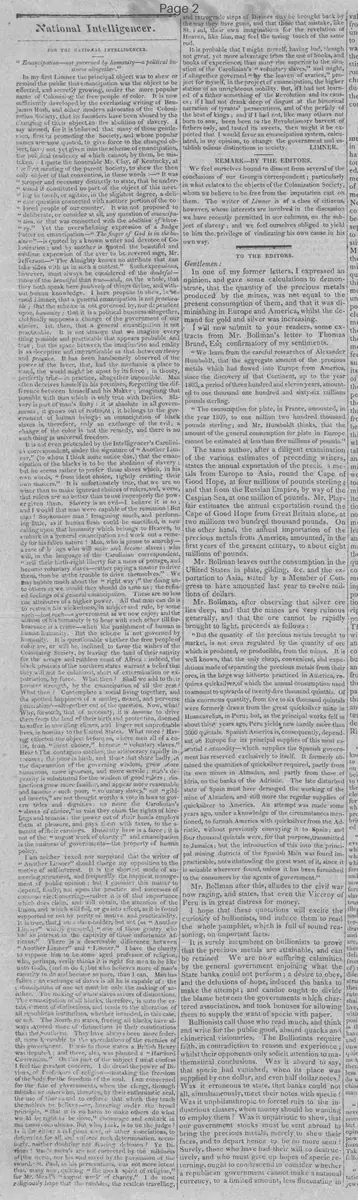
In my first Limner the principal object was to shew or remind the public that emancipation was the object to be effected, and secretly growing, under the more popular name of Colonizing the free people of color. It is now sufficiently developed by the everlasting writing of Benjamin Rush, and other modern advocates of the Colonization Society, that its founders have been abused by the changing of their object to the abolition of slavery. I say abused, for it is believed that many of those gentlemen, first in promoting the Society, and whose popular names are now quoted, to give force to the changed object, have not yet given into the scheme of emancipation, the political tendency of which cannot, by them, be mistaken. I quote the honorable Mr. Clay, of Kentucky, at the first meeting of the parent Society, to shew the then only object of that convention, in these words :—"It was proper and necessary distinctly to state, that he understood it constituted no part of the object of this meeting to touch, or agitate, in the slightest degree, a delicate question connected with another portion of the colored people of our country. It was not proposed to deliberate, or consider at all, any question of emancipation, or that was connected with the abolition of slavery." Yet the overwhelming expression of a Judge Potter on emancipation—"The finger of God is in the business"—is quoted by a known writer and devotee of Colonization; and by another is quoted the beautiful and sublime expression of the ever to be revered sage, Mr. Jefferson—"The Almighty knows no attribute that can take sides with us in such a contest." Such expressions, however, must always be considered of the doubtful—more of the beautiful than true—and, on the whole, that they both speak here positively of things divine, and without human knowledge. I here propose to shew, in second Limner, that a general emancipation is not practicable; that the scheme is not governed by, nor dependent upon, humanity; that it is a political business altogether, and finally supposes a change of the government of our choice. Ist. then, that a general emancipation is not practicable. It is not strange that we imagine every thing possible and practicable that appears probable and true; but the space between the imagination and reality is as deceptive and impracticable as that between theory and practice. It has been handsomely observed of the power of the lever, that, had the mechanic a place to stand, the world might be upset by its force; in theory, perfectly true in practice, altogether impossible. Man often deceives himself in his premises, forgetting the difference between himself and his Maker; imagining that possible with man which is only true with Deities. Slavery is part of man's finity: it is absolute in all governments, it grows out of restraint; it belongs to the government of human beings: an emancipation of black slaves is, therefore, only an exchange of the evil; a change of the color is not the remedy, and there is no such thing as universal freedom.
It is not even pretended by the Intelligencer's Carolinian correspondent, under the signature of "Another Limner," (to whom I think some notice due,) that the emancipation of the blacks is to be the abolition of slavery; but he seems rather to prefer those slaves which, in his own words, "from idiot choice, rightly creating their own masters." It is unfortunately true, that we are no wiser than to make ignorant choices of rulers, and, worse, that rulers are no better than to use improperly the power given them. Slavery is an evil—I believe it is so; and I would that man were capable of the remission! But man! Sophomore man! Imagining much, and performing little, as if human flesh could be sanctified, is now calling upon that humanity which belongs to Heaven, to embark in a general emancipation and work out a remedy for his fallen nature! Man, who is prone to anarchy—a race of beings who will make and become slaves; who will, in the language of the Carolinian correspondent, "sell their birth-right liberty for a mess of pottage, and become voluntary slaves—rather paying a master to drive them, than be at the trouble to drive themselves." We may bubble much about the "right way;" the doing unto others as we would they should do unto us; the refined feelings of a general emancipation. These are no less the attributes of a higher power. All that man can do is to restrain his wickedness, in subject and rule, by some such—a such—a government as we now enjoy; and the utmost of his humanity is to bear with each other till forbearance is a crime—when the punishment of human is human humanity. But the scheme is not governed by humanity. It is questionable whether the free people of color are, or will be, inclined to favor the wishes of the Colonizing Society, by leaving the land of their nativity for the savage and ruthless coast of Africa: indeed, the black protests of the northern states warrant a belief that they will not be colonized, short of extermination or expatriation, by force. What then? Shall we add to their present strength, by the emancipation of all the rest? What then? Contemplate a social living together, and the spotted happiness of a motley, mixed, and perverse generation?—altogether out of the question. Now, what? Why, forsooth, that of necessity, it is humane to drive them from the land of their birth and protection, doomed to suffer in unwilling climes, and linger out unprofitable lives, in hostility to the United States. What more? Having effected the object before us, where men all of a color, from "idiot choice," become "voluntary slaves." Hear! The contagion catches; the aristocracy rapidly increases; the poor in birth, and those that share badly in the dispensation of the governing wisdom, grow more numerous, more ignorant, and more servile; man's depravity is substituted for the wisdom of good rulers; distinctions grow more familiar, and appear more reasonable and humane: such poor, "voluntary slaves," not "gilded insects," are not thought worthy a vote in laws to govern titles and dignities: no more the Carolinian's "slaves of choice," in vain they claim the rights of hirelings and tenants: the power out of their hands employs them at pleasure, and pays them with taxes, to the amount of their earnings. Humanity here is a farce; it is not of the "august work of charity;" and emancipation is the business of governments—the property of human policy.
I am neither vexed nor surprised that the writer of "Another Limner" should charge my opposition to the motive of self-interest. It is the shortest mode of answering argument, and frequently the happiest management of public opinion; but I consider this matter to depend, finally, not upon the practice and successes of common electioneering—rather it is of that importance which does claim, and will obtain, the attention of the Union, and which will fail, or go into effect, as it is found supported or not by purity of motive and practicability.
It is true, that I am a slave-holder, but not (as "Another Limner" widely guessed, "one of those gentry who had an interest in the captivity of those unfortunate Africans." There is a describable difference between "Another Limner" and Limner." I have the charity to suppose him to be some aged professor of religion, who, perhaps, verily thinks it is right for men to be like unto Gods, (and so do I,) but who believes more of man's capacity to do and become so pure, than I can. Man has fallen: an exchange of slaves is all he is capable of: the mancipation of one set must be only the making of another. The making of white slaves savors of distinctions. The emancipation of all blacks, therefore, is unto the establishment of distinctions, and tends to the alteration of all republican institutions, whether intended, in this case, or not. The Northern states, freeing all blacks, have always savored more of distinctions in their constitutions than the Southern. They have always been more federal, more favorable to the speculations of the enemies of this government. It was to those states a British Henry was deputed; and there, also, was planned a "Hartford Convention." On this part of the subject I must confess I feel the greatest concern. I do dread the power of Divines, of Professors of religion—mistaking the freedom of the body for the freedom of the soul. I am concerned for the fate of governments, when the clergy, through mistake or otherwise, threaten, by their enthusiastic zeal, the use of the sword to enforce that which they teach themselves to believe—or, hovering under the broad principle, "that it is no harm to make others do what would be right to be done," encourage and embark in mutinous convulsions. But who, I ask, is to be the judge? Is it for either a religious sect, or other associations, to determine for all, and enforce such determination, seemingly, neither doubting nor fearing delusion? Ye Divines! Man's morals are not corrected by the mildness of the storm, nor his soul saved by the persuasion of the sword.—St. Paul, in his persecutious, was not more intent than many now, quitting "the meek spirit of religion," for Mr. Mead's "august work of charity." I do most religiously hope that the rabbles, the restless travelling
and retrograde steps of Divines may be brought back by the way they have gone, and that those that mistake, like St. Paul, their own imaginations for the revelation of Heaven, like him, may feel the saving touch of the same rod.
It is probable that I might myself, having had, though not great, yet more advantage from the use of books, and books of experience, than many rise superior to the situation of the Carolinian's "voluntary slaves," and might, if altogether governed "by the leaven of avarice," project for myself, in the project of emancipation, the higher station of an unrighteous nobility. But, if I had not learned of a father something of the Revolution and its causes; if I had not drank deep of disgust at the historical narration of tyrants' persecutions, and of the perfidy of the best of kings: and if I had not, like many others not born to sow, been born to the Revolutionary harvest of fathers only, and tasted its sweets, then might it be expected that I would favor an emancipation system, calculated, in my opinion, to change the government and establish odious distinctions in society.
LIMNER.
What sub-type of article is it?
What themes does it cover?
What keywords are associated?
What entities or persons were involved?
Letter to Editor Details
Author
Limner.
Recipient
National Intelligencer
Main Argument
general emancipation of slaves is not practicable as it merely exchanges one form of slavery for another, is driven by political motives rather than true humanity, and would lead to societal distinctions and a change in republican government.
Notable Details