Thank you for visiting SNEWPapers!
Sign up free
Literary
June 4, 1853
Anti Slavery Bugle
New Lisbon, Salem, Columbiana County, Ohio
What is this article about?
An American visitor recounts attending a professor's evening party in Berlin, observing German home life, strict social norms between sexes, lively dances, conversations on customs, poetry, women's roles, fashions, food, and a heated debate on Hungarian revolution, German oppression, and American slavery.
Clipping
OCR Quality
95%
Excellent
Full Text
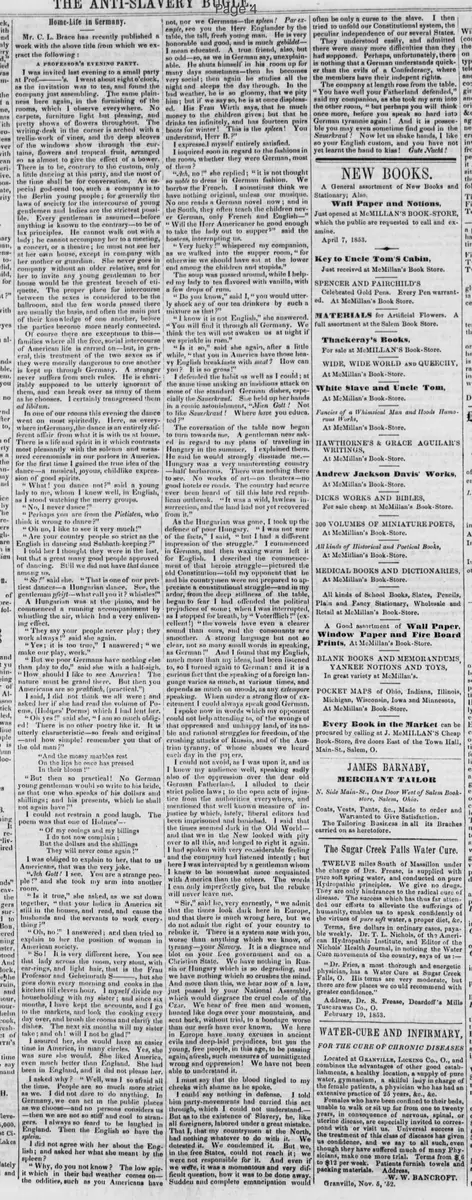
Home-Life in Germany.
Mr. C. L. Brace has recently published a work with the above title from which we extract the following:
A PROFESSOR'S EVENING PARTY.
I was invited last evening to a small party at Prof.—'s. I went about eight o'clock, as the invitation was to tea, and found the company just assembling. The same plainness here again, in the furnishing of the rooms, which I observe everywhere. No carpets, furniture light but pleasing, and pretty shows of flowers throughout. The writing-desk in the corner is arched with a trellis-work of vines, and the deep alcoves of the windows show through the curtains, flowers and tropical fruit, arranged so as almost to give the effect of a bower. There is to be, contrary to the custom, only a little dancing at this party, and the most of the time shall be for conversation. An especial god-send too, such a company is to the Berlin young people; for generally the laws of society for the intercourse of young gentlemen and ladies are the strictest possible. Every gentleman is assumed—before anything is known to the contrary—to be of lax principles. He cannot walk out with a lady; he cannot accompany her to a meeting, a concert, or a theatre; he must not see her at her own house, except in company with her mother or guardian. She never goes in company without an older relative, and for her to invite any young gentleman to her house would be the greatest breach of etiquette. The proper place for intercourse between the sexes is considered to be the ballroom, and the few words passed there are usually the basis, and often the main part of their knowledge of one another, before the parties become more nearly connected. Of course there are exceptions to this—families where all the free, social intercourse of American life is carried on—but, in general, this treatment of the two sexes as if they were morally dangerous to one another is kept up through Germany. A stranger never suffers from such rules. He is charitably supposed to be utterly ignorant of them, and can break over as many of them as he chooses. I certainly transgressed them ad libitum.
In one of our rooms this evening the dance went on most spiritedly. Here, as everywhere in Germany, the dance is an entirely different affair from what it is with us at home. There is a life and spirit in it which contrasts most pleasantly with the solemn and measured ceremonials in our parlors in America. For the first time I gained the true idea of the dance—a musical, joyous, childlike expression of good spirits.
"What! you dance not?" said a young lady to me, whom I knew well, in English, as I stood watching the merry groups.
"No. I never dance!"
"Perhaps you are from the Pietisten, who think it wrong to dance?"
"Oh no, I like to see it very much!"
"Are your country people so strict as the English in dancing and Sabbath-keeping?"
I told her I thought they were in the last, but that a great many good people approved of dancing. Still we did not have that dance among us.
"So!" said she. "That is one of our prettiest dances—a Hungarian dance. See, the gentleman pfeift—what call you it? whistles!"
A Hungarian was at the piano, and he commenced a running accompaniment by whistling the air, which had a very enlivening effect.
"They say your people never play; they work always!" said she again.
"Yes; it is too true," I answered; "we make our play, work."
"But we poor Germans have nothing else than play to do," said she with a half-sigh.
"How should I like to see America! The nature must be grand there. But then you Americans are so praktisch, (practical.)"
I said, I did not think we all were: and asked her if she had read the volume of Poems, (Holmes' Poems) which I had lent her.
"Oh yes!" said she, "I am so much obliged! There is no other poetry like it. It is utterly characteristic—so fresh and original—and how simple! Remember you that of the old man?"
"And the mossy marbles rest
On the lips he once has pressed
In their bloom!"
"But then so practical! No German young gentleman would so write to his bride, as that one who speaks of his dollars and shillings; and his presents, which he shall not again have!"
I could not restrain a good laugh. The poem was that one of Holmes'-
"Of my cooings and my billings
I do not now complain;
But the dollars and the shillings
They will never come again!"
I was obliged to explain to her, that to us Americans, that was the very joke.
"Ach Gott! I see. You are a strange people!" and she took my arm into another room.
"Is it true," she asked, as we sat down together, "that your ladies in America sit still in the houses, and read, and cause the husbands and the servants to work everything?"
"Oh, no!" I answered; and then tried to explain to her the position of woman in American society.
"So! It is very different here. You see that lady across the room, very stout, with ear-rings, and light hair, that is the Frau Professor and Geheimrath S—, but she goes down every morning and cooks in the kitchen till eleven hour. I myself divide my house-keeping with my sister; and since six months, I have kept the accounts, and I go to the markets, and look the cooking every day over, and brush the rooms and clarify the dishes. The next six months will my sister take; and oh! will I not be glad!"
I assured her, she would have an easier time in America, in many circles. Yes, she was sure she would. She liked America, even much better than England. She had been in England, and it did not please her. I asked why? "Well, was I so afraid all the time. People are so much more strict as we. I did not dare to do anything. In Germany, we can act in the public places as we choose—and no persons considers us—then we are not so stiff and cool to strangers. I always so feared to be laughed in England. Then the English so have the spleen."
I did not agree with her about the English; and asked her what she meant by the spleen?
"Why, do you not know? The low spirit which in their bad weather comes on—the oddities, such as you Americans have not, nor we Germans—the spleen! Par exemple, see you the Herr Englander by the table, the tall, fresh young man. He is very honorable and good, and is much gebildet—I mean educated. A true friend, also, but so odd—so, as we in German say, unexplainable. He shuts himself in his room up for many days sometimes—then he becomes very social; then again he studies all the night and sleeps the day through. In the bad weather, he is so gloomy, that we pity him; but if we say so, he is at once displeased. His Frau Wirth says, that he much money to the children gives; but that he drinks tea infinitely, and has fourteen pairs boots for winter! This is the spleen! You understand. Herr B. P."
I expressed myself entirely satisfied.
I inquired soon in regard to the fashions in the room, whether they were German, most of them?
"Ach, no!" she replied; "it is not thought so noble to dress in German fashion. We borrow the French. I sometimes think we have nothing original, unless our musique. No one reads a German novel now; and in the South, they often teach the children never German, only French and English—"
"Will the Herr Americaner be good enough to take the lady out to supper?" said the hostess, interrupting us.
"Very lucky!" whispered my companion, as we walked into the supper room, "for otherwise we should have sat at the lower end among the children and stupids."
The soup was passed around, while I helped my lady to tea flavored with vanilla, with a few drops of rum.
"Do you know," said I, "you would utterly shock any of our tea drinkers by such a mixture as that?"
"I know it is not English," she answered.
"You will find it through all Germany. We think the tea will not awaken us at night if we sprinkle in rum."
"Is it so," said she again, after a little while, "that you in America have those heavy English breakfasts with meat? How can you? It is so gross!"
I defended the habit as well as I could; at the same time making an insidious attack on some of the standard German dishes, especially the Sauerkraut. She held up her hands in a comic astonishment, "Mein Gott! Not to like Sauerkraut! Where have you educated?"
The conversation of the table now began to turn towards me. A gentleman near asked in regard to my plans of traveling in Hungary in the summer. I explained them. He said he would strongly dissuade me.—Hungary was a very uninteresting country—half barbarous. There was nothing there to see. No works of art—no theaters—no good hotels or roads. The country had scarce ever been heard of till this late red republican outbreak. "It was a wild, lawless insurrection, and the land had not yet recovered from it."
As the Hungarian was gone, I took up the defence of poor Hungary. "I was not sure of the facts," I said, "but I had different impression of the struggle." I commenced in German, and then waxing warm left it for English. I described the commencement of that heroic struggle—pictured the old Constitution—told my opponent that he and his countrymen were not prepared to appreciate a constitutional struggle—and in my ardor, from the deep stillness of the table, began to fear I had offended the political prejudices of some; when I was interrupted, as I stopped for breath, by "Vortrefflich!" (excellent!) "the vowels have even a clearer sound than ours, and the consonants are smoother. A strong language but not so clear, not so many small words in speaking, as German!" And I found that my English, much more than my ideas, had been listened to, so I turned again to German: and it is a curious fact that the speaking of a foreign language varies as much, at various times, and depends as much on moods, as any extempore speaking. When under a strong flow of excitement I could always speak good German.
I spoke now in words which my opponent could not help attending to, of the wrongs of that oppressed and unhappy land, of its noble and rational struggles for freedom, of the crushing attacks of Russia, and of the Austrian tyranny, of whose abuses we heard each day in the papers.
I could not avoid, as I was upon it, and as I knew my audience well, speaking sadly also of the oppression over the dear old German Fatherland. I alluded to their strict police laws; to the open acts of injustice from the authorities everywhere, and mentioned that well known measure of injustice by which, lately, liberal editors had been imprisoned and banished. I said that the times seemed dark in the Old World—and that we in the New looked with pity over to all this, and longed to right it again.
I had spoken with very considerable feeling and the company had listened intently; but here I was interrupted by a gentleman whom I knew to be somewhat more acquainted with America than the others. The words I can only imperfectly give, but the rebuke will never leave me.
"Sir," said he, very earnestly, "we admit that the times look dark here in Europe, and that there is much wrong here, but we do not admit the right of your country to rebuke it. There is a system now with you, worse than anything which we know, of tyranny—your Slavery. It is a disgrace and blot on your free government and on a Christian State. We have nothing in Russia or Hungary which is so degrading, and we have nothing which so crushes the mind. And more than this, we hear now of a law, just passed by your National Assembly, which would disgrace the cruel code of the Czar. We hear of free men and women, hunted like dogs over your mountains, and sent back, without trial, to a bondage worse than our serfs have ever known. We here in Europe have many excuses in ancient evils and deep-laid prejudices, but you the young, free people, in this age, to be passing again, afresh, such measures of unmitigated wrong and oppression! We have not been able to understand it."
I must say that the blood tingled to my cheeks with shame as he spoke.
I could say nothing in defense. I told him party-movements had carried this act through, which I could not understand.—But as to the existence of Slavery, he, like all foreigners, labored under a great mistake. That I, that my countrymen at the North, had nothing whatever to do with it. We detested it. We condemned it. But we, in the free States, could not reach it; we were not responsible for it. And even if we were, it was a momentous and very difficult question, how it was to be done away. Sudden and complete emancipation would often be only a curse to the slave. I then tried to unfold our Constitutional system, the peculiar independence of our several States.
They understood easily, and admitted there were many more difficulties than they had supposed. Perhaps, unfortunately, there is nothing that a German understands quicker than the evils of a Confederacy, where the members have their independent rights.
The company at length rose from the table.
"You have well your Fatherland defended," said my companion, as she took my arm into the other room, "but perhaps you will think once more, before you speak so hard into German tyrannie again! And it is possible you may even sometime find good in the Sauerkraut! Now let us shake hands, I like so your English custom, and you have not yet learnt the hand to kiss! Gute Nacht!"
Mr. C. L. Brace has recently published a work with the above title from which we extract the following:
A PROFESSOR'S EVENING PARTY.
I was invited last evening to a small party at Prof.—'s. I went about eight o'clock, as the invitation was to tea, and found the company just assembling. The same plainness here again, in the furnishing of the rooms, which I observe everywhere. No carpets, furniture light but pleasing, and pretty shows of flowers throughout. The writing-desk in the corner is arched with a trellis-work of vines, and the deep alcoves of the windows show through the curtains, flowers and tropical fruit, arranged so as almost to give the effect of a bower. There is to be, contrary to the custom, only a little dancing at this party, and the most of the time shall be for conversation. An especial god-send too, such a company is to the Berlin young people; for generally the laws of society for the intercourse of young gentlemen and ladies are the strictest possible. Every gentleman is assumed—before anything is known to the contrary—to be of lax principles. He cannot walk out with a lady; he cannot accompany her to a meeting, a concert, or a theatre; he must not see her at her own house, except in company with her mother or guardian. She never goes in company without an older relative, and for her to invite any young gentleman to her house would be the greatest breach of etiquette. The proper place for intercourse between the sexes is considered to be the ballroom, and the few words passed there are usually the basis, and often the main part of their knowledge of one another, before the parties become more nearly connected. Of course there are exceptions to this—families where all the free, social intercourse of American life is carried on—but, in general, this treatment of the two sexes as if they were morally dangerous to one another is kept up through Germany. A stranger never suffers from such rules. He is charitably supposed to be utterly ignorant of them, and can break over as many of them as he chooses. I certainly transgressed them ad libitum.
In one of our rooms this evening the dance went on most spiritedly. Here, as everywhere in Germany, the dance is an entirely different affair from what it is with us at home. There is a life and spirit in it which contrasts most pleasantly with the solemn and measured ceremonials in our parlors in America. For the first time I gained the true idea of the dance—a musical, joyous, childlike expression of good spirits.
"What! you dance not?" said a young lady to me, whom I knew well, in English, as I stood watching the merry groups.
"No. I never dance!"
"Perhaps you are from the Pietisten, who think it wrong to dance?"
"Oh no, I like to see it very much!"
"Are your country people so strict as the English in dancing and Sabbath-keeping?"
I told her I thought they were in the last, but that a great many good people approved of dancing. Still we did not have that dance among us.
"So!" said she. "That is one of our prettiest dances—a Hungarian dance. See, the gentleman pfeift—what call you it? whistles!"
A Hungarian was at the piano, and he commenced a running accompaniment by whistling the air, which had a very enlivening effect.
"They say your people never play; they work always!" said she again.
"Yes; it is too true," I answered; "we make our play, work."
"But we poor Germans have nothing else than play to do," said she with a half-sigh.
"How should I like to see America! The nature must be grand there. But then you Americans are so praktisch, (practical.)"
I said, I did not think we all were: and asked her if she had read the volume of Poems, (Holmes' Poems) which I had lent her.
"Oh yes!" said she, "I am so much obliged! There is no other poetry like it. It is utterly characteristic—so fresh and original—and how simple! Remember you that of the old man?"
"And the mossy marbles rest
On the lips he once has pressed
In their bloom!"
"But then so practical! No German young gentleman would so write to his bride, as that one who speaks of his dollars and shillings; and his presents, which he shall not again have!"
I could not restrain a good laugh. The poem was that one of Holmes'-
"Of my cooings and my billings
I do not now complain;
But the dollars and the shillings
They will never come again!"
I was obliged to explain to her, that to us Americans, that was the very joke.
"Ach Gott! I see. You are a strange people!" and she took my arm into another room.
"Is it true," she asked, as we sat down together, "that your ladies in America sit still in the houses, and read, and cause the husbands and the servants to work everything?"
"Oh, no!" I answered; and then tried to explain to her the position of woman in American society.
"So! It is very different here. You see that lady across the room, very stout, with ear-rings, and light hair, that is the Frau Professor and Geheimrath S—, but she goes down every morning and cooks in the kitchen till eleven hour. I myself divide my house-keeping with my sister; and since six months, I have kept the accounts, and I go to the markets, and look the cooking every day over, and brush the rooms and clarify the dishes. The next six months will my sister take; and oh! will I not be glad!"
I assured her, she would have an easier time in America, in many circles. Yes, she was sure she would. She liked America, even much better than England. She had been in England, and it did not please her. I asked why? "Well, was I so afraid all the time. People are so much more strict as we. I did not dare to do anything. In Germany, we can act in the public places as we choose—and no persons considers us—then we are not so stiff and cool to strangers. I always so feared to be laughed in England. Then the English so have the spleen."
I did not agree with her about the English; and asked her what she meant by the spleen?
"Why, do you not know? The low spirit which in their bad weather comes on—the oddities, such as you Americans have not, nor we Germans—the spleen! Par exemple, see you the Herr Englander by the table, the tall, fresh young man. He is very honorable and good, and is much gebildet—I mean educated. A true friend, also, but so odd—so, as we in German say, unexplainable. He shuts himself in his room up for many days sometimes—then he becomes very social; then again he studies all the night and sleeps the day through. In the bad weather, he is so gloomy, that we pity him; but if we say so, he is at once displeased. His Frau Wirth says, that he much money to the children gives; but that he drinks tea infinitely, and has fourteen pairs boots for winter! This is the spleen! You understand. Herr B. P."
I expressed myself entirely satisfied.
I inquired soon in regard to the fashions in the room, whether they were German, most of them?
"Ach, no!" she replied; "it is not thought so noble to dress in German fashion. We borrow the French. I sometimes think we have nothing original, unless our musique. No one reads a German novel now; and in the South, they often teach the children never German, only French and English—"
"Will the Herr Americaner be good enough to take the lady out to supper?" said the hostess, interrupting us.
"Very lucky!" whispered my companion, as we walked into the supper room, "for otherwise we should have sat at the lower end among the children and stupids."
The soup was passed around, while I helped my lady to tea flavored with vanilla, with a few drops of rum.
"Do you know," said I, "you would utterly shock any of our tea drinkers by such a mixture as that?"
"I know it is not English," she answered.
"You will find it through all Germany. We think the tea will not awaken us at night if we sprinkle in rum."
"Is it so," said she again, after a little while, "that you in America have those heavy English breakfasts with meat? How can you? It is so gross!"
I defended the habit as well as I could; at the same time making an insidious attack on some of the standard German dishes, especially the Sauerkraut. She held up her hands in a comic astonishment, "Mein Gott! Not to like Sauerkraut! Where have you educated?"
The conversation of the table now began to turn towards me. A gentleman near asked in regard to my plans of traveling in Hungary in the summer. I explained them. He said he would strongly dissuade me.—Hungary was a very uninteresting country—half barbarous. There was nothing there to see. No works of art—no theaters—no good hotels or roads. The country had scarce ever been heard of till this late red republican outbreak. "It was a wild, lawless insurrection, and the land had not yet recovered from it."
As the Hungarian was gone, I took up the defence of poor Hungary. "I was not sure of the facts," I said, "but I had different impression of the struggle." I commenced in German, and then waxing warm left it for English. I described the commencement of that heroic struggle—pictured the old Constitution—told my opponent that he and his countrymen were not prepared to appreciate a constitutional struggle—and in my ardor, from the deep stillness of the table, began to fear I had offended the political prejudices of some; when I was interrupted, as I stopped for breath, by "Vortrefflich!" (excellent!) "the vowels have even a clearer sound than ours, and the consonants are smoother. A strong language but not so clear, not so many small words in speaking, as German!" And I found that my English, much more than my ideas, had been listened to, so I turned again to German: and it is a curious fact that the speaking of a foreign language varies as much, at various times, and depends as much on moods, as any extempore speaking. When under a strong flow of excitement I could always speak good German.
I spoke now in words which my opponent could not help attending to, of the wrongs of that oppressed and unhappy land, of its noble and rational struggles for freedom, of the crushing attacks of Russia, and of the Austrian tyranny, of whose abuses we heard each day in the papers.
I could not avoid, as I was upon it, and as I knew my audience well, speaking sadly also of the oppression over the dear old German Fatherland. I alluded to their strict police laws; to the open acts of injustice from the authorities everywhere, and mentioned that well known measure of injustice by which, lately, liberal editors had been imprisoned and banished. I said that the times seemed dark in the Old World—and that we in the New looked with pity over to all this, and longed to right it again.
I had spoken with very considerable feeling and the company had listened intently; but here I was interrupted by a gentleman whom I knew to be somewhat more acquainted with America than the others. The words I can only imperfectly give, but the rebuke will never leave me.
"Sir," said he, very earnestly, "we admit that the times look dark here in Europe, and that there is much wrong here, but we do not admit the right of your country to rebuke it. There is a system now with you, worse than anything which we know, of tyranny—your Slavery. It is a disgrace and blot on your free government and on a Christian State. We have nothing in Russia or Hungary which is so degrading, and we have nothing which so crushes the mind. And more than this, we hear now of a law, just passed by your National Assembly, which would disgrace the cruel code of the Czar. We hear of free men and women, hunted like dogs over your mountains, and sent back, without trial, to a bondage worse than our serfs have ever known. We here in Europe have many excuses in ancient evils and deep-laid prejudices, but you the young, free people, in this age, to be passing again, afresh, such measures of unmitigated wrong and oppression! We have not been able to understand it."
I must say that the blood tingled to my cheeks with shame as he spoke.
I could say nothing in defense. I told him party-movements had carried this act through, which I could not understand.—But as to the existence of Slavery, he, like all foreigners, labored under a great mistake. That I, that my countrymen at the North, had nothing whatever to do with it. We detested it. We condemned it. But we, in the free States, could not reach it; we were not responsible for it. And even if we were, it was a momentous and very difficult question, how it was to be done away. Sudden and complete emancipation would often be only a curse to the slave. I then tried to unfold our Constitutional system, the peculiar independence of our several States.
They understood easily, and admitted there were many more difficulties than they had supposed. Perhaps, unfortunately, there is nothing that a German understands quicker than the evils of a Confederacy, where the members have their independent rights.
The company at length rose from the table.
"You have well your Fatherland defended," said my companion, as she took my arm into the other room, "but perhaps you will think once more, before you speak so hard into German tyrannie again! And it is possible you may even sometime find good in the Sauerkraut! Now let us shake hands, I like so your English custom, and you have not yet learnt the hand to kiss! Gute Nacht!"
What sub-type of article is it?
Essay
What themes does it cover?
Social Manners
Political
Liberty Freedom
What keywords are associated?
German Society
Social Customs
American Comparison
Dance In Germany
Slavery Debate
Hungarian Revolution
Women's Roles
Political Oppression
What entities or persons were involved?
Mr. C. L. Brace
Literary Details
Title
A Professor's Evening Party.
Author
Mr. C. L. Brace
Subject
Observations On German Social Life And Comparisons To America
Form / Style
Narrative Prose Account
Key Lines
"What! You Dance Not?" Said A Young Lady To Me, Whom I Knew Well, In English, As I Stood Watching The Merry Groups.
"Sir," Said He, Very Earnestly, "We Admit That The Times Look Dark Here In Europe, And That There Is Much Wrong Here, But We Do Not Admit The Right Of Your Country To Rebuke It. There Is A System Now With You, Worse Than Anything Which We Know, Of Tyranny—Your Slavery."
"You Have Well Your Fatherland Defended," Said My Companion, As She Took My Arm Into The Other Room, "But Perhaps You Will Think Once More, Before You Speak So Hard Into German Tyrannie Again! And It Is Possible You May Even Sometime Find Good In The Sauerkraut! Now Let Us Shake Hands, I Like So Your English Custom, And You Have Not Yet Learnt The Hand To Kiss! Gute Nacht!"