Thank you for visiting SNEWPapers!
Sign up free
Literary
July 27, 1814
The Rhode Island Republican
Newport, Newport County, Rhode Island
What is this article about?
An essay in two parts discussing the history and potential of torpedoes and submarine boats for defending American shores against British ships, highlighting experiments by Bushnell and Fulton during the Revolutionary War and recent trials.
Merged-components note: Continuation of the essay 'Remarks on Torpedoes and Submarine Navigation' (No. I and No. II), split across columns or pages.
Clipping
OCR Quality
95%
Excellent
Full Text
MISCELLANEOUS.
FOR THE R. I. REPUBLICAN:
REMARKS ON TORPEDOES AND SUBMARINE NAVIGATION.—No. 1.
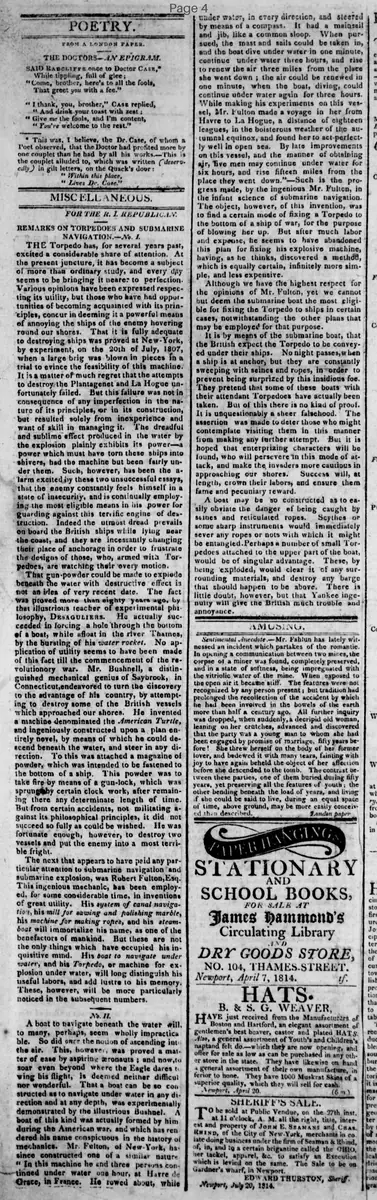
THE Torpedo has, for several years past, excited a considerable share of attention. At the present juncture, it has become a subject of more than ordinary study, and every day seems to be bringing it nearer to perfection. Various opinions have been expressed respecting its utility, but those who have had opportunities of becoming acquainted with its principles, concur in deeming it a powerful means of annoying the ships of the enemy hovering round our shores. That it is fully adequate to destroying ships was proved at New-York, by experiment, on the 20th of July, 1807, when a large brig was blown in pieces in a trial to evince the feasibility of this machine. It is a matter of much regret that the attempts to destroy the Plantagenet and La Hogue unfortunately failed. But this failure was not in consequence of any imperfection in the nature of its principles, or in its construction, but resulted solely from inexperience and want of skill in managing it. The dreadful and sublime effect produced in the water by the explosion plainly exhibits its power—a power which must have torn these ships into shivers, had the machine but been fairly under them. Such, however, has been the alarm excited by these two unsuccessful essays, that the enemy constantly feels himself in a state of insecurity, and is continually employing the most eligible means in his power for guarding against this terrific engine of destruction. Indeed the utmost dread prevails on board the British ships while lying near the coast, and they are incessantly changing their place of anchorage in order to frustrate the designs of those, who, armed with Torpedoes, are watching their every motion.
That gun-powder could be made to explode beneath the water with destructive effect is not an idea of very recent date. The fact was proved more than eighty years ago, by that illustrious teacher of experimental philosophy, Desaguliers. He actually succeeded in forcing a hole through the bottom of a boat, while afloat in the river Thames, by the bursting of his water rocket. No application of utility seems to have been made of this fact till the commencement of the revolutionary war. Mr. Bushnell, a distinguished mechanical genius of Saybrook, in Connecticut, endeavored to turn the discovery to the advantage of his country, by attempting to destroy some of the British vessels which approached our shores. He invented a machine denominated the American Turtle, and ingeniously constructed upon a plan entirely novel, by means of which he could descend beneath the water, and steer in any direction. To this was attached a magazine of powder, which was intended to be fastened to the bottom of a ship. This powder was to take fire by means of a gun-lock, which was sprung by certain clock work, after remaining there any determinate length of time. But from certain accidents, not militating against its philosophical principles, it did not succeed so fully as could be wished. He was fortunate enough, however, to destroy two vessels and put the enemy into a most terrible fright.
The next that appears to have paid any particular attention to submarine navigation and submarine explosion, was Robert Fulton, Esq. This ingenious mechanic, has been employed, for some considerable time, in inventions of great utility. His system of canal navigation, his mill for sawing and polishing marble, his machine for making ropes, and his steamboat will immortalize his name, as one of the benefactors of mankind. But these are not the only things which have occupied his inquisitive mind. His boat to navigate under water, and his Torpedo, or machine for explosion under water, will long distinguish his useful labors, and add lustre to his memory. These, however, will be more particularly noticed in the subsequent numbers.
No. II.
A boat to navigate beneath the water will, to many, perhaps, seem wholly impracticable. So did once the notion of ascending into the air. This, however, was proved a matter of ease by aspiring aeronauts; and now, to soar even beyond where the Eagle dares to wing his flight, is deemed neither difficult nor wonderful. That a boat can be so constructed as to navigate under water in any direction and at any depth, was experimentally demonstrated by the illustrious Bushnell. A boat of this kind was actually formed by him during the American war, and which has rendered his name conspicuous in the history of mechanics. Mr. Fulton, of New-York, has since constructed one of a similar nature. In this machine he and three persons continued under water one hour, at Havre de Grace, in France. He rowed about, while under water, in every direction, and steered by means of a compass. It had a mainsail and jib, like a common sloop. When pursued, the mast and sails could be taken in, and the boat dive under water in one minute, continue under water three hours, and rise to renew the air three miles from the place she went down; the air could be renewed in one minute, when the boat, diving, could continue under water again for three hours. While making his experiments on this vessel, Mr. Fulton made a voyage in her from Havre to La Hogue, a distance of eighteen leagues, in the boisterous weather of the autumnal equinox, and found her to act perfectly well in open sea. By late improvements on this vessel, and the manner of obtaining air, live men may continue under water for six hours, and rise fifteen miles from the place they went down. "Such is the progress made, by the ingenious Mr. Fulton, in the infant science of submarine navigation. The object, however, of this invention, was to find a certain mode of fixing a Torpedo to the bottom of a ship of war, for the purpose of blowing her up. But after much labor and expense, he seems to have abandoned this plan for fixing his explosive machine, having, as he thinks, discovered a method, which is equally certain, infinitely more simple, and less expensive.
Although we have the highest respect for the opinions of Mr. Fulton, yet we cannot but deem the submarine boat the most eligible for fixing the Torpedo to ships in certain cases, notwithstanding the other plans that may be employed for that purpose.
It is by means of the submarine boat, that the British expect the Torpedo to be conveyed under their ships. No night passes, when a ship is at anchor, but they are constantly sweeping with seines and ropes, in order to prevent being surprised by this insidious foe. They pretend that some of these boats with their attendant Torpedoes have actually been taken. But of this there is no kind of proof. It is unquestionably a sheer falsehood. The assertion was made to deter those who might contemplate visiting them in this manner from making any further attempt. But it is hoped that enterprising characters will be found, who will persevere in this mode of attack, and make the invaders more cautious in approaching our shores. Success will, at length, crown their labors, and ensure them fame and pecuniary reward.
A boat may be so constructed as to easily obviate the danger of being caught by seines and reticulated ropes. Scythes or some sharp instruments would immediately sever any ropes or nets with which it might be entangled. Perhaps a number of small Torpedoes attached to the upper part of the boat, would be of singular advantage. These, by being exploded, would clear it of any surrounding materials, and destroy any barge that should happen to be above. There is little doubt, however, but that Yankee ingenuity will give the British much trouble and annoyance.
FOR THE R. I. REPUBLICAN:
REMARKS ON TORPEDOES AND SUBMARINE NAVIGATION.—No. 1.
THE Torpedo has, for several years past, excited a considerable share of attention. At the present juncture, it has become a subject of more than ordinary study, and every day seems to be bringing it nearer to perfection. Various opinions have been expressed respecting its utility, but those who have had opportunities of becoming acquainted with its principles, concur in deeming it a powerful means of annoying the ships of the enemy hovering round our shores. That it is fully adequate to destroying ships was proved at New-York, by experiment, on the 20th of July, 1807, when a large brig was blown in pieces in a trial to evince the feasibility of this machine. It is a matter of much regret that the attempts to destroy the Plantagenet and La Hogue unfortunately failed. But this failure was not in consequence of any imperfection in the nature of its principles, or in its construction, but resulted solely from inexperience and want of skill in managing it. The dreadful and sublime effect produced in the water by the explosion plainly exhibits its power—a power which must have torn these ships into shivers, had the machine but been fairly under them. Such, however, has been the alarm excited by these two unsuccessful essays, that the enemy constantly feels himself in a state of insecurity, and is continually employing the most eligible means in his power for guarding against this terrific engine of destruction. Indeed the utmost dread prevails on board the British ships while lying near the coast, and they are incessantly changing their place of anchorage in order to frustrate the designs of those, who, armed with Torpedoes, are watching their every motion.
That gun-powder could be made to explode beneath the water with destructive effect is not an idea of very recent date. The fact was proved more than eighty years ago, by that illustrious teacher of experimental philosophy, Desaguliers. He actually succeeded in forcing a hole through the bottom of a boat, while afloat in the river Thames, by the bursting of his water rocket. No application of utility seems to have been made of this fact till the commencement of the revolutionary war. Mr. Bushnell, a distinguished mechanical genius of Saybrook, in Connecticut, endeavored to turn the discovery to the advantage of his country, by attempting to destroy some of the British vessels which approached our shores. He invented a machine denominated the American Turtle, and ingeniously constructed upon a plan entirely novel, by means of which he could descend beneath the water, and steer in any direction. To this was attached a magazine of powder, which was intended to be fastened to the bottom of a ship. This powder was to take fire by means of a gun-lock, which was sprung by certain clock work, after remaining there any determinate length of time. But from certain accidents, not militating against its philosophical principles, it did not succeed so fully as could be wished. He was fortunate enough, however, to destroy two vessels and put the enemy into a most terrible fright.
The next that appears to have paid any particular attention to submarine navigation and submarine explosion, was Robert Fulton, Esq. This ingenious mechanic, has been employed, for some considerable time, in inventions of great utility. His system of canal navigation, his mill for sawing and polishing marble, his machine for making ropes, and his steamboat will immortalize his name, as one of the benefactors of mankind. But these are not the only things which have occupied his inquisitive mind. His boat to navigate under water, and his Torpedo, or machine for explosion under water, will long distinguish his useful labors, and add lustre to his memory. These, however, will be more particularly noticed in the subsequent numbers.
No. II.
A boat to navigate beneath the water will, to many, perhaps, seem wholly impracticable. So did once the notion of ascending into the air. This, however, was proved a matter of ease by aspiring aeronauts; and now, to soar even beyond where the Eagle dares to wing his flight, is deemed neither difficult nor wonderful. That a boat can be so constructed as to navigate under water in any direction and at any depth, was experimentally demonstrated by the illustrious Bushnell. A boat of this kind was actually formed by him during the American war, and which has rendered his name conspicuous in the history of mechanics. Mr. Fulton, of New-York, has since constructed one of a similar nature. In this machine he and three persons continued under water one hour, at Havre de Grace, in France. He rowed about, while under water, in every direction, and steered by means of a compass. It had a mainsail and jib, like a common sloop. When pursued, the mast and sails could be taken in, and the boat dive under water in one minute, continue under water three hours, and rise to renew the air three miles from the place she went down; the air could be renewed in one minute, when the boat, diving, could continue under water again for three hours. While making his experiments on this vessel, Mr. Fulton made a voyage in her from Havre to La Hogue, a distance of eighteen leagues, in the boisterous weather of the autumnal equinox, and found her to act perfectly well in open sea. By late improvements on this vessel, and the manner of obtaining air, live men may continue under water for six hours, and rise fifteen miles from the place they went down. "Such is the progress made, by the ingenious Mr. Fulton, in the infant science of submarine navigation. The object, however, of this invention, was to find a certain mode of fixing a Torpedo to the bottom of a ship of war, for the purpose of blowing her up. But after much labor and expense, he seems to have abandoned this plan for fixing his explosive machine, having, as he thinks, discovered a method, which is equally certain, infinitely more simple, and less expensive.
Although we have the highest respect for the opinions of Mr. Fulton, yet we cannot but deem the submarine boat the most eligible for fixing the Torpedo to ships in certain cases, notwithstanding the other plans that may be employed for that purpose.
It is by means of the submarine boat, that the British expect the Torpedo to be conveyed under their ships. No night passes, when a ship is at anchor, but they are constantly sweeping with seines and ropes, in order to prevent being surprised by this insidious foe. They pretend that some of these boats with their attendant Torpedoes have actually been taken. But of this there is no kind of proof. It is unquestionably a sheer falsehood. The assertion was made to deter those who might contemplate visiting them in this manner from making any further attempt. But it is hoped that enterprising characters will be found, who will persevere in this mode of attack, and make the invaders more cautious in approaching our shores. Success will, at length, crown their labors, and ensure them fame and pecuniary reward.
A boat may be so constructed as to easily obviate the danger of being caught by seines and reticulated ropes. Scythes or some sharp instruments would immediately sever any ropes or nets with which it might be entangled. Perhaps a number of small Torpedoes attached to the upper part of the boat, would be of singular advantage. These, by being exploded, would clear it of any surrounding materials, and destroy any barge that should happen to be above. There is little doubt, however, but that Yankee ingenuity will give the British much trouble and annoyance.
What sub-type of article is it?
Essay
What themes does it cover?
War Peace
Political
Liberty Freedom
What keywords are associated?
Torpedo
Submarine Navigation
Bushnell
Fulton
American Turtle
Revolutionary War
British Ships
Explosion
Defense
Invention
What entities or persons were involved?
For The R. I. Republican
Literary Details
Title
Remarks On Torpedoes And Submarine Navigation.
Author
For The R. I. Republican
Subject
Torpedoes And Submarine Navigation As Means Of Defense Against Enemy Ships
Form / Style
Prose Essay In Two Parts On Military Inventions
Key Lines
That It Is Fully Adequate To Destroying Ships Was Proved At New York, By Experiment, On The 20th Of July, 1807, When A Large Brig Was Blown In Pieces
Mr. Bushnell, A Distinguished Mechanical Genius Of Saybrook, In Connecticut, Endeavored To Turn The Discovery To The Advantage Of His Country
His Boat To Navigate Under Water, And His Torpedo, Or Machine For Explosion Under Water, Will Long Distinguish His Useful Labors
Success Will, At Length, Crown Their Labors, And Ensure Them Fame And Pecuniary Reward