Thank you for visiting SNEWPapers!
Sign up free
Literary
March 10, 1809
The Enquirer
Richmond, Henrico County, Virginia
What is this article about?
Excerpt from John Bristed's 'The Society of Friends' criticizing common swearing as an absurd vice of the ignorant, recommended by 'K.' to the Philadelphia Daily Advertiser for attention against profane swearing and judicial oaths.
Clipping
OCR Quality
95%
Excellent
Full Text
From the Philadelphia Daily Advertiser.
Z. Poison,
The following observations are extracted from a work lately Published in London, entitled "The Society of Friends, or people commonly called Quakers, examined by John Bristed," and are recommended to the serious attention of persons who habituate themselves to the shameful and degrading practice of profane swearing. and it is believed his remarks on Judicial Oaths are well worthy the consideration of persons of all descriptions : Please give them publicity.
K.
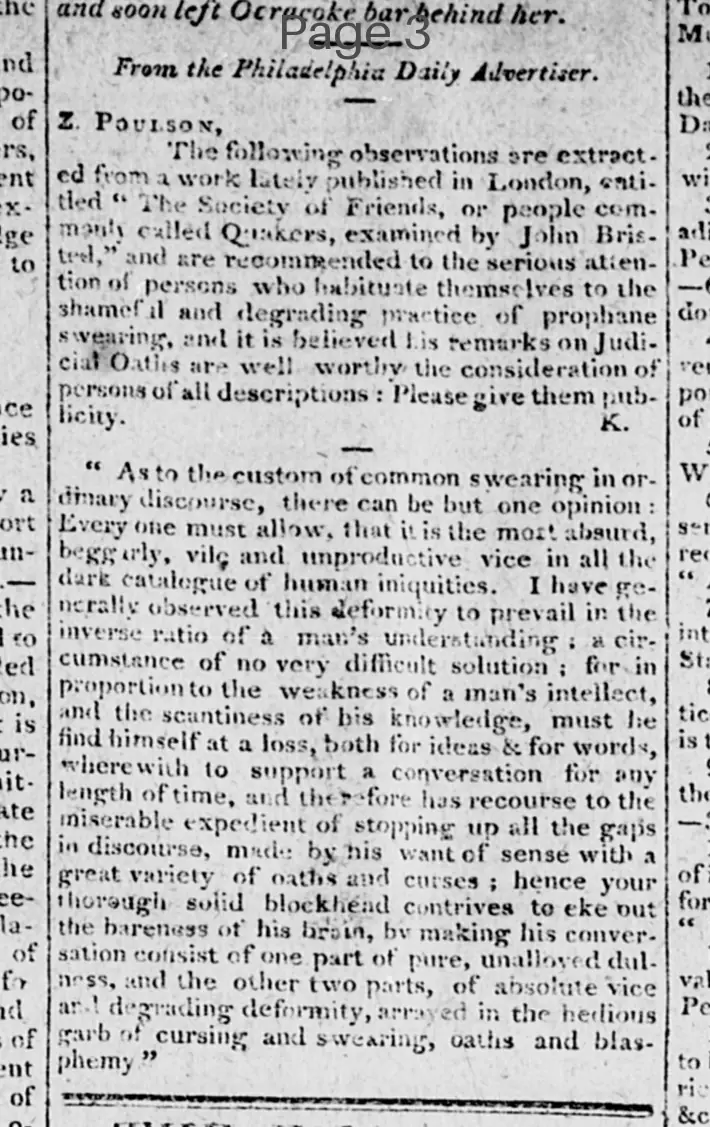
"As to the custom of common swearing in ordinary discourse, there can be but one opinion : Every one must allow, that it is the most absurd, beggarly, vile and unproductive vice in all the dark catalogue of human iniquities. I have generally observed this deformity to prevail in the inverse ratio of a man's understanding : a circumstance of no very difficult solution : for--in proportion to the weakness of a man's intellect, and the scantiness of his knowledge, must he find himself at a loss, both for ideas & for words, wherewith to support a conversation for any length of time, and therefore has recourse to the miserable expedient of stopping up all the gaps in discourse, made by his want of sense with a great variety of oaths and curses ; hence your thorough solid blockhead contrives to eke out the bareness of his brain, by making his conversation consist of one part of pure, unalloyed dulness, and the other two parts, of absolute vice and degrading deformity, arrayed in the hideous garb of cursing and swearing, oaths and blasphemy."
Z. Poison,
The following observations are extracted from a work lately Published in London, entitled "The Society of Friends, or people commonly called Quakers, examined by John Bristed," and are recommended to the serious attention of persons who habituate themselves to the shameful and degrading practice of profane swearing. and it is believed his remarks on Judicial Oaths are well worthy the consideration of persons of all descriptions : Please give them publicity.
K.
"As to the custom of common swearing in ordinary discourse, there can be but one opinion : Every one must allow, that it is the most absurd, beggarly, vile and unproductive vice in all the dark catalogue of human iniquities. I have generally observed this deformity to prevail in the inverse ratio of a man's understanding : a circumstance of no very difficult solution : for--in proportion to the weakness of a man's intellect, and the scantiness of his knowledge, must he find himself at a loss, both for ideas & for words, wherewith to support a conversation for any length of time, and therefore has recourse to the miserable expedient of stopping up all the gaps in discourse, made by his want of sense with a great variety of oaths and curses ; hence your thorough solid blockhead contrives to eke out the bareness of his brain, by making his conversation consist of one part of pure, unalloyed dulness, and the other two parts, of absolute vice and degrading deformity, arrayed in the hideous garb of cursing and swearing, oaths and blasphemy."
What sub-type of article is it?
Essay
What themes does it cover?
Moral Virtue
What keywords are associated?
Profane Swearing
Vice
Oaths
Blasphemy
Quakers
Moral Instruction
What entities or persons were involved?
John Bristed
Literary Details
Author
John Bristed
Subject
Critique Of Profane Swearing
Key Lines
As To The Custom Of Common Swearing In Ordinary Discourse, There Can Be But One Opinion : Every One Must Allow, That It Is The Most Absurd, Beggarly, Vile And Unproductive Vice In All The Dark Catalogue Of Human Iniquities.
I Have Generally Observed This Deformity To Prevail In The Inverse Ratio Of A Man's Understanding : A Circumstance Of No Very Difficult Solution : For In Proportion To The Weakness Of A Man's Intellect, And The Scantiness Of His Knowledge, Must He Find Himself At A Loss, Both For Ideas & For Words, Wherewith To Support A Conversation For Any Length Of Time,