Thank you for visiting SNEWPapers!
Sign up free
Alexandria Gazette
Alexandria, Alexandria County, District Of Columbia
What is this article about?
In the US Senate on Wednesday, a debate arose on Mr. Walker's resolution for recognizing Texas's independence. Speakers including Walker, Preston, Norvell, Calhoun, Clay, and Buchanan argued for and against, with amendments proposed and the session recessing without resolution.
Clipping
OCR Quality
Full Text
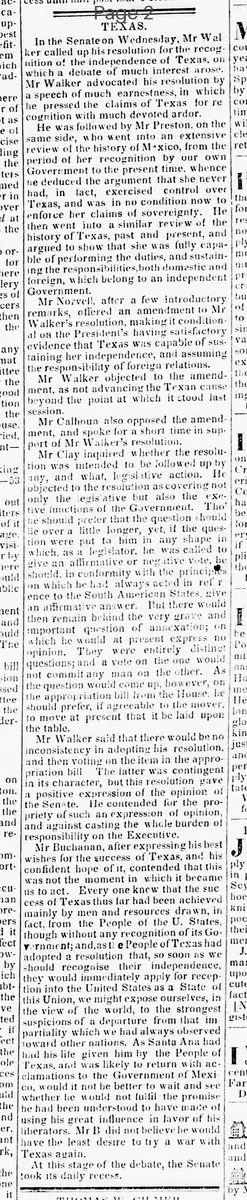
In the Senate on Wednesday, Mr. Walker called up his resolution for the recognition of the independence of Texas, on which a debate of much interest arose.
Mr. Walker advocated his resolution by a speech of much earnestness, in which he pressed the claims of Texas for recognition with much devoted ardor.
He was followed by Mr. Preston, on the same side, who went into an extensive review of the history of Mexico, from the period of her recognition by our own Government to the present time, whence he deduced the argument that she never had, in fact, exercised control over Texas, and was in no condition now to enforce her claims of sovereignty. He then went into a similar review of the history of Texas, past and present, and argued to show that she was fully capable of performing the duties, and sustaining the responsibilities, both domestic and foreign, which belong to an independent Government.
Mr. Norvell, after a few introductory remarks, offered an amendment to Mr. Walker's resolution, making it conditional on the President's having satisfactory evidence that Texas was capable of sustaining her independence, and assuming the responsibility of foreign relations.
Mr. Walker objected to the amendment, as not advancing the Texan cause beyond the point at which it stood last session.
Mr. Calhoun also opposed the amendment, and spoke for a short time in support of Mr. Walker's resolution.
Mr. Clay inquired whether the resolution was intended to be followed up by any, and what, legislative action. He objected to the resolution as covering not only the legislative but also the executive functions of the Government. Tho he should prefer that the question should lie over a little longer, yet, if the question were put to him in any shape in which, as a legislator, he was called to give an affirmative or negative vote, he should, in conformity with the principles on which he had always acted in reference to the South American States, give an affirmative answer. But there would then remain behind the very grave and important question of annexation; on which he would at present express no opinion. They were entirely distinct questions; and a vote on the one would not commit any man on the other. As the question would come up, however, on the appropriation bill from the House, he should prefer, if agreeable to the mover, to move at present that it be laid upon the table.
Mr. Walker said that there would be no inconsistency in adopting his resolution, and then voting on the item in the appropriation bill The latter was contingent in its character, but this resolution gave a positive expression of the opinion of the Senate. He contended for the propriety of such an expression of opinion, and against casting the whole burden of responsibility on the Executive.
Mr. Buchanan, after expressing his best wishes for the success of Texas, and his confident hope of it, contended that this was not the moment in which it became us to act. Every one knew that the success of Texas thus far had been achieved mainly by men and resources drawn, in fact, from the People of the U. States though without any recognition of its Government; and, as the People of Texas had adopted a resolution that, so soon as we should recognise their independence, they would immediately apply for reception into the United States as a State of this Union, we might expose ourselves, in the view of the world, to the strongest suspicions of a departure from that impartiality which we had always observed toward other nations. As Santa Ana had had his life given him by the People of Texas, and was likely to return with acclamations to the Government of Mexico, would it not be better to wait and see whether he would not fulfil the promise he had been understood to have made of using his great influence in favor of his liberators. Mr. B did not believe he would have the least desire to try a war with Texas again.
At this stage of the debate, the Senate took its daily recess.
What sub-type of article is it?
What keywords are associated?
What entities or persons were involved?
Where did it happen?
Domestic News Details
Primary Location
United States Senate
Event Date
On Wednesday
Key Persons
Outcome
debate ongoing; senate took daily recess without resolution.
Event Details
Mr. Walker introduced a resolution for recognizing Texas's independence, sparking debate. Supporters like Preston argued Texas's capability for independence and Mexico's lack of control. Norvell proposed a conditional amendment, opposed by Walker and Calhoun. Clay questioned legislative implications and preferred delay but would vote affirmatively if pressed, distinguishing from annexation. Walker defended the resolution's propriety. Buchanan urged caution due to potential impartiality concerns and Texas's intent to join the US, suggesting to wait on Santa Ana's influence. Session recessed.